ASTM D1974 Standard Practice for Methods of Closing, Sealing, and Reinforcing Fiberboard Boxes

    What is ASTM D1974?  

    ASTM D1974 is a standard practice for selecting and applying methods to close, seal, and reinforce fiberboard shipping boxes. When application parameters stay within the defined operating limits, the structural integrity, transit protection, and security of shipping containers improve. Test box-closing methods to determine a container’s strength under distribution-related hazards. This practice establishes procedures for using tapes, adhesives, staples, and strapping. The changes and reactions of the sealed box closures are recorded as indicators of long-term performance, handling suitability, and packaging consistency. ASTM D1974 (Standard Practice for Methods of Closing, Sealing, and Reinforcing Fiberboard Boxes) is used for reliability checks, closure tests, material certification, and compliance with packaging specifications. 

    Read more

     Get Certified ASTM D1974 Testing for Uncompromising Quality and Project Success 

    Closures include pressure-sensitive tapes, water-activated tapes, hot-melt adhesives, metallic staples, and plastic strapping, all of which affect the physical performance of fiberboard containers; therefore, proper closure execution directly affects box stackability and cargo protection. The ASTM D1974 testing method provides a quality assurance method for the sealing characteristics of a packaging lot before shipment. 

    What is the Scope of ASTM D1974? 

    ASTM D1974 specifies the materials to be used, the application methods, and the structural reinforcement methods for fitting slotted, telescope, and folder-type fiberboard boxes. The primary applications of ASTM D1974 are to verify container closure security, to provide quality control during packaging line operations, and to verify that the mechanical strength of fiberboard shipping boxes is adequate for commercial transport. 

    Read more

    The scope of ASTM D1974 includes:

    • Material type: corrugated and solid fiberboard boxes, pressure-sensitive tapes, water-activated reinforced tapes, liquid adhesives, metallic staples, and synthetic strapping. 
    • Purpose: Standardize how to pick, use, and check the closing, sealing, and reinforcing of fiberboard shipping containers so they stay strong during travel and storage.
    • Elements analyzed: Application uniformity, closure strength, flap alignment, adhesive coverage, and seam reinforcement. 
    • Method: The practice involves the use of standard closure systems (taping, gluing, stapling, or strapping) to prepared fiberboard flaps in standard patterns, the dimensioning of overlaps, and the measurement of seams for adhesion and/or fastener location. 
    • Result: Verification of correct closure configuration and seam alignment (checked against performance criteria). 
    • Test Limitations: Only tests package closure and reinforcement practices, not package strength (e.g., drop testing, compression testing, etc.). 
    • Environmental conditions: Controlled ambient conditions are essential for testing and application, which are set to approximately 23 °C and 50 % relative humidity (RH)  to ensure proper tape tack and adhesive setting. 
    • Applications: Packaging line quality control, logistics specification verification, transit packaging design, and failure investigation. 

    What are the Uses of ASTM D1974 Practice?

    Implementing ASTM D1974 helps packaging engineers quickly ensure the integrity of container closures, as well as support routine production testing and technical investigations. Moreover, the standardized practice provides a repeatable foundation for comparing closure methods across suppliers and packaging lines. This standard:

    • Helps with quality control in automated box sealing and manual box sealing processes.
    • Assists with investigations of technical service and shipping damage.
    • Provides data to determine the best tape, glue, or staple arrangement.
    • Checks material specifications for the required width of tape and pattern of staples.
    • Helps to resolve packaging failure issues before going to bulk distribution. 

    What Materials Can Be Tested Under ASTM D1974? 

    ASTM D1974 covers corrugated and solid fiberboard boxes. ASTM D1974 includes standard materials including single wall, double wall, and triple wall corrugated containers, pressure-sensitive film tapes, water-activated gummed paper tapes, hot-melt and cold-adhesive glues, steel box-staples, and polypropylene or polyester strapping. 

    Why is ASTM D1974 Important? 

    ASTM D1974 provides a method manufacturers can use to verify the security of their fiberboard boxes before sending them to customers. Insufficient closure execution can lead to early box opening, product spillage, moisture ingress, and mechanical damage during handling and transportation. The over- or misapplication of tape or staples, however, makes packaging more costly and contributes to tearing of the fiberboard. ASTM D1974 practices help to provide a controlled method of closure execution, preventing costly loss during transit and ensuring reliable continued shipping. 

    ASTM D1974  Equipment and Sample Preparation Guide

    For even closure forces, ASTM D1974 requires standardized application machinery, tape dispensers, staplers, and pneumatic strapping tools. Application accuracy depends on avoiding surface dust, moisture, and flap misalignment when handling the box specimens. The table below lists the specifications followed in this practice: 

    Read more

    Sample and Specimen DetailsLaboratories inspect knocked-down flat (KDF) or erected fiberboard boxes weighing up to standard shipping limits, prepared in replicate sets. 
    Specimen PreparationTechnicians square box flaps, verify scoreline alignment, remove surface dust or contaminants, and set up the designated closure media. 
    Specimen DimensionsTest box dimensions typically range from standard small shipping cartons (200 mm × 150 mm × 100 mm) to large master containers (600 mm × 400 mm × 400 mm), with flap-gap tolerances strictly maintained within 0 mm to 6 mm (¼ in.) prior to applying closure materials. 
    InstrumentationThe practice uses automatic tape heads, manual tape dispensers, pneumatic box staplers, adhesive applicators, strapping tensioners, and measuring scales. 

    Testing Procedures and Requirements for ASTM D1974 

    Technicians square the box, fold the outside flaps to meet without gaps or overlap, and apply tape or other closure media to the flaps following designated ASTM patterns (center-seam taping or edge-reinforcement strapping). Full contact of applied tape, adhesive, or staple and uniformity of pressure and overlap dimensions are checked. For specialized material evaluations or non-destructive quality checks on related packaging components, refer to our technical guides on  ASTM D2239, ASTM D6132, and ASTM D1283. 

    Read more

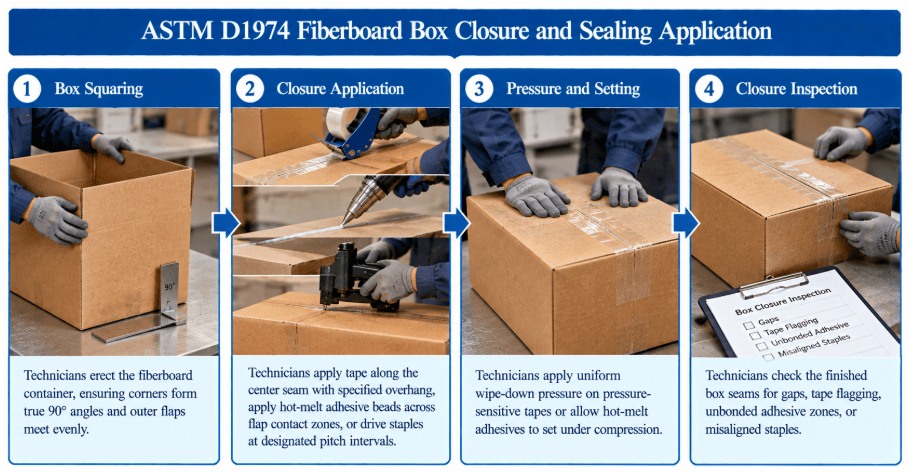
    Box Squaring Technicians erect the fiberboard container, ensuring corners form true 90°  angles and outer flaps meet evenly. 
    Closure Application Technicians apply tape along the center seam with specified overhang, apply hot-melt adhesive beads across flap contact zones, or drive staples at designated pitch intervals. 
    Pressure and Setting Technicians apply uniform wipe-down pressure on pressure-sensitive tapes or allow hot-melt adhesives to set under compression. 
    Closure Inspection Technicians check the finished box seams for gaps, tape flagging, unbonded adhesive zones, or misaligned staples. 

    ASTM D1974  Testing Process and Data Collection

    Analysts first measure the flap gap dimension and squareness of the erected fiberboard box. The box is fed to the application station where automatic or manual equipment applies tape, glue, or staples to the box per closure specification. For a consistent adhesive bond or staple clinch, either a controlled wipe-down or compression tool ensures consistent pressure. Analysts then examine the closed container post-application to document closure alignment, seam coverage, and any application defects. 

    Sealed corrugated fiberboard box displaying center seam pressure-sensitive tape closure according to ASTM D1974 standards
    ASTM D1974 Fiberboard Box Closure and Sealing Application 

    Common Challenges and Troubleshooting

    Common problems with testing are that the test tape is not fully adhered to because of low application temperatures or because of too much staple pressure causing the adjoining corrugated flutes to leave gaps in the bond. Troubleshooting encompasses actions taken to ensure that no application flaw contributes to the compromised integrity of the closure, including cleaning actions of the container surfaces, hot-melt applicator temperature adjustments, and calibration of the staple anvil depth.

    ASTM D1974 Analysis Results and Interpretation

    The report provides a summary of the closure configuration and application compliance of the tested fiberboard container. The standard is for the quality of the closure application and is not directly related to box compression strength.

    Read more

    • Laboratory documentation records the specific closure method (tape type, staple pattern, adhesive layout, or strapping spec).
    • The technician identifies the type of box to be sealed: regular slotted container (RSC), full overlap container (FOL), or telescope box.
    • The analyst documents any anomalies in the application (e.g., lifting tape, gap in flaps that is beyond tolerance, or area of tape that is not bonded) and links these to the quality of the closure.
    • The engineer takes transport hazards, handling environment, and box gross weight limits into account when interpreting closure compliance results for packaging specifications.
    • The packaging engineer records the closure evaluation to aid distribution quality control, packaging material selection, and damage claim resolution. 

    Link to ASTM D1974 

    FAQ

    What is the standard’s assessment of box closure security?
    This practice is used to determine if tapes, adhesives, staples, or strapping are used properly to ensure that a container will remain closed and structurally sound during distribution.
    ASTM D1974 covers corrugated and solid fiberboard boxes that are assembled with pressure-sensitive tapes, water-activated tapes, hot-melt adhesives, cold glues, metallic staples, or plastic/steel strapping.
    The proper application of tape is verified by checking for alignment of center seams, minimum overhang on box end panels, uniform tape surface adhesion and no flagging, and flap gap limits.

    Updated on September 17, 2026

    Malhar Khole
    About Author
    Malhar Khole is a Material Testing Associate at MaTestLab Inc. and holds a postgraduate degree in Material Science and Technology from IIT (BHU), Varanasi.
    Know More
    Testimonials
    Real results
    Engineers trust us with what matters most
    Start Your Testing
    Project Today
    Define your requirements and get access to
    specialized laboratories ready to deliver results
    Partners with us
    Clients
    Vendors
    Process for testing
    • STEP 01

      You share your testing requirements

    • STEP 02

      You share your sample(s)

    • STEP 03

      We deliver your test reports

    Get your testing done

    Let us know your testing requirements and we will be right back with a solution.

      Let us root for each other. Collaborate to grow, expand, and accelerate our businesses.

      Partner with us

        Discover more from Matestlab

        Subscribe now to keep reading and get access to the full archive.

        Continue reading