ASTM D1938 Tear-Propagation Resistance (Trouser Tear) of Plastic Film and Thin Sheeting by a Single-Tear Method
What is ASTM D1938?
ASTM D1938 describes a standard test method for tear-propagation resistance of plastic film and thin sheeting using the single-tear method. Technicians cut or slit a specimen to the required size and mount it on a tensile testing machine. The machine separates the two legs of the specimen and records the force required to create the tear. The test provides information on the material’s resistance to further tearing once it has torn. The findings help manufacturers, engineers, and quality-control laboratories compare plastic films, assess material consistency, support product development, and determine whether a plastic film can provide acceptable tear-propagation resistance for its intended application.
Get Certified ASTM D1938 Tear-Propagation Resistance Testing
ASTM D1938 testing aids plastic film and plastic thin sheet manufacturers, suppliers, and users in assessing tear-propagation resistance. Laboratories prepare the specimens to the desired configuration, introduce the required tear, fix the specimens in the testing machine, and apply the tensile force under controlled conditions. The testing machine measures the force needed to propagate the tear. When tear resistance is a significant product-performance requirement, the resulting measurements are used in a laboratory to compare plastic materials, formulations, thicknesses, processing conditions, and production batches.
What is the scope of ASTM D1938?
ASTM D1938 test method measures the resistance to tear propagation of plastic film and thin sheeting by the single-tear and trouser-tear configurations. The test determines the force necessary to propagate an existing tear through the specimen. The method gives manufacturers and engineers a tool to assess the tearing strength of plastic films during continued tearing and compare materials for packaging, industrial applications, agricultural uses, and other flexible plastic applications. This test method covers-
Plastic Film: Technicians evaluate plastic film specimens for resistance to continued tear propagation after initiating a tear.
Thickness: ASTM D1938 applies to plastic film and thin sheeting with a thickness of 1 mm (0.04 in.) or less. For this method, film is defined as sheeting with a nominal thickness not greater than 0.25 mm (0.010 in.).
Grip Separation: The test is to determine the strength to propagate a tear across the specimen.
Thin Sheeting: The method applies to applicable thin plastic sheeting where tear-propagation resistance affects product performance.
Tear Propagation: The test is to determine the strength to propagate a tear across the specimen.
Material Comparison: Engineers can compare the tear propagation resistance of different plastic materials, formulations, thicknesses, and production batches.
Tear data can be used by manufacturers to track material uniformity and to identify material changes caused by formulation or processing.
What are the uses of ASTM D1938 testing?
This standard testing provides tear-propagation data for plastic films and thin sheeting and helps manufacturers evaluate resistance to continued tearing. The ASTM D1938 standard-
Determines the tear-propagation resistance of plastic film and thin sheeting.
Compares the tear resistance of different plastic materials and formulations.
Supports quality control by identifying variations between production batches.
Helps engineers evaluate the effect of material thickness and processing conditions.
Supports product development and material selection.
Helps manufacturers investigate film performance when a small cut or tear could propagate during handling or use.
Provides data for comparing plastic films intended for flexible and demanding applications.
Which materials can be tested according to ASTM D1938?
ASTM D1938 focuses on applicable plastic films and thin sheeting that can be prepared in the required specimen configuration; the following materials can be tested per this method-
Plastic Films: Evaluates flexible plastic films for resistance to tear propagation.
Thin Plastic Sheeting: Measures the force required to continue a tear through thin sheet materials.
Flexible Polymer Films: Compares tear-propagation behavior among applicable polymer formulations.
Packaging Films: Helps evaluate films where resistance to tear propagation can affect handling and product protection.
Agricultural and Industrial Films: Provides comparative tear-resistance data for applicable flexible plastic sheets and films.
The laboratory should confirm that the material, thickness, specimen configuration, and test requirements are appropriate before testing.
Why is ASTM D1938 Testing Important?
Mechanical stresses such as handling, tension, impact, or other mechanical stresses can cause a small cut or notch to grow in size. ASTM D1938 specifies a standardized technique to assess the force needed to extend an existing tear. The data provide manufacturers with insight into the tendency of a plastic film to continue to tear when damaged. Engineers can use these measurements to compare materials, optimize formulations, monitor production quality, and choose films for use in applications where tearing may result in product failure.
ASTM D1938 Equipment & Sample Preparation Guide
Tear propagation testing requires an appropriate tensile testing machine, specimen grips, cutting equipment, and a measurement system. It is also crucial to have correct specimen preparation, as inconsistent cutting, damage to the edges, and irregular dimensions can influence the behavior of the tear.
Technicians identify the plastic film or thin sheeting, thickness, material type, orientation, and condition before preparing the specimens.
Specimen Preparation
Technicians cut specimens to the specified dimensions and introduce the required slit or tear without creating unintended damage.
Specimen Inspection
Technicians inspect specimens for wrinkles, scratches, edge defects, holes, contamination, and other conditions that could influence tear propagation.
Test Setup
Laboratories mount the two legs of the specimen securely in the tensile testing machine and align the specimen with the direction of applied force.
Instrumentation
Laboratories use a calibrated tensile testing machine, suitable grips, specimen-cutting tools, and a force-measurement system to record tear-propagation resistance.
ASTM D1938 Testing Procedures and Requirements
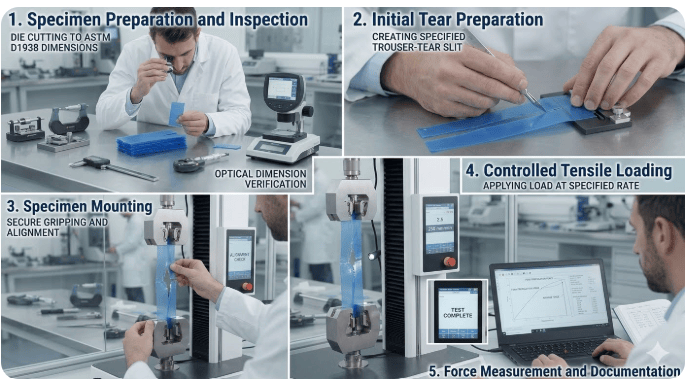
Technicians prepare the plastic film specimens and introduce the specified tear configuration before mounting them in the testing machine. The laboratory aligns the specimen correctly and applies tensile force to the two legs of the trouser-tear specimen.
As the machine pulls the specimen, the existing tear propagates through the film. The testing system records the force required to continue the tear. Technicians monitor the test and document the measured force and any unusual tearing behavior. ASTM D1938 comprises the following steps-
Specimen Preparation and Inspection
Technicians prepare representative specimens with the specified dimensions and inspect them for defects before testing.
Initial Tear Preparation
Technicians create the specified starting tear or slit while avoiding unintended damage that could affect the test result.
Specimen Mounting
Technicians secure the two specimen legs in the testing machine and align them properly with the direction of applied force.
Controlled Tensile Loading
The testing machine applies tensile force at the specified rate while the tear propagates through the plastic film.
Force Measurement
The laboratory records the force required to propagate the tear and evaluates the resulting tear-propagation resistance.
ASTM D1938 Universal Testing Machine (UTM)
ASTM D1938 Testing Process and Data Collection
Technicians first identify the plastic film or thin sheeting and prepare specimens according to the specified dimensions. They inspect the specimens and create the required starting tear. The laboratory then places the two legs of each specimen into the tensile testing machine and verifies proper alignment. The machine pulls the specimen legs apart at the specified test rate, causing the existing tear to propagate through the film. The force-measurement system records the resistance encountered during tear propagation. Technicians document the specimen identification, thickness, test conditions, force measurements, and observations of the tear path. The laboratory then analyzes the recorded force data to determine the tear-propagation resistance under the specified test conditions.
Common Challenges and Troubleshooting
Tear-propagation measurements can vary as a result of differences in specimen dimensions, specimen thickness, tear preparation, specimen orientation, grip alignment, and tear speed. Technicians should standardize specimens and direction of specimen orientation throughout the test program. Improper preparation of the starting tear can lead to irregular propagation and inconsistent results. Technicians should also check the grips and ensure they do not damage the film when holding the specimen. The laboratory should regularly check the tensile testing machine for calibration and proper operation. When the tear deviates from the expected tear path or when the specimen exhibits unusual failure behavior, technicians should register the observation and explore the causes associated with the specimen and/or setup.
Analysis Results and Interpretation
The laboratory should report the tear-propagation result together with the specimen information and test conditions required to interpret the measurement. The following results help engineers compare applicable plastic films and thin sheeting:
The laboratory report contains information such as tear-propagation resistance, size of specimen, specimen thickness, material identification, test direction, and test observations.
The test determines the force that is needed to tear plastic film or thin sheeting under the specified conditions.
Engineers leverage the results to evaluate the tear propagation resistance of plastic materials, formulations, thicknesses, and production batches.
Manufacturers can use the results for quality assurance, material qualification, product development, and process evaluation.
Engineers should consider the results in conjunction with specimen thickness, material orientation, specimen condition, starting-tear quality and test conditions.
The higher the tear-propagation resistance, the more force it takes to propagate an existing tear under test conditions.
The laboratory should report on any unusual path of tears and/or any failures in the specimen which might affect the interpretation of the measured result.
Dr. Ruchika Yogesh is a serial entrepreneur, material science and AI/ML enthusiast, medicinal chemistry subject matter expert (SME), scientific/medical copyeditor, and a researcher. Know More
Testimonials
Real results
Engineers trust us with what matters most
“We had a great experience working with this company for our ASTM E84 testing. They were the first company to respond to our inquiry within just a few minutes of submitting it. From start to finish, the communication was excellent, and the entire process was swift, straightforward, and hassle-free.”
Ivars FancyWalls
United States
“Very good communication, testing associates were very patient with delays on our end. Reasonable turnaround time for results and nicely detailed report. Analysts were also quick to answer any follow-up questions. Happy with results.”
Skye Henderson
United States
“Matestlab connected us with an accredited lab within days, cutting weeks off our product validation timeline.”
Rebecca Kozodoy-Pins
United States
Start Your Testing Project Today
Define your requirements and get access to specialized laboratories ready to deliver results