ASTM D1786 Standard Specification for Toluene Diisocyanate
What is ASTM D1786?
ASTM D1786 specifies requirements for toluene diisocyanate (TDI) used as an ingredient in polyurethane production. Technicians use applicable referenced ASTM procedures to measure the required chemical and physical characteristics of TDI and compare the results with the specification limits. Manufacturers, suppliers, and users can use these results to assess raw-material consistency, compare TDI grades and production batches, and support quality-control decisions.
Get Certified ASTM D1786 Testing for Reliable Toluene Diisocyanate Quality
ASTM D1786 (Standard Specification for Toluene Diisocyanate) provides a method for manufacturers, suppliers, and users to assess TDI against requirements. Laboratories use the appropriate referenced ASTM methods to test for isomeric content, total chlorine, hydrolyzable chlorine, APHA color, isocyanate content, and acidity to assess quality and ensure compliance of materials.
What is the scope of the ASTM D1786 test standard?
ASTM D1786 is a standard specification for TDI intended for use in the production of polyurethanes. This standard divides TDI into three classes according to isomer ratio and three types according to acidity and hydrolyzable chloride. Laboratories use the applicable referenced ASTM test methods to determine properties such as isomer content, purity, APHA color, total chlorine, hydrolyzable chlorine, isocyanate content, and acidity. These results help users compare TDI materials with the applicable specification requirements and support raw-material quality control and acceptance. The specification defines the requirements for various TDI classifications and grades and incorporates referenced ASTM procedures to measure properties required to characterize the material.
Toluene Diisocyanate: Evaluates TDI used as an ingredient in polyurethane materials against the requirements specified by the applicable grade.
TDI Isomer Classes: Classifies TDI according to its isomer ratio and uses the applicable ratio requirements to distinguish the covered classes.
TDI Types: Classifies the material according to acidity and hydrolyzable chloride requirements.
TDI Purity: Determines the percentage of pure TDI and compares the measured value with the minimum purity requirement for the applicable TDI class.
TDI Quality Requirements: Evaluates isomer ratio, purity, APHA color, and total chlorine to determine conformity with the applicable grade.
What are the uses of ASTM D1786 testing?
ASTM D1786 testing can aid in laboratory characterization of TDI employed in the manufacture of polyurethanes. Manufacturers or users use the results to prove specification fulfillment, compare TDI grades, check incoming raw materials, and as part of quality control work. ASTM D1786 testing-
Determines the isomer ratio of TDI.
Evaluates purity against the applicable specification.
Determines APHA color to assess the appearance of the material.
Measures total chlorine and evaluates the material against the applicable requirement.
Supports quality control and material acceptance for polyurethane raw materials.
Which materials can be tested under ASTM D1786?
ASTM D1786 applies specifically to toluene diisocyanate used as an ingredient in polyurethane materials. The specification covers three TDI classes based on isomer ratio and three types based on acidity and hydrolyzable chloride-
Toluene Diisocyanate (TDI): Evaluates the chemical and physical characteristics of TDI against the requirements for its applicable classification and grade.
Different TDI Isomer-Ratio Classes: Determines the isomer ratio to classify the TDI according to the specified class.
Different TDI Types: Evaluates acidity and hydrolyzable chloride to establish conformity with the applicable TDI type.
Why is ASTM D1786 Important?
Toluene diisocyanate is a feedstock for manufacturing polyurethanes. ASTM D1786 provides standardized requirements to characterize TDI and determine whether it conforms to its grade requirements. The results help manufacturers and users control raw-material quality, ensure the product meets specifications, compare materials, and decide on material acceptance.
ASTM D1786 Equipment and Sample Preparation Guide
The ASTM D1786 uses multiple referenced ASTM test methods, not a single testing apparatus. Technicians take representative samples and prepare them as prescribed by the procedure before conducting the necessary analysis. Calibrated instruments suitable for the determination of isomer content, chlorine, APHA color, and acidity are used in laboratories.
Technicians collect representative TDI samples and identify the applicable class, type, and grade before testing.
Sample Preparation
Technicians prepare the TDI sample according to the applicable referenced ASTM test method and protect it from conditions that could affect the measured properties.
Testing Requirements
Technicians select the applicable procedures for isomer content, total chlorine, hydrolyzable chlorine, APHA color, isocyanate content, and acidity.
Instrumentation
Technicians use calibrated analytical equipment appropriate for the selected referenced methods, including chromatographic, color-measurement, titration, and chemical-analysis equipment.
Testing Procedures and Requirements for ASTM D1786
ASTM D1786 specifies the sampling and analysis of TDI using referenced ASTM procedures. The technician selects the appropriate method, analyzes in a controlled environment, documents the results, and compares them with the specification. ASTM D1786 references ASTM D4660, D4661, D4663, D4877, D5155, and D5629 for the required analyses.
Technicians determine the TDI isomer content and evaluate purity using the applicable referenced ASTM procedure.
Chlorine Analysis
Technicians determine total chlorine and hydrolyzable chlorine to evaluate the material against the applicable requirements.
Color and Isocyanate Analysis
Technicians determine APHA color and isocyanate content using the applicable ASTM procedures.
Acidity Determination and Reporting
Technicians determine acidity, record the applicable test results and conditions, and compare the results with the specification requirements.
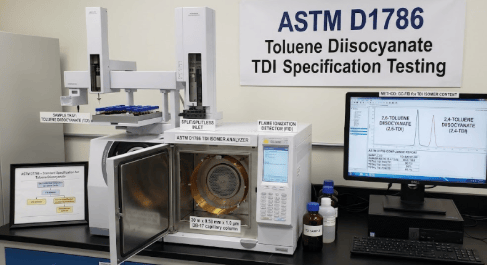
ASTM D1786 Gas Chromatograph
ASTM D1786 Testing Process and Data Collection
The analyst determines the applicable isomer ratio, purity, APHA color, chlorine, isocyanate content, and acidity characteristics. The analyst then chooses the ASTM methods that have been referenced for each of the desired properties and follows each procedure to prepare the sample. The laboratory sets the appropriate isomer ratio, purity, color, chlorine, isocyanate content, and acidity characteristics. Technicians document the measured values and use those to compare with the appropriate ASTM D1786 requirements for conformity.
Common Challenges and Troubleshooting
Successful testing of TDI depends on samples that are representative, proper analytical equipment, test conditions that are controlled, and proper handling. Sample contamination, incorrect preparation, equipment calibration problems, and inappropriate analytical procedures can affect the results. Technicians should choose the appropriate referenced ASTM procedure for each property and check equipment performance prior to testing. Laboratories should also set up controls prior to conducting the analyses, since TDI demands proper safety, health, and environmental practices. ASTM D1786 expressly provides that the user is responsible for establishing safety and health practices and regulatory restrictions as appropriate.
ASTM D1786 Analysis Results and Interpretation
The laboratory report includes applicable TDI isomer ratio, purity, APHA color, total chlorine, hydrolyzable chlorine, isocyanate content, and acidity results, together with the applicable units, test conditions, sample identification, and conformity information.
The testing characterizes TDI according to the chemical properties required for its applicable class, type, and grade.
Engineers evaluate the results to compare TDI grades, production batches, suppliers, and raw-material quality for specification compliance.
Manufacturers and users use the results for quality assurance, raw-material acceptance, supplier evaluation, material comparison, and polyurethane production control.
Engineers interpret the results together with TDI classification, grade, sampling condition, analytical method, and applicable specification limits because these factors affect conformity decisions.
Rohit Dhembare is an Operations Associate at Matestlab Inc., holds a postgraduate degree in Organic Chemistry and is trained in Materials Science testing techniques. Know More
Testimonials
Real results
Engineers trust us with what matters most
“We had a great experience working with this company for our ASTM E84 testing. They were the first company to respond to our inquiry within just a few minutes of submitting it. From start to finish, the communication was excellent, and the entire process was swift, straightforward, and hassle-free.”
Ivars FancyWalls
United States
“Very good communication, testing associates were very patient with delays on our end. Reasonable turnaround time for results and nicely detailed report. Analysts were also quick to answer any follow-up questions. Happy with results.”
Skye Henderson
United States
“Matestlab connected us with an accredited lab within days, cutting weeks off our product validation timeline.”
Rebecca Kozodoy-Pins
United States
Start Your Testing Project Today
Define your requirements and get access to specialized laboratories ready to deliver results