ASTM D1746 Standard Test Method for Transparency of Plastic Sheeting

    What Is ASTM D1746?

    ASTM D1746 is a test method for measuring the transparency of plastic sheeting by measuring the regular transmittance (Tr). It mainly applies to thin layers of clear (nominally) colorless plastic sheets; it can also be applied to translucent or transparent sheets. The test involves measuring the amount of light passing through the specimen in a regular or directly transmitted direction. The test relates regular transmittance to the commonly recognized “see-through” property of plastic sheeting. Clearer materials generally allow observers to distinguish distant objects more easily, while light-scattering materials reduce visual clarity. 

    Read more

    Get Certified ASTM D1746 Transparency Testing

    Manufacturers and engineers use ASTM D1746 testing to determine the optical clarity of transparent plastic sheeting. Laboratories take regular transmittance measurements under controlled optical conditions to compare materials, support quality control in production, and meet product specifications.

    What is the Scope of ASTM D1746?

    ASTM D1746 specifies the transparency of plastic sheeting by measuring the regular transmittance (Tr). The method primarily applies to nominally clear and colorless thin plastic sheeting and provides results that correlate with the commonly observed “see-through” characteristic.  The test helps manufacturers and laboratories evaluate the “see-through” quality of plastic sheeting. Higher regular transmittance generally indicates better visual clarity because more image-forming light passes through the sheet. 

    Read more

    This standard covers measuring transparency in plastic sheeting using regular transmittance (Tr). Although the method can generally apply to translucent and transparent materials, it is principally intended for nominally clear and colorless thin sheeting. The ASTM D1746 test method-

    • Evaluates transparent plastic sheeting by measuring the regular transmittance of light through the sheet to determine its transparency. 
    • Evaluates nominally clear and colorless thin plastic sheeting by measuring how effectively the material transmits image-forming light and supports clear see-through viewing. 
    • Assesses translucent and transparent materials by determining their regular light-transmission behavior when the materials fall within the applicable scope of the method. 
    • Compares plastic sheets with different optical clarity by measuring their regular transmittance under controlled optical conditions. 
    • Supports evaluation of commercial plastic sheeting by providing transparency data that engineers can use to compare optical performance and material consistency. 
    • Provides regular-transmittance data for optical quality assessment because the measured value correlates with the commonly observed “see-through” characteristic of plastic sheeting. 

    What Properties Does ASTM D1746 Evaluate?

    ASTM D1746 primarily measures regular transmittance and transparency, not a wide variety of optical properties.

    • Regular Transmittance: Measures the proportion of image-forming light transmitted regularly through the plastic sheet. 
    • Transparency: Evaluates the sheet’s ability to transmit image-forming light and provides an objective measure of its clarity. 
    • See-Through Characteristics: Provides regular-transmittance data that can correlate with an observer’s ability to distinguish a relatively distant target through the sheet. ASTM notes that this correlation becomes poor for highly diffusing materials because scattered light interferes with visual assessment. 

    What Materials Can Be Tested According to ASTM D1746?

    ASTM D1746 principally targets thin, nominally clear and colorless plastic sheeting, while its scope also allows general application to translucent or transparent materials. 

    • Clear Plastic Sheeting: Evaluates transparent sheets by measuring regular transmittance to determine their optical clarity. 
    • Colorless Plastic Films: Evaluates nominally colorless thin films to determine how effectively they transmit image-forming light. 
    • Transparent Plastic Sheets: Measures the regular transmission of light through transparent sheet products to support optical-performance comparisons. 
    • Translucent Plastic Sheeting: Can evaluate translucent materials when the material and its optical behavior fall within the applicable scope of the method. 

    How Does ASTM D1746 Work?

    The laboratory places the plastic sheeting specimen in the optical path of a regular-transmittance measuring device. The instrument focuses the light upon the specimen and determines the amount of light that passes through at normal angles. The laboratory then reports the regular transmittance as the transparency measurement. ASTM elaborates that “the sensitivity and the measured result depend upon the incident-beam and receptor-aperture geometry. So laboratories should be careful when comparing measurements taken with different instruments, especially for specimens with low regular transmittance. 

    Why is ASTM D1746 Testing Important?

    Clearness is directly linked to the transparency of plastic sheeting seen by users. Compared to previous subjective visual judgments, ASTM D1746 offers an objective measurement of regular transmittance. Engineers and manufacturers can use the results to compare clear plastic materials to check optical consistency, determine product requirements, and assess whether a plastic sheet offers the desired see-through clarity.

    What are the Applications of ASTM D1746 Testing?

    ASTM D1746 testing measures the see-through clarity (regular transmittance) of clear, thin plastic sheeting and films. It gives an absolute number of the ability of image-forming light to penetrate a material without scattering, a vital parameter for quality control of packaging, fabrication, and optical components. ASTM D1746 testing-

    • Enables manufacturers to compare the transparency of plastic products between production runs, facilitating QC of transparent plastic products. 
    • Supports quality control of transparent plastic products by allowing manufacturers to compare regular transmittance values between production batches. 
    • Supports material selection by helping engineers compare plastic sheets with different transparency levels for applications requiring clear or see-through materials. 
    • Supports product development by providing quantitative transparency data that engineers can use when developing or modifying clear plastic sheeting. 
    • Helps to ensure specification compliance with a standardized regular-transmittance measurement to compare plastic sheeting with existing optical requirements.

    ASTM D1746 Equipment and Sample Preparation Guide

    The test uses an optical instrument that measures transmittance under controlled incident and receptor geometry. ASTM states that the parameters used in instrument design, such as the angular width of the receptor aperture, can cause a substantial change in the measured transparency. 

    Read more

    Sample DetailsTechnicians use representative, nominally clear or colorless plastic sheeting specimens that provide a suitable optical path for measuring regular transmittance.
    Sample PreparationTechnicians prepare clean specimens with surfaces free from contamination, scratches, or defects that are not representative of the material being evaluated.
    Sample ConfigurationPosition the plastic sheet correctly in the optical path so that the instrument measures the regular transmission of light through the specimen.
    InstrumentationLaboratories use a regular-transmittance optical measuring instrument with controlled incident and receptor geometry suitable for determining the transparency of plastic sheeting.

    Testing Procedures and Requirements

    This test method is the standard for transparency by regular transmittance. The measured value depends strongly on instrument design, so laboratories should ensure consistent optical geometry when comparing results. ASTM D1746 test procedure comprises the following-

    Read more

    Specimen Preparation and CleaningTechnicians prepare representative plastic sheeting specimens and clean their surfaces to minimize the influence of nonrepresentative contamination or surface defects on the optical measurement.
    Instrument Setup and CalibrationTechnicians establish the specified optical conditions and verify the regular-transmittance instrument before measuring the specimens.
    Specimen Positioning and Light Transmission MeasurementTechnicians position the plastic sheet in the optical path and measure the regular transmittance of image-forming light through the specimen.
    Result Recording and InterpretationTechnicians record the regular transmittance value and use it to compare the transparency and see-through characteristics of the tested plastic sheeting.

    ASTM D1746 Testing Process and Data Collection

    Technicians prepare representative plastic sheeting specimens and place them correctly within the regular-transmittance optical instrument. They establish the required optical conditions, measure the light transmitted through each specimen, and record the resulting regular-transmittance value. The laboratory records specimen identification, relevant test conditions, instrument information, and measured regular transmittance so engineers can compare the optical performance of different plastic sheets.

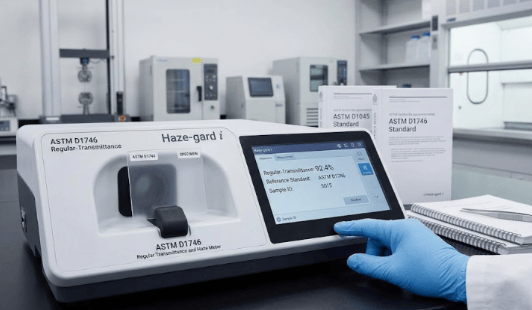
    The image shows a haze meter measuring the regular transmittance of a transparent plastic sheeting specimen according to ASTM D1746.
    ASTM D1746 Haze Meter

    Common Challenges and Troubleshooting

    Several factors, such as surface contamination, scratches, nonrepresentative defects, specimen positioning, and instrument geometry, may influence transparency measurements. Laboratories must use representative specimens, keep optical surfaces clean, set up the laboratory, follow specimen-placement instructions, and select the proper instrument condition. ASTM specifically warns that results can vary with instrument design parameters, especially the angular width of the receptor aperture. 

    Analysis Results and Interpretation

    • The test determines the transparency of plastic sheeting through regular transmittance, reported as a percentage, which indicates the material’s ability to transmit image-forming light. 
    • The test measures the transparency of plastic sheets by measuring regular transmittance, which provides an objective indication of the plastic sheet’s ability to transmit image-forming light. 
    • Engineers analyze the results to compare plastic formulations, materials, suppliers, manufacturing processes, and production batches for consistency in optical clarity and transparency. 
    • Manufacturers and engineers use the results for material qualification, quality assurance, product specification, material selection, and product development where clear or transparent plastic sheeting is required. 
    • Engineers interpret the results together with specimen condition and instrument geometry because the incident-beam and receptor-aperture design can significantly influence measured transparency, particularly for materials with low regular transmittance. 

    Link to ASTM D1746

    Read more

    FAQ

    Where can I get the astm d1746 tested?
    You can share your astm d1746 testing requirements with MaTestLab. MaTestLab has a vast network of material testing laboratories, spread across the USA and Canada. We support your all material testing needs ranging from specific astm d1746 test to various testing techniques.
    Please contact us for a detailed quote for your astm d1746 testing needs. Cost incurred to carry out different astm d1746 testing methodology depends on the type of raw material; number of samples, coupons, or specimens; test conditions, turn around time etc. Costs of some ASTM testing methods start from $100 and the final value depends upon the factors listed above. Please contact us for the best and latest prices.
    The required number of samples or specimens should comply with the procedure given in the astm d1746 standard. However, the MaTestLab operations team can assist you for your special requirements once you share your testing details with us.
    MaTestLab has a vast testing laboratory network, hence we bring you the best testing facilities in a cost-effective way. We offer considerable discounts (15-20%) to our returning customers based on test volume and frequency.
    The turnaround time for astm d1746 test methodology depends upon the test procedure mentioned in the standard test document. However, we at MaTestLab understand your research requirements and hence try to get your test completed within the least possible time.
    Dr Ruchika Yogesh
    About Author
    Dr Ruchika Yogesh
    Dr. Ruchika Yogesh is an entrepreneur, science and AI/ML enthusiast, medicinal chemistry subject matter expert (SME), scientific/medical copyeditor, and an independent researcher.
    Testimonials
    Real results
    Engineers trust us with what matters most
    Start Your Testing
    Project Today
    Define your requirements and get access to
    specialized laboratories ready to deliver results
    Partners with us
    Clients
    Vendors
    Process for testing
    • STEP 01

      You share your testing requirements

    • STEP 02

      You share your sample(s)

    • STEP 03

      We deliver your test reports

    Get your testing done

    Let us known your testing requirements and we will be right back with a solution.

      Let us root for each other. Collaborate to grow, expand, and accelerate our businesses.

      Partner with us

        Contact Us

        Discover more from MaTestLab

        Subscribe now to keep reading and get access to the full archive.

        Continue reading