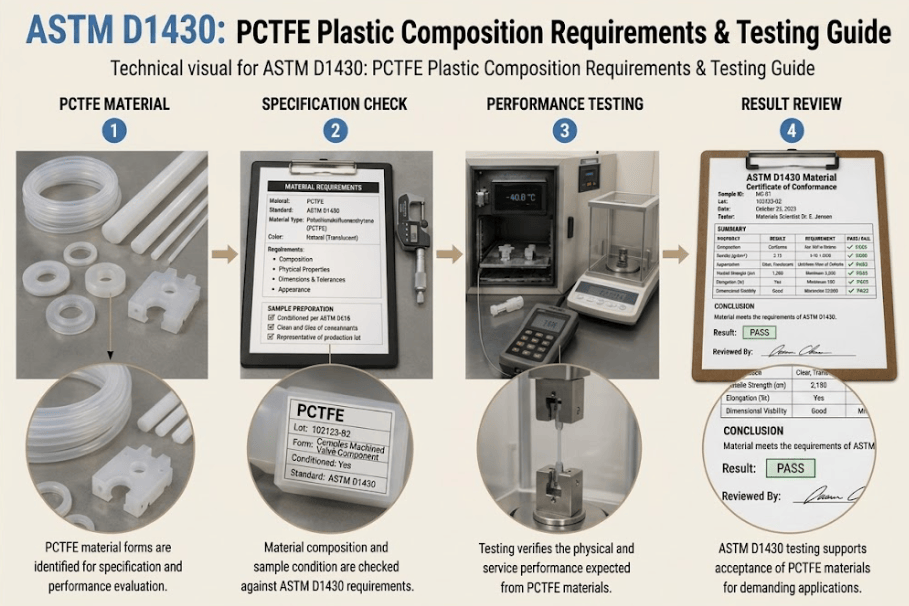
ASTM D1430 Standard Classification System for Polychlorotrifluoroethylene (PCTFE) Plastics
What is ASTM D1430?
ASTM D1430 is a standard classification system for polychlorotrifluoroethylene plastics used for molding and extrusion. The system covers PCTFE plastics containing at least 90% chlorotrifluoroethylene and excludes recycled PCTFE materials. PCTFE materials in powder and pellet form are classified into one group, which is then divided into Classes 1, 2, and 3 based on chemical composition. Each class contains specified grades based on the applicable property requirements. ASTM D1430 (Standard Classification System for Polychlorotrifluoroethylene (PCTFE) Plastics) also identifies test methods for evaluating plastic properties such as zero strength time, deformation under load, melting point, dielectric properties, and specific gravity.
Get Certified ASTM D1430 Testing for Reliable PCTFE Material Evaluation
ASTM D1430 classification and laboratory testing verify PCTFE material properties to meet applicable requirements. Testing provides information for material verification, grade comparison, and product qualification. The ASTM D1430-certified evaluation provides quality assurance, material selection, research and development, supplier qualification, and production control. The results can also help manufacturers set material specifications for special PCTFE applications.
What is the Scope of ASTM D1430 Test Standard?
ASTM D1430 classification provides a consistent method for communicating material characteristics and distinguishing PCTFE grades among manufacturers, suppliers, laboratories, and end users. It applies to sectors such as plastics, chemical processing, aerospace, electrical, pharmaceutical, and manufacturing for polymer testing, material selection, quality control, product development, and specification management. This classification-
Establishes a uniform classification system for PCTFE products.
Assists in the specification of grades of PCTFE.
Facilitates the flow of information about the materials required between suppliers and users.
Helps with material specifications for special uses.
Assists in quality control and product qualification.
Serves as a point of reference for comparing the properties of PCTFE materials.
ASTM D1430 Equipment and Sample Preparation Guide
To ensure accurate PCTFE classification, use representative materials, prepare specimens appropriately, and use calibrated equipment for the property evaluations. The type of equipment depends on the properties required for classification.
Representative materials include: PCTFE resins; molded PCTFE specimens; processed PCTFE materials; other representative forms appropriate for evaluation under the applicable classification requirements.
Specimen Preparation
Technicians prepare representative specimens by following proper processing and conditioning procedures. They test each sample and look for cracks, voids, warping, or contamination.
Specimen Dimensions
Specimen sizes depend on the property being tested and the test method used. Laboratories make specimens based on the evaluation procedure they will use.
Instrumentation
Common equipment may comprise universal testing machines, analytical balances, density measurement instruments, thermal analysis instruments, dimensional measurement instruments, environmental conditioning chambers, ovens, and other laboratory equipment necessary for specific property evaluations of PCTFE.
What is the Use of ASTM D1430 Testing?
ASTM D1430 helps manufacturers and users establish a uniform classification for materials made from PCTFE. The system supports material selection and provides a common basis for evaluating and communicating PCTFE properties.
Fluoropolymer manufacturers categorize materials based on applicable requirements.
Chemical processing industries select PCTFE for demanding environments.
Aerospace manufacturers test PCTFE on special-purpose components.
Electrical manufacturers evaluate PCTFE for insulation applications.
Pharmaceutical equipment manufacturers test appropriate fluoropolymers for use.
Quality control laboratories check the material’s characteristics and classification.
What Materials Can Be Tested Under ASTM D1430?
ASTM D1430 covers suitable forms of polychlorotrifluoroethylene (PCTFE) materials for classification and property evaluation. These can be used for applications that demand chemical resistance, low moisture absorption, dimensional stability, and specific fluoropolymer performance.
Why is ASTM D1430 Important for PCTFE Material Classification?
The ASTM D1430 standard provides an agreed classification system for PCTFE materials. A consistent classification enables manufacturers and suppliers, engineers, and end users to choose the correct grade and clearly communicate material requirements. The system also enables quality assurance and material qualification by providing a structured framework to compare PCTFE characteristics across suppliers and production batches.
Testing Procedures and Requirements for PCTFE Classification
ASTM D1430 has no single property test; it is a classification system. The PCTFE material is subjected to relevant physical, mechanical, thermal, or other property tests, as appropriate, in the laboratory to assess the material.
Prior to the evaluation, technicians determine the material, grade, formulation, and supplier data for the PCTFE.
Specimen Preparation
Representative specimens are prepared in the laboratory in accordance with the property test methods. They ensure specimens are clean, uniform, and defect-free.
Physical Property Evaluation
Technicians assess relevant physical features and applications for the chosen PCTFE classification.
Mechanical Property Evaluation and Thermal Evaluation
When needed, laboratories determine mechanical properties (tensile behavior and other properties) to distinguish or qualify the material. When the classification or application calls for more thermal performance information, laboratories can be evaluated for the applicable thermal characteristics.
Instrument Verification
Analysts verify testing equipment before testing and calibrate it in accordance with laboratory and manufacturer procedures.
Data Collection
Records personnel identification of material, specimen information, test conditions, test values, equipment information, and observations.
Classification and Result Analysis
The properties measured are compared to the requirements of the applicable ASTM D1430 classification, and the classification of the material is determined.
Documentation and Reporting
Laboratory reports usually include specimen identification (PCTFE), material classification, specimen details, test methods performed, properties measured, relevant requirements, equipment used, and information for evaluation under ASTM D1430.
ASTM D1430 Testing Process and Data Collection
The first step in testing is to determine the ASTM D1430 classification requirements that apply to the PCTFE material under test. Analysts prepare representative specimens and conduct physical, mechanical, thermal, or other property evaluations. The laboratory measures the characteristics and compares them to the classification criteria. Then, personnel record the material class and supporting test results.
ASTM D1430 Classification Testing of Polychlorotrifluoroethylene
Common Challenges and Troubleshooting
Evaluation results may vary due to material variability, contamination, specimen preparation differences, processing variations, instrument calibration errors, and/or classification errors. Better reliability by representative sampling, controlled specimen preparation, verified instruments, and careful comparison to suitable classification requirements.
Analysis Results and Interpretation
The laboratory reports the applicable PCTFE property values and material classification according to the specified requirements and evaluation procedures, with each property reported in its applicable unit.
The analyst compares the measured property values with the classification requirements to differentiate PCTFE materials according to their specified characteristics.
Engineers evaluate the consistency of the measured properties to identify variations in resin composition, processing conditions, or material quality.
The manufacturer compares the classification results with purchasing specifications, product requirements, and service conditions when selecting PCTFE materials for a particular application.
ASTM D1430 classifies Polychlorotrifluoroethylene (PCTFE) materials based on specific properties and characteristics.
What is PCTFE?
Polychlorotrifluoroethylene (PCTFE) is a fluoropolymer with a number of important properties, including chemical resistance, low moisture absorption, and dimensional stability.
Why is ASTM D1430 important?
ASTM D1430 provides a common classification system that helps manufacturers and users of PCTFE materials identify, compare, specify, and qualify materials for various applications.
Dr. Ruchika Yogesh is a serial entrepreneur, material science and AI/ML enthusiast, medicinal chemistry subject matter expert (SME), scientific/medical copyeditor, and a researcher. Know More
Testimonials
Real results
Engineers trust us with what matters most
“We had a great experience working with this company for our ASTM E84 testing. They were the first company to respond to our inquiry within just a few minutes of submitting it. From start to finish, the communication was excellent, and the entire process was swift, straightforward, and hassle-free.”
Ivars FancyWalls
United States
“Very good communication, testing associates were very patient with delays on our end. Reasonable turnaround time for results and nicely detailed report. Analysts were also quick to answer any follow-up questions. Happy with results.”
Skye Henderson
United States
“Matestlab connected us with an accredited lab within days, cutting weeks off our product validation timeline.”
Rebecca Kozodoy-Pins
United States
Start Your Testing Project Today
Define your requirements and get access to specialized laboratories ready to deliver results