
ASTM D1304 Standard Test Methods for Adhesives Relative to Their Use as Electrical Insulation

    What is ASTM D1304?

    ASTM D1304 describes a series of test methods for evaluating adhesives for use as electrical insulation. The standard covers adhesives used for electrical insulation, such as electrical apparatus adhesives, as well as adhesives intended to be cured by electrical heating. The standard checks liquid adhesives before use and dried or cured adhesive films after use. ASTM D1304 (Standard Test Methods for Adhesives Relative to Their Use as Electrical Insulation) covers power factor and dielectric constant, direct current conductivity, extract conductivity, acidity and alkalinity, pH, dielectric strength, volume and surface resistivity, and arc resistance. Methods include liquid and highly viscous adhesives, as well as solid and set adhesives, and procedures for assessing properties before and after use. These evaluations help determine an adhesive’s appropriate insulating properties for its intended electrical use.

    Read more

    Get Certified ASTM D1304 Testing for Reliable Electrical Insulation Evaluation.

    ASTM D1304 testing helps manufacturers and laboratories assess an adhesive’s electrical insulation properties. Laboratory testing can help compare adhesive formulations, verify material consistency, and evaluate material properties relevant to the electrical application. ASTM D1304 testing can help qualify materials, provide quality assurance, support product development, and support research. The results can indicate which adhesive properties matter for suitability in an electrical system or apparatus.

    What is the Scope of ASTM D1304 Test Standard?

    ASTM D1304 covers procedures for testing liquid, highly viscous, solid, and set adhesives used for electrical insulation, electrical apparatus, or electrical heating, and for curing the adhesive. The standard separates procedures for testing adhesives before use from procedures for evaluating adhesive properties as used. This standard-

    Read more

    • Tests adhesives for electrical insulating properties.
    • Adhesives for use in electrical apparatus.
    • Uses adhesives that will be electrically heated to cure.
    • Tests adhesives in liquid, very high viscosity, solid, or set form.
    • Measures the power factor and dielectric constant of liquid Adhesives.
    • Measures direct current and extract conductivity.
    • Identifies acidity, alkalinity, and pH as appropriate.
    • Measures the power factor and dielectric constant of dry or cured adhesive films.
    • Determines dielectric strength.
    • Calculates volume and surface resistivity.

    What are the Uses of ASTM D1304 Testing?

    ASTM D1304 is designed to help manufacturers and laboratories characterize adhesives used for electrical insulation. There are a number of procedures in the standard, as an adhesive’s electrical properties can vary depending on whether the material is in its liquid form, whether it is cured, or whether it is a component of an electrical assembly. The data can help assess insulation resistance, dielectric properties, conductivity, and electrical arcing resistance.

    • Adhesive manufacturers can assess electrical-insulation properties.
    • Electrical-component manufacturers can assess adhesives used in electrical apparatus.
    • Research laboratories can make comparisons of adhesive formulations.
    • Quality-control laboratories can monitor electrical properties between batches.
    • Product developers can compare adhesive properties to assess their suitability as an electrical insulator.
    • Manufacturers can study curing changes, moisture changes, contamination effects, and material deterioration.

    What Materials Can Be Tested Under ASTM D1304?

    ASTM D1304 is applicable to adhesives in liquid, highly viscous, solid, or set condition that are used for electrical insulation, electrical apparatus, or curing by electrical heating. It depends on the adhesive condition and the electrical or chemical property being evaluated.

    Why is ASTM D1304 Important for Electrical Insulation Evaluation?

    ASTM D1304 establishes a standards-based approach to testing several properties that affect an adhesive’s ability to serve as an electrical insulator. Insulation resistance, resistivity, dielectric behavior, and arc resistance can affect an adhesive’s effectiveness as an insulator. The standard also accounts for how measured resistance and conductance depend on applied voltage, electrification time, humidity, and temperature.

    ASTM D1304 Equipment and Sample Preparation Guide

    Technicians prepare representative adhesive samples under the conditions required for each applicable procedure. With proper specimen preparation, curing, conditioning, electrode configuration, and environmental control, laboratories can obtain meaningful electrical-insulation results.

    Read more

    Specimen DetailsRepresentative specimens include liquid, highly viscous, solid, or set-state adhesives intended for use as electrical heating materials, electrical apparatus adhesives, or electrical insulation.
    Specimen PreparationFor liquid adhesive samples, technicians prepare the samples according to the requirements of the applicable ASTM D1304 procedure. For adhesive films, technicians form and cure the films per the applicable procedure.
    Specimen DimensionsASTM D1304 does not specify a single specimen geometry; instead, dimensions and configurations depend on the electrical or chemical property being measured.
    InstrumentationEquipment may consist of electrical-resistance and dielectric-property measurement devices, dielectric-strength devices, arc-resistance devices, pH meters, conductivity meters, temperature control devices, and appropriate electrodes.

    Testing Procedures and Requirements for Electrical Insulation Adhesives

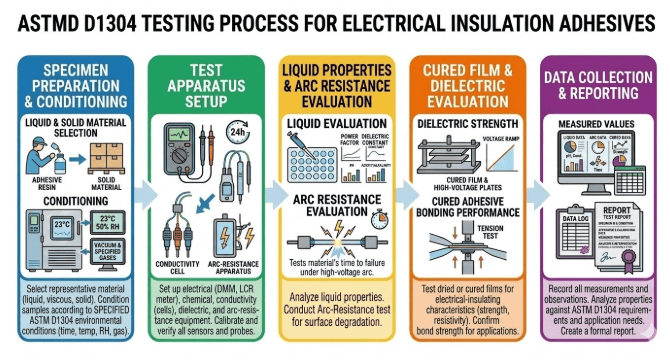
    This test is used to create adhesive specimens and measure the related properties under controlled laboratory conditions. Proper specimen preparation, conditioning, equipment calibration, and consistent test procedures increase result reliability. The ASTM D1304 testing procedure is as follows-

    Read more

    Specimen PreparationTechnicians select the representative adhesive material and condition it according to the selected procedure, in its liquid, viscous, solid, or cured state.
    Sample ConditioningTechnicians condition the adhesive or cured film under the specified environmental and test conditions before measurement.
    Test Apparatus SetupTechnicians set up and verify the electrical, chemical, conductivity, dielectric, or arc-resistance equipment as appropriate.
    Liquid Adhesive Evaluation and Arc Resistance EvaluationSuitable properties of the adhesive, such as power factor, dielectric constant, direct current conductivity, extract conductivity, acidity or alkalinity, and pH, are tested at the laboratory before use. The laboratory tests the adhesive insulation’s resistance to electrical arcs using the appropriate procedure.
    Cured Adhesive Film EvaluationTechnicians test the dried or cured adhesive film to determine the appropriate electrical-insulating characteristics.
    Dielectric Strength TestingWhere applicable, technicians test adhesive-bonding performance to confirm the product provides the bond strength required for electrical insulation use.
    Data Collection and Result AnalysisEngineers document the specimen identification, adhesive condition, test conditions, electrical measurements, chemical measurements, and any observations. Analysts interpret the measured properties based on the ASTM D1304 procedure to which the test is applied and the intended electrical-insulation application.
    Documentation and ReportingLaboratory reports include adhesive identification, specimen condition, preparation and curing data, test conditions, measured properties, computed results, and ASTM D1304 test data.

    ASTM D1304 Testing Process and Data Collection

    The first step in testing is to establish the adhesive condition and decide which ASTM D1304 procedure to use for the desired electrical-insulation test. Technicians prepare liquid adhesive samples or dried, cured adhesive films as needed for the selected procedure. The laboratory then conducts the necessary electrical or chemical measurement(s). These can be dielectric properties or conductivity, pH or dielectric strength, volume and surface resistivity, or arc resistance. Analysts record the measured values and interpret them based on the procedure and intended use.

    The image shows laboratory equipment evaluating an adhesive specimen for electrical insulation performance according to ASTM D1304.
    ASTM D1304 Testing of Adhesives for Electrical Insulation Applications

    Common Challenges and Troubleshooting

    Moisture, temperature, contamination, inconsistent curing, electrode configuration, applied voltage, and electrification time can all impact the results. Surface resistance can respond quickly to humidity, while volume resistance responds more slowly. Therefore, it is important to have the correct environmental conditions in the laboratory to make adhesive films in the same way, test electrical equipment, and record voltage and time used for measurement when necessary.

    Analysis Results and Interpretation

    • The test results indicate the adhesive’s electrical resistance through its volume and surface resistivity, while the dielectric constant and power factor describe its dielectric response under the specified electrical conditions.
    • The test results determine the adhesive’s dielectric strength, which indicates its ability to withstand an applied electric field, and its arc resistance under the specified test conditions.
    • The test results provide information about the adhesive’s electrical conductivity through direct-current conductivity and extract conductivity measurements.
    • Engineers use acidity, alkalinity, and pH results to assess the adhesive’s chemical condition and identify characteristics that may affect its electrical insulation properties.
    • Engineers consider temperature, humidity, applied voltage, electrification time, adhesive condition, and cure when interpreting the results because these factors can affect the measured properties.
    • Laboratories compare the test results with applicable material specifications, customer requirements, or historical results to assess adhesive suitability and batch-to-batch consistency.

    Link to ASTM D1304

    Read more

    FAQ

    Where can I get the astm d1304 tested?
    You can share your astm d1304 testing requirements with MaTestLab. MaTestLab has a vast network of material testing laboratories, spread across the USA and Canada. We support your all material testing needs ranging from specific astm d1304 test to various testing techniques.
    Please contact us for a detailed quote for your astm d1304 testing needs. Cost incurred to carry out different astm d1304 testing methodology depends on the type of raw material; number of samples, coupons, or specimens; test conditions, turn around time etc. Costs of some ASTM testing methods start from $100 and the final value depends upon the factors listed above. Please contact us for the best and latest prices.
    The required number of samples or specimens should comply with the procedure given in the astm d1304 standard. However, the MaTestLab operations team can assist you for your special requirements once you share your testing details with us.
    MaTestLab has a vast testing laboratory network, hence we bring you the best testing facilities in a cost-effective way. We offer considerable discounts (15-20%) to our returning customers based on test volume and frequency.
    The turnaround time for astm d1304 test methodology depends upon the test procedure mentioned in the standard test document. However, we at MaTestLab understand your research requirements and hence try to get your test completed within the least possible time.
    Malhar Khole
    About Author
    Malhar Khole
    Malhar Khole is a Material Testing Associate at MaTestLab Inc. and holds a postgraduate degree in Material Science and Technology from IIT (BHU), Varanasi.
    Testimonials
    Real results
    Engineers trust us with what matters most
    Start Your Testing
    Project Today
    Define your requirements and get access to
    specialized laboratories ready to deliver results
    Partners with us
    Clients
    Vendors
    Process for testing
    • STEP 01

      You share your testing requirements

    • STEP 02

      You share your sample(s)

    • STEP 03

      We deliver your test reports

    Get your testing done

    Let us known your testing requirements and we will be right back with a solution.

      Let us root for each other. Collaborate to grow, expand, and accelerate our businesses.

      Partner with us

        Contact Us

        Discover more from Matestlab Inc

        Subscribe now to keep reading and get access to the full archive.

        Continue reading