
ASTM D1201 Standard Specification for Thermosetting Polyester Molding Compounds

    What is ASTM D1201?

    ASTM D1201 is a standard specification for compression-molding thermosetting unsaturated polyester molding compounds. The specification establishes the classification, requirements, and testing of six types of thermosetting unsaturated polyester molding compounds. The values stated in SI units are the standard. The specification includes Type 1 to Type 6 compounds. The six types include general-purpose granular materials with mineral fillers; granular materials with mineral and cellulosic fillers with improved mechanical strength; putty-type materials with mineral fillers; putty-type materials with mineral fillers with superior electrical properties; high-impact glass-fiber-filled materials in mat form with good electrical properties; and high-impact glass-fiber-filled materials in putty form.

    Read more

    Get Certified ASTM D1201 Testing for Reliable Polyester Molding Compounds

    Manufacturers use consistent molding compounds to get reliable thermoset components. ASTM D1201 (Standard Specification for Thermosetting Polyester Molding Compounds) helps manufacturers classify compounds and verify important mechanical, physical, electrical, and water-absorption properties. Laboratories can compare the measured properties with the applicable requirements to support material qualification, quality control, and production consistency.
    What is the scope of ASTM D1201? 

    ASTM D1201 covers compression-molding thermosetting unsaturated polyester molding compounds. The specification covers six types of polyester molding compounds and establishes requirements used to identify these types. The ASTM D1201 standard-

    Read more

    • Covers thermosetting unsaturated polyester molding compounds. 
    • Applies to compression-molding compounds. 
    • Classifies compounds into six types. 
    • Covers mineral-filled and cellulosic-filled compounds. 
    • Includes glass-fiber-filled compounds. 
    • Establishes requirements for selected physical, mechanical, electrical, and water-absorption properties. 
    • Uses SI units as the standard units. 
    • Assists with material classification and quality assessment.

    What are the uses of ASTM D1201?

    Manufacturers use ASTM D1201 to classify thermosetting polyester molding compounds and verify their desired properties. The specification ensures consistent material evaluation before using compounds in compression-molded applications. This standard-

    • Classifies polyester molding compounds. 
    • Evaluates specific gravity. 
    • Determines flexural strength. 
    • Measures flexural modulus. 
    • Evaluates Izod impact resistance. 
    • Determines arc resistance. 
    • Measures water absorption. 
    • Supports material quality control. 
    • Helps manufacturers compare different compound types.

    What Makes Thermosetting Polyester Molding Compounds Important? 

    Thermosetting polyester molding compounds provide manufacturers with moldable materials for producing rigid components. Their filler systems and formulation characteristics enable manufacturers to develop compounds with different mechanical and electrical performance requirements.

    ASTM D1201 Equipment and Sample Preparation Guide

    Manufacturers must sample molding compounds and test them against the material requirements specified in ASTM D1201. The specification defines several properties for compound classification and evaluation, and referenced ASTM methods provide procedures for each property.

    Read more

    Sample and Specimen DetailsTechnicians select representative samples of the thermosetting, unsaturated polyester molding compound for evaluation.
    Specimen PreparationAnalysts prepare molded test specimens based upon referenced test methods and requirements for the compound type.
    Specimen DimensionsTechnicians use specimen dimensions specified by the applicable referenced ASTM test method for each property.
    Instrumentation Technicians use the applicable equipment and referenced ASTM test methods to determine specific gravity, flexural properties, Izod impact resistance, arc resistance, and water absorption.

    ASTM D1201 Testing Procedure and Requirements 

    ASTM D1201 covers the classification, requirements, and testing of thermosetting unsaturated polyester molding compounds. Technicians test representative samples and compare the measured properties with the requirements applicable to the specified compound type.

    Read more

    Specific Gravity TestLaboratories determine the specific gravity of the molding compound according to the applicable ASTM test method.
    Flexural StrengthTechnicians determine the flexural strength of the molded compound.
    Modulus of Elasticity in FlexureAnalysts determine the modulus of elasticity in flexure of the molded material.
    Izod Impact ResistanceLaboratories evaluate the material’s resistance to impact loading.
    Arc ResistanceTechnicians determine the arc resistance of the molded compound according to the applicable test procedure.
    Water AbsorptionLaboratories determine the amount of water absorbed by the molded material.

    ASTM D1201 Testing Technique, Process, and Data Collection

    Technicians take representative samples of thermosetting polyester molding compounds and prepare them using appropriate referenced ASTM methods. Then technicians determine the required properties, including specific gravity, flexural strength, modulus of elasticity in flexure, Izod impact resistance, arc resistance, and water absorption.

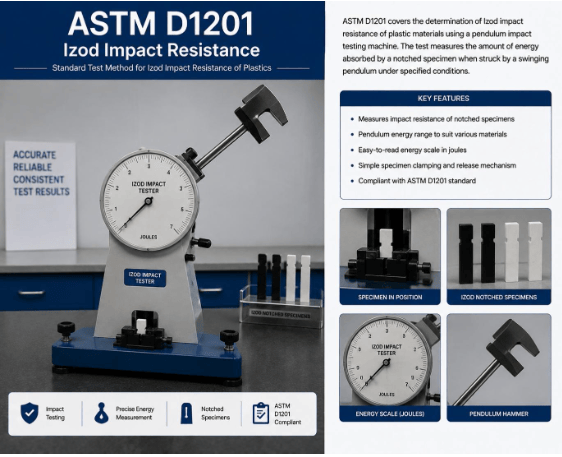
    This image shows pendulum impact testing equipment used to evaluate the impact resistance of plastic specimens as per ASTM D1201.
    ASTM D1201 Pendulum Impact Tester

    Common Challenges and Troubleshooting

    Manufacturers can reduce variations in filler distribution, specimen preparation, molding conditions, and material composition. These factors can influence measured mechanical, physical, electrical, and water-absorption properties. Technicians should use representative samples and follow the applicable specimen preparation and testing procedures. Laboratories should also ensure equipment calibration and testing conditions to increase repeatability.

    ASTM D1201 Analysis Results and Interpretation

    • ASTM D1201 evaluates several properties rather than producing one single test value. 
    • Each laboratory reports each property in the unit as required by the test method.
    • Laboratories often report specific gravity in dimensionless units, flexural strength in MPa, flexural modulus in MPa, and water absorption in %. 
    • Manufacturers use these results and the applicable requirements to decide if the molding compound meets the required type.

    What if a molding compound fails ASTM D1201? 

    A failed result indicates that the tested compound does not meet the applicable requirement for the specified property or classification. Engineers should investigate material formulation, filler distribution, processing conditions, specimen preparation, and testing procedures.

    Link to ASTM D1201

    How Do You Ensure Accurate ASTM D1201 Results?

    Representative sampling and proper specimen preparation are essential for reproducible and reproducible results. The technicians should use calibrated equipment and the referenced ASTM procedure for each property.

    Read more

    What Types of Polyester Molding Compounds Does ASTM D1201 Cover?

    ASTM D1201 classifies the covered compounds into six types designated Type 1 through Type 6. Each type specifies a specific combination of filler, physical shape, mechanical properties, or electrical properties.

    • Type 1: General-purpose granular material containing mineral fillers.
    • Type 2: General-purpose granular material containing mineral and cellulosic fillers and enhanced mechanical strength.
    • Type 3: General-purpose putty-type material with mineral fillers.
    • Type 4: Putty-type material with mineral fillers and superior electrical properties.
    • Type 5: High-impact glass-fiber-filled material in mat form with good electrical properties.
    • Type 6: High-impact glass-fiber-filled material in putty form.

    How Does ASTM D1201 Enhance Product Reliability?

    ASTM D1201 helps manufacturers establish uniform requirements for thermosetting polyester molding compounds. The specification provides classification and property requirements for material qualification and quality control.

    FAQ

    Where can I get the astm d1201 tested?
    You can share your astm d1201 testing requirements with MaTestLab. MaTestLab has a vast network of material testing laboratories, spread across the USA and Canada. We support your all material testing needs ranging from specific astm d1201 test to various testing techniques.
    Please contact us for a detailed quote for your astm d1201 testing needs. Cost incurred to carry out different astm d1201 testing methodology depends on the type of raw material; number of samples, coupons, or specimens; test conditions, turn around time etc. Costs of some ASTM testing methods start from $100 and the final value depends upon the factors listed above. Please contact us for the best and latest prices.
    The required number of samples or specimens should comply with the procedure given in the astm d1201 standard. However, the MaTestLab operations team can assist you for your special requirements once you share your testing details with us.
    MaTestLab has a vast testing laboratory network, hence we bring you the best testing facilities in a cost-effective way. We offer considerable discounts (15-20%) to our returning customers based on test volume and frequency.
    The turnaround time for astm d1201 test methodology depends upon the test procedure mentioned in the standard test document. However, we at MaTestLab understand your research requirements and hence try to get your test completed within the least possible time.
    Rohit Dhembare
    About Author
    Rohit Dhembare
    Rohit Dhembare is an Operations Associate at MaTestLab Inc. and holds a postgraduate degree in Organic Chemistry.
    Testimonials
    Real results
    Engineers trust us with what matters most
    Start Your Testing
    Project Today
    Define your requirements and get access to
    specialized laboratories ready to deliver results
    Partners with us
    Clients
    Vendors
    Process for testing
    • STEP 01

      You share your testing requirements

    • STEP 02

      You share your sample(s)

    • STEP 03

      We deliver your test reports

    Get your testing done

    Let us known your testing requirements and we will be right back with a solution.

      Let us root for each other. Collaborate to grow, expand, and accelerate our businesses.

      Partner with us

        Contact Us

        Discover more from MaTestLab

        Subscribe now to keep reading and get access to the full archive.

        Continue reading