ASTM D1140 Standard Test Methods for Determining the Amount of Material Finer than 75-μm (No. 200) Sieve in Soils by Washing
What is ASTM D1140?
ASTM D1140 is a set of standard test methods for determining the amount of soil material finer than a 75-μm (No. 200) sieve by washing. ASTM D1140 (Standard Test Methods for Determining the Amount of Material Finer than 75-μm (No. 200) Sieve in Soils by Washing) provides two methods: Method A uses soaking in water before wash sieving, while Method B uses soaking in a dispersing solution before wash sieving for soils, particularly clayey soils, in which fine material behaves plastically and tends to adhere to larger particles. The method applies to soil material having a maximum particle size of 75 mm (3 in.). Laboratories use the resulting percentages of fines to support soil characterization, gradation evaluation, and engineering decisions. These test methods use wet sieving because wet sieving separates material finer than the 75-μm sieve from larger particles and soil aggregations more efficiently and completely than dry sieving.
Fine material can significantly affect soil properties such as compaction, drainage, engineering properties, and permeability. ASTM D1140 specifies the standard washing procedures to determine the amount of material passing a 75-μm sieve. The use of representative samples, appropriate sieve sizes, precise scales, and controlled drying conditions ensures reliable results.
What is the scope of ASTM D1140?
ASTM D1140 covers the determination of material finer than a 75-μm (No. 200) sieve through washing. The method covers soil materials with maximum particle sizes up to 75 mm (3 in.). Laboratories can use water or a dispersant to separate fine particles from larger soil particles. This test method-
Determines the amount of material finer than 75 μm.
Applies to soils with maximum particle sizes up to 75 mm.
Provides Method A for dispersion by soaking the specimen in water and Method B for dispersion by soaking the specimen in a dispersing solution before wash sieving.
Supports geotechnical and construction material testing.
What are the uses of ASTM D1140 testing?
ASTM D1140 testing determines the percentage of fine material that passes the 75-μm sieve. Engineers use this information to assess soil properties and to determine soil classification, construction materials, and geotechnical purposes. This test standard-
Determines the percentage of soil fines. Supports soil gradation analysis.
Helps characterize sand, silt, and clay-containing soils.
Supports soil classification.
Assists construction material evaluation.
Helps compare soil samples from different sources.
Supports quality control of soil materials.
Provides data for geotechnical engineering decisions.
ASTM D1140 Equipment and Sample Preparation Guide
The test procedure specified in ASTM D1140 includes representative test material, suitable specimen mass determination, a wash sieve of 75-μm (No. 200), and controlled drying. The laboratory decides whether to use Method A or Method B based on the soil’s suitability and the requesting authority’s requirements. Method A is applied when the fine material in a soil has little or no plasticity, and Method B is used for soils, especially clayey soils, where the fine material has plastic properties and is apt to cling to larger particles.
Technicians first collect representative soil samples and reduce them to the required test mass. The standard covers material with a maximum particle size of 75 mm (3 in.).
Specimen preparation
Analysts then thoroughly mix the soil, reduce the sample to the required mass, and dry the specimen to a constant mass before washing. Method A uses water for soaking, while Method B uses a dispersing solution.
Specimen dimensions
The method specifies maximum particle size and minimum dry specimen mass based on the material’s maximum particle size.
Instrumentation
The laboratory uses a balance, a 75-μm (No. 200) wash sieve, a drying oven, specimen containers, a water-delivery system, and the dispersing solution required for Method B.
Testing Procedures and Requirements for ASTM D1140
ASTM D1140 employs wet sieving to separate materials finer than 75 μm from the coarser soil fraction. ASTM D114 outlines two methods, Method A and Method B. Technicians determine the initial specimen mass, prepare the specimen according to Method A or Method B, wash the material through the 75-μm (No. 200) sieve, dry the retained material, and calculate the amount of material finer than 75 μm. Method A employs water; Method B is used for soils containing plastic or clayey fines.
Technicians obtain a representative sample and prepare the required test specimen mass.
Initial Drying and Weighing and Sample Dispersion
Technicians dry the specimen as required by the applicable procedure, determine its mass, and soak it in water for Method A or in a dispersing solution for Method B.
Wash Sieving and Fine Material Removal
Technicians wash the prepared specimen through the 75-μm (No. 200) sieve using the specified washing procedure.
Material Recovery and Final Drying
Then technicians transfer the retained soil back to the specimen container, avoiding material loss, and dry the retained material to a constant mass at 110 ± 5°C.
Mass Determination and Calculation
Technicians weigh the dried retained material on the specified balance with the appropriate accuracy and calculate the amount of material finer than 75 μm by subtracting the final retained dry mass from the initial dry mass.
Data Reporting
Laboratories report the amount of material finer than the 75-μm (No. 200) sieve as required by the applicable procedure and follow the significant-digit and rounding requirements of Practice D6026 unless superseded by the test method.
ASTM D1140 Testing Process and Data Collection
Technicians take representative soil samples, dry them, and weigh them before selecting the washing method. Then, the technician disperses the soil in water or a dispersing solution and places the sample in the 75-μm wash sieve. The technician washes the specimen until the water passing through the sieve runs clear, then recovers the retained material. Finally, the technician dries the retained material to a constant mass and records its mass. The laboratory uses the initial and final masses to determine the percentage of material finer than the 75-μm sieve.
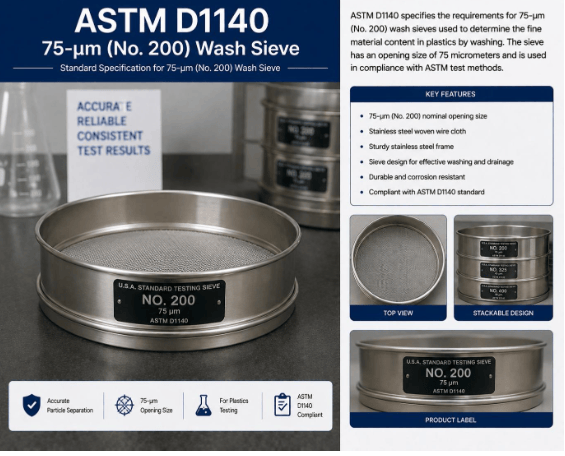
ASTM D1140 75-μm (No. 200) Wash Sieve
Common Challenges and Troubleshooting
Laboratories can encounter several problems during wet sieve testing. Inaccurate results can be obtained if the fine particles are not uniformly dispersed. Common challenges include incomplete soil dispersion, loss of retained material during washing, and damage or tearing of the 75-μm sieve. Additional challenges include wash-sieve overloading, excessive washing, incomplete drying of retained material, incorrect balance selection, specimen contamination, and improper selection between Method A and Method B. Technicians can reduce these issues by pre-checking sieving, maintaining drying temperature, controlling washing operations, and selecting the appropriate dispersion method.
ASTM D1140 Analysis Results and Interpretation
ASTM D1140 reports the amount of material finer than the 75-μm (No. 200) sieve as a percentage of the test specimen mass.
A higher percentage of material finer than the 75-μm (No. 200) sieve indicates a greater proportion of fine material in the tested soil.
A lower percentage of material finer than the 75-μm (No. 200) sieve indicates a lower proportion of fine material in the tested soil.
Laboratories report mass in SI units and express the primary test result as a percentage.
The standard also permits non-SI reporting when applicable and requires laboratories to follow appropriate significant-digit and rounding practices.
Consistent results for the amount of material finer than the 75-μm sieve can help laboratories monitor variations in soil materials.
When evaluating soil materials, laboratories and engineers should interpret the results according to applicable specifications and project requirements.
Malhar Khole is a Material Testing Associate at Matestlab Inc. and holds a postgraduate degree in Material Science and Technology from IIT (BHU), Varanasi. Know More
Testimonials
Real results
Engineers trust us with what matters most
“We had a great experience working with this company for our ASTM E84 testing. They were the first company to respond to our inquiry within just a few minutes of submitting it. From start to finish, the communication was excellent, and the entire process was swift, straightforward, and hassle-free.”
Ivars FancyWalls
United States
“Very good communication, testing associates were very patient with delays on our end. Reasonable turnaround time for results and nicely detailed report. Analysts were also quick to answer any follow-up questions. Happy with results.”
Skye Henderson
United States
“Matestlab connected us with an accredited lab within days, cutting weeks off our product validation timeline.”
Rebecca Kozodoy-Pins
United States
Start Your Testing Project Today
Define your requirements and get access to specialized laboratories ready to deliver results