ASTM D1056 Flexible Cellular Materials, Sponge or Expanded Rubber

    What is ASTM D1056?

    ASTM D1056 is a standard specification for flexible cellular rubber products, such as sponge rubber and expanded rubber. ASTM D1056 (Standard Specification for Flexible Cellular Materials—Sponge or Expanded Rubber) classifies flexible cellular rubber by type, Class, Grade, and applicable Suffix Letter, with each classification identifying specific physical-property requirements. The specification covers open- and closed-cell cellular rubber made from natural, synthetic, or reclaimed rubber, whether mixed with other polymers, chemicals, or additives. ASTM D1056 does not apply to latex foam rubber or ebonite cellular rubber. 

    Read more

    Get Certified ASTM D1056 Testing for Sponge and Expanded Rubber

    ASTM D1056 testing is used to ensure that flexible cellular rubber products comply with the physical-property requirements of the designated classification. The results apply to material selection, product qualification, manufacturing quality control, and performance testing of sponge and expanded rubber products.

    What is the scope of ASTM D1056?

    ASTM D1056 covers two materials, sponge rubber and expanded rubber, which are flexible cellular rubber materials, and provides classification and physical-property requirements for them. The specification also enables manufacturers to determine which material grade to use and ensure the product has the desired performance properties. The ASTM D1056 test standard

    Read more

    • Evaluates sponge rubber products by applying the applicable physical-property tests to determine whether the material meets the requirements of its specified Type, Class, Suffix, and Grade.
    • Evaluates closed-cell expanded rubber products by measuring applicable properties such as density, water absorption, fluid resistance, aging resistance, and low-temperature flexibility to determine their suitability for the specified classification.
    • Classifies flexible cellular rubber by type, class, Suffix, and grade so manufacturers and users can identify materials according to their required physical and performance characteristics.
    • Evaluates cellular rubber made from natural, synthetic, or reclaimed rubber by determining the applicable physical properties of the resulting sponge or expanded rubber formulation.
    • Assesses cellular rubber formulations containing polymers, chemicals, and organic or inorganic additives to determine whether the finished cellular material satisfies the applicable physical-property requirements.
    • Determines compliance with specified physical-property requirements by applying the relevant tests for compression-deflection, accelerated aging, immersion, water absorption, density, and low-temperature flex behavior.

    What are the Applications of ASTM D1056 Testing?

    ASTM D1056 testing helps manufacturers and users identify the class of flexible cellular rubber and determine whether a product has the required physical properties. Results are useful in the selection of materials and in the quality control of products that need flexibility, recovery, environmental exposure resistance, and controlled compression behavior.

    • Evaluates flexible sponge rubber products to verify that their physical properties meet the requirements associated with the specified ASTM D1056 classification. 
    • Assesses closed-cell expanded rubber products to determine their performance during fluid exposure, water absorption, aging, density, and low-temperature conditions. 
    • Supports quality control in rubber manufacturing by comparing physical-property results between formulations, manufacturing processes, and production batches. 
    • Assists material selection for sealing, cushioning, insulation, padding, and other flexible cellular rubber applications where controlled physical properties are required. 
    • Supports product qualification and specification compliance by determining whether cellular rubber meets the applicable requirements for its type, class, suffix, and grade. 
    • Provides performance data for automotive, industrial, construction, appliance, packaging, and general rubber-product applications where flexible cellular rubber performance is important. 

    What are Sponge Rubber and Expanded Rubber?

    Exposure to oils, fluids, water, heat, and low temperatures can affect the compression characteristics, dimensions, water absorption, and flexibility of flexible cellular rubber. ASTM D1056 provides a standard specification for measuring these properties and testing whether a cellular rubber product meets the requirements.

    Why is ASTM D1056 Testing Important?

    Flexible cellular rubber, when influenced by heat, oils, fluids, water, or low temperatures, may change in terms of compression characteristics, dimensions, moisture absorption, and flexibility. ASTM D1056 provides the necessary criteria to review these traits and determine if a cellular rubber product can be used within a needed specification. 

    What Materials Can Be Tested According to ASTM D1056?

    ASTM D1056 covers flexible cellular rubber from natural rubber, synthetic rubber, reclaimed rubber, and combinations of these materials as well as formulations including other polymers, chemicals, and various organic and inorganic components. While ASTM D1056 is used for sponge rubber and expanded rubber, it cannot be used for ebonite cellular rubber or latex foam rubber.

    How Does ASTM D1056 Evaluate Flexible Cellular Rubber?

    ASTM D1056 is a specification for flexible cellular rubber that performs the physical-property tests necessary for the classification of the material. The compression-deflection characteristics, resistance to accelerated aging, water absorption, oil resistance (open-cell sponge), fluid resistance (closed-cell materials), and low-temperature flex performance can all be determined in laboratories. Results are analyzed against the appropriate requirements for the type, class, suffix, and grade of the material. 

    ASTM D1056 Equipment and Sample Preparation Guide

    Laboratories prepare representative cellular rubber specimens with dimensions suitable for the applicable physical-property tests specified by ASTM D1056.  Technicians condition sponge or expanded products to meet the requirements of the specific test procedures before testing density, compression, aging, fluid resistance, water absorption, or low-temperature testing.

    Read more

    Sample DetailsFlexible cellular rubber products manufactured from natural, synthetic, or reclaimed rubber, including open-cell sponge rubber and closed-cell expanded rubber.
    Sample PreparationTechnicians select representative material, prepare specimens of suitable dimensions for the required test, inspect the cellular structure and surfaces, and condition the specimens according to the applicable test procedure.
    Sample ConfigurationTechnicians prepare suitable standard test specimens from sheet, strip, molded, or extruded cellular rubber products. Very small molded or extruded shapes may require special testing procedures.
    InstrumentationLaboratories use compression testing equipment, density measurement equipment, an aging oven, immersion containers, water-absorption equipment, low-temperature flex-testing equipment, dimensional measurement tools, a balance, and other apparatus required by the applicable test procedures.

    Testing Procedures and Requirements

    The ASTM D1056 specification for flexible cellular rubber consists of multiple tests of physical properties instead of a single test. Testing involves accelerated aging, compression-deflection, oil immersion (for open cell sponge), fluid immersion (for closed cell), water absorption, density, low temperature flex testing, etc. For a specific product, determine the relevant tests. 

    Read more

    Other ASTM reference documents in this specification are ASTM D1171, D3183, ASTM D471, and D575.

    Specimen Classification and AgingTechnicians identify the applicable type, class, suffix, and grade requirements and evaluate changes in physical properties after controlled exposure to elevated temperatures.
    Compression-Deflection TestingTechnicians measure the force required to compress the cellular rubber by the specified amount and evaluate its firmness and compression behavior.
    Immersion, Water Absorption, and Density TestingTechnicians expose the material to the specified fluids, measure changes in its properties, and determine its water absorption and density. 
    Low-Temperature Flexibility TestingTechnicians evaluate the material’s flexibility and resistance to failure under specified low-temperature conditions. 

    ASTM D1056 Testing Process and Data Collection

    Technicians determine the ASTM D1056 classification needed and create representative specimens of the cellular rubber product. They conduct the relevant testing, including compression-deflection, accelerated aging, immersion, water absorption, density, and low-temperature flex testing, and document the data on physical properties. The lab then compares the results to the requirements in the specified material classification to see if it meets the requirements. 

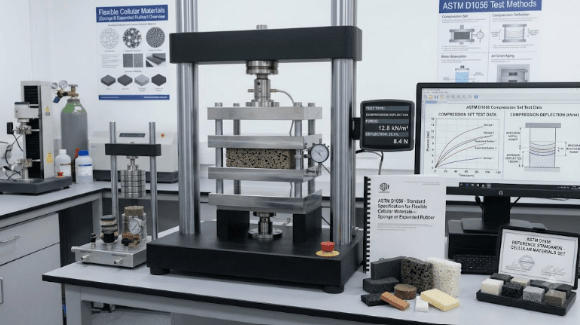
    The image shows a universal testing machine used to evaluate physical properties of flexible cellular rubber in accordance with applicable ASTM D1056 test procedures. 
    ASTM D1056 Universal Testing Machine (UTM)

    Common Challenges and Troubleshooting

    Results may differ with incorrect specimen dimensions, improper specimen preparation, variation in cellular structure, improper conditioning, and inconsistent test conditions. Laboratories can minimize these issues by taking representative samples, applying the appropriate individual test procedure, setting conditioning/exposure conditions, and employing calibrated measurement equipment.

    Analysis Results and Interpretation

    • The laboratory report includes compression-deflection, density, water absorption, aging changes, oil or fluid resistance, and low-temperature flex results, together with specimen identification, material classification, dimensions, and applicable test conditions.
    • The testing determines whether the flexible cellular rubber meets the physical-property requirements associated with its specified type, class, suffix, and grade.
    • Engineers evaluate the results to compare cellular rubber formulations, raw materials, manufacturing processes, and production batches for material quality and performance assessment.
    • Manufacturers and engineers use the test results for material qualification, quality assurance, product specification, engineering design, and product development of sponge and expanded rubber components.
    • Engineers interpret the results together with cellular structure, specimen dimensions, material type, exposure conditions, and the specific test method because these factors can influence the measured physical properties.

    Link to ASTM D1056

    Read more

    FAQ

    Where can I get the astm d1056 tested?
    You can share your astm d1056 testing requirements with MaTestLab. MaTestLab has a vast network of material testing laboratories, spread across the USA and Canada. We support your all material testing needs ranging from specific astm d1056 test to various testing techniques.
    Please contact us for a detailed quote for your astm d1056 testing needs. Cost incurred to carry out different astm d1056 testing methodology depends on the type of raw material; number of samples, coupons, or specimens; test conditions, turn around time etc. Costs of some ASTM testing methods start from $100 and the final value depends upon the factors listed above. Please contact us for the best and latest prices.
    The required number of samples or specimens should comply with the procedure given in the astm d1056 standard. However, the MaTestLab operations team can assist you for your special requirements once you share your testing details with us.
    MaTestLab has a vast testing laboratory network, hence we bring you the best testing facilities in a cost-effective way. We offer considerable discounts (15-20%) to our returning customers based on test volume and frequency.
    The turnaround time for astm d1056 test methodology depends upon the test procedure mentioned in the standard test document. However, we at MaTestLab understand your research requirements and hence try to get your test completed within the least possible time.
    Dr Ruchika Yogesh
    About Author
    Dr Ruchika Yogesh
    Dr. Ruchika Yogesh is an entrepreneur, science and AI/ML enthusiast, medicinal chemistry subject matter expert (SME), scientific/medical copyeditor, and an independent researcher.
    Testimonials
    Real results
    Engineers trust us with what matters most
    Start Your Testing
    Project Today
    Define your requirements and get access to
    specialized laboratories ready to deliver results
    Partners with us
    Clients
    Vendors
    Process for testing
    • STEP 01

      You share your testing requirements

    • STEP 02

      You share your sample(s)

    • STEP 03

      We deliver your test reports

    Get your testing done

    Let us known your testing requirements and we will be right back with a solution.

      Let us root for each other. Collaborate to grow, expand, and accelerate our businesses.

      Partner with us

        Contact Us

        Discover more from MaTestLab

        Subscribe now to keep reading and get access to the full archive.

        Continue reading