
ASTM C958 Standard Test Method for Particle Size Distribution of Alumina or Quartz by X-Ray Monitoring of Gravity Sedimentation

    What is ASTM C958?

    ASTM C958 outlines a standard test method for measuring the particle size distribution of alumina or quartz by gravity sedimentation and X-ray measurement.  The method covers powders with particle sizes from 0.5 μm to 50 μm and median particle diameters from 2.5 μm to 10 μm. Technicians prepare a homogeneous aqueous dispersion and allow the particles to settle in a cell. An X-ray beam monitors the decrease in particle concentration as the particles sediment. ASTM C958 calculates equivalent spherical particle diameter using Stokes’ law. This test allows an aqueous homogeneous dispersion of the powder to settle within a sedimentation cell. Technicians monitor the decrease in particle concentration over a programmed settling distance using a constant-intensity X-ray beam and detector. As sedimentation proceeds, an X-ray monitoring system monitors the number of particles at specific locations. The X-ray response provides information about particle concentration at different sedimentation distances. ASTM C958 uses sedimentation behavior and Stokes’ law to calculate equivalent spherical particle diameters and determine the particle size distribution.

    Read more

    Get Certified ASTM C958 Testing for Reliable Particle Size Distribution Evaluation

    ASTM C958 testing provides quantitative information about the particle size distribution of alumina or quartz powders. Laboratory evaluation can help manufacturers assess powder consistency and better understand how powder properties affect processing and finished-product performance. Certified ASTM C958 testing is used to qualify the raw material, for quality assurance, process optimization, product development, and for manufacturing control. The results can also be used to compare suppliers and keep track of batch-to-batch variations.
    What is the Scope of ASTM C958 Test Standard?

    ASTM C958 determines the particle size distribution of alumina or quartz powder by gravity sedimentation with X-ray monitoring. This standard-

    Read more

    • Determines the particle size distribution of alumina powders.
    • Tests the size properties of quartz powders.
    • Separates particles by settling velocity using gravity sedimentation.
    • Controls sedimentation by X-ray measurements.
    • Characterizes and controls ceramic powders.
    • Assists manufacturers in comparing and controlling fine powder materials.

    What is the Use of ASTM C958 Testing?

    ASTM C958 is used to characterize the particle size distribution of alumina or quartz powders for ceramic or other technical applications. The results are useful data for material selection, formulation development, powder processing, and production control.

    • Ceramic manufacturers evaluate the particle size characteristics of raw powders.
    • Refractory producers check the consistency of alumina and quartz powder.
    • Abrasive manufacturers evaluate powder characteristics for product development.
    • Mineral processors compare particle distributions of the material sources.
    • Research labs research powder behavior and how it reacts to formulation effects.
    • Quality control laboratories check for changes in particle size from batch to batch.

    What Materials Can Be Tested Under ASTM C958?

    ASTM C958 is mainly used for alumina and quartz powders for gravity sedimentation and X-ray monitoring. They can be used as ceramic raw materials, refractories, abrasives, mineral products, and other applications with technical requirements for fine particle size evaluation.

    Why is ASTM C958 Important for Particle Size Distribution Evaluation?

    ASTM C958 is a consistent test method for particle size distribution of fine alumina and quartz powders. Accurate particle size information allows manufacturers to control powder quality, ensure consistency of materials, optimize formulations, and understand processing behavior. The particle size distribution may affect the packing behavior, mixing behavior, forming behavior, sintering behavior, surface properties, and the performance of ceramic and refractory products.

    ASTM C958 Equipment and Sample Preparation Guide

    Analysts prepare a homogeneous aqueous dispersion and use suitable X-ray sedimentation equipment. Proper dispersion helps reduce particle agglomeration and supports reliable sedimentation measurements

    Read more

    Specimen DetailsAlumina or quartz powders with particle sizes within the ASTM C958 range of 0.5 μm to 50 μm and a median particle diameter from 2.5 μm to 10 μm.
    Specimen PreparationTechnicians prepare the powder as a homogeneous aqueous dispersion and use ultrasonic equipment to assist with proper particle dispersion.
    Specimen DimensionsASTM C958 evaluates fine powder particles rather than conventional solid specimens with fixed dimensions. The applicable particle-size range extends from 0.5 μm to 50 μm.
    InstrumentationThe test uses an X-ray sedimentation apparatus, a constant-intensity X-ray source and detector, and an ultrasonic probe or bath for dispersing the powder.

    Testing Procedures and Requirements for Particle Size Evaluation

    ASTM C958 is a sedimentation test method for determining the particle size distribution of alumina or quartz powders. Reliable results require suitable sample dispersion, controlled sedimentation, accurate X-ray monitoring, and appropriate application of sedimentation calculations.

    Read more

    Specimen PreparationTechnicians take a representative powder sample and process it following the appropriate procedure. They remove contaminating material and ensure the sample reflects the material being evaluated.
    Sample DispersionThe powder is then spread in the designated liquid to best distinguish individual particles before sedimentation.
    Instrument CalibrationTechnicians calibrate and check the X-ray sedimentation equipment as per the manufacturer’s guidelines and laboratory procedures.
    Gravity SedimentationControlled settling by gravity of the prepared suspension. The larger the particle, the quicker it will sink, and the smaller the particle, the longer it will stay suspended.
    X-Ray MonitoringThe instrument tracks changes in the particle concentration through sedimentation. Data from the X-ray measurements are used in the lab to calculate particle-size characteristics.
    Data CollectionTechnicians record sample ID, suspension conditions, measurement parameters, sedimentation time, X-ray readings, and environmental and instrument conditions.
    Result AnalysisEngineers analyze the X-ray sedimentation data to calculate the particle size distribution of the alumina or quartz powder.
    Documentation and ReportingLaboratory reports usually contain specimen identification, material type, sample preparation information, dispersion information, instrument information, test conditions, particle size distribution results, and information about the ASTM C958 test.

    ASTM C958 Testing Process and Data Collection

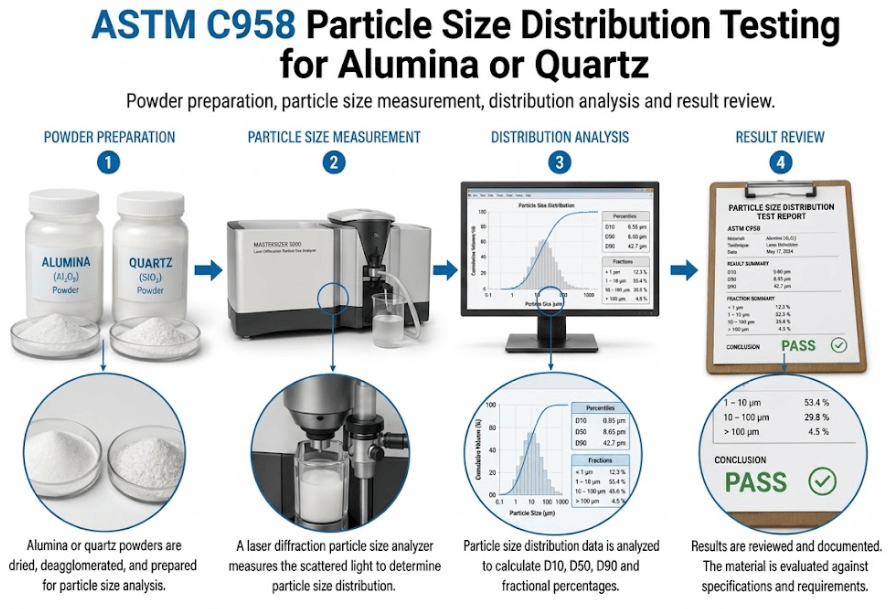
    The first step in testing is to select a representative sample of alumina or quartz powder. Analysts prepare the powder, disperse it in the required liquid, and then add the suspension to the sedimentation system. As the particles fall under gravity, the instrument detects changes in particle concentration. Analysts record measurements during the sedimentation period and process them to obtain the particle size distribution, following ASTM C958.

    The image shows laboratory X-ray sedimentation equipment used to analyze alumina or quartz powder to determine particle size distribution according to ASTM C958.
    ASTM C958 Particle Size Distribution Analysis of Alumina or Quartz

    Common Challenges and Troubleshooting

    A variety of factors, including particle agglomeration, dispersion issues, sample contamination, temperature variations, instrument calibration problems, and suspension stability, can influence particle size results. Proper sample dispersion, equipment calibration, controlled test conditions, and careful sample handling can improve repeatability.

    Analysis Results and Interpretation

    • The laboratory reports the particle size distribution (PSD) using the applicable particle-size units, typically µm (micrometers), together with the corresponding percentage (%) of particles or cumulative percentage within each size range.
    • The analyst evaluates the distribution of fine and coarse particles, with a greater proportion of smaller particles indicating a finer powder and a greater proportion of larger particles indicating a coarser powder.
    • The laboratory compares PSD results across production batches to determine whether consistent particle-size characteristics indicate stable raw-material and processing conditions.
    • Engineers compare the measured particle-size distribution with the applicable material specification and intended application requirements when selecting or evaluating the powder.

    FAQs

    What is ASTM C958 used for?

    Read more

    ASTM C958 determines the particle size distribution of alumina or quartz powders using an X-ray method to monitor gravity sedimentation.

    What is measured during ASTM C958 testing?

    The test measures particles’ settling behavior using X-rays to determine the particle size distribution of the powder being tested.

    Why is ASTM C958 important?

    ASTM C958 aids manufacturers in characterizing fine powders, comparing raw materials, controlling particle size consistency, optimizing formulations, and providing reliable production of ceramics and refractories.

    Link to ASTM C958

    FAQ

    Where can I get the astm c958 tested?
    You can share your astm c958 testing requirements with MaTestLab. MaTestLab has a vast network of material testing laboratories, spread across the USA and Canada. We support your all material testing needs ranging from specific astm c958 test to various testing techniques.
    Please contact us for a detailed quote for your astm c958 testing needs. Cost incurred to carry out different astm c958 testing methodology depends on the type of raw material; number of samples, coupons, or specimens; test conditions, turn around time etc. Costs of some ASTM testing methods start from $100 and the final value depends upon the factors listed above. Please contact us for the best and latest prices.
    The required number of samples or specimens should comply with the procedure given in the astm c958 standard. However, the MaTestLab operations team can assist you for your special requirements once you share your testing details with us.
    MaTestLab has a vast testing laboratory network, hence we bring you the best testing facilities in a cost-effective way. We offer considerable discounts (15-20%) to our returning customers based on test volume and frequency.
    The turnaround time for astm c958 test methodology depends upon the test procedure mentioned in the standard test document. However, we at MaTestLab understand your research requirements and hence try to get your test completed within the least possible time.
    Rohit Dhembare
    About Author
    Rohit Dhembare
    Rohit Dhembare is an Operations Associate at MaTestLab Inc. and holds a postgraduate degree in Organic Chemistry.
    Testimonials
    Real results
    Engineers trust us with what matters most
    Start Your Testing
    Project Today
    Define your requirements and get access to
    specialized laboratories ready to deliver results
    Partners with us
    Clients
    Vendors
    Process for testing
    • STEP 01

      You share your testing requirements

    • STEP 02

      You share your sample(s)

    • STEP 03

      We deliver your test reports

    Get your testing done

    Let us known your testing requirements and we will be right back with a solution.

      Let us root for each other. Collaborate to grow, expand, and accelerate our businesses.

      Partner with us

        Contact Us

        Discover more from MaTestLab

        Subscribe now to keep reading and get access to the full archive.

        Continue reading