
ASTM C949 Standard Test Method for Porosity in Vitreous Whitewares by Dye Penetration

    What is ASTM C949?

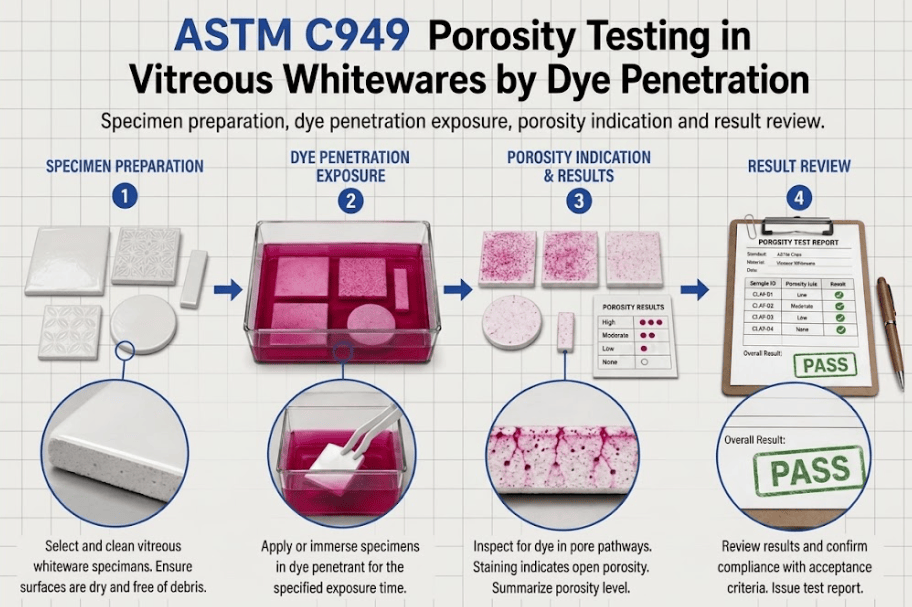
    ASTM C949 provides a standard method for determining the porosity of vitreous whiteware products by dye penetration. The method identifies pores open to the surface of the ceramic body and capable of letting liquids or other substances percolate into the body. Technicians prepare freshly broken, unglazed ceramic fragments and immerse them in a basic fuchsine dye solution. They then apply specified pressure conditions for a prescribed period, dry the specimens, and break them for inspection. The dye penetrates inaccessible pores, and examination of the areas it enters can determine whether penetration is occurring. ASTM C949 (Standard Test Method for Porosity in Vitreous Whitewares by Dye Penetration) is a methodical approach to finding surface-connected porosity, unlike a standard visual check. Manufacturers can use the results to assess firing quality, compare ceramic bodies, detect process variations, and support product quality control.

    Read more

    Get Certified ASTM C949 Testing for Reliable Ceramic Porosity Evaluation

    ASTM C949 is a standard test for detecting porosity in vitreous whiteware products by dye penetration. By evaluating their products in the lab, manufacturers can detect pores connected to the surface that could affect functionality, aesthetics, or liquid penetration. ASTM C949 testing supports quality assurance, material qualification, process optimization, and product development. Manufacturers can also use the results to investigate defects and check batch-to-batch consistency in ceramic manufacturing.

    What is the Scope of the ASTM C949 Test Standard?

    ASTM C949 provides a standardized procedure for determining the porosity of vitreous whiteware materials using dye penetration. This standard-

    Read more

    • Detects pores in vitreous whiteware ceramics.
    • Detects cracks and other voids that may occur within the ceramic body.
    • Identifies porosity associated with underfired ceramic ware.
    • Uses dye penetration to reveal defects within the ceramic.
    • Supports evaluation of whether ceramic ware has been properly fired and matured.
    • Helps assess whether dye penetration could affect the ceramic product’s usefulness or commercial quality.

    What are the Uses of ASTM C949 Testing?

    The ceramic manufacturing industry uses ASTM C949 to identify surface-connected porosity in vitreous whiteware products. The test provides valuable data on ceramic processing quality and whether a product has achieved sufficient density through firing or manufacturing.

    • Ceramic manufacturers can use dye penetration to evaluate the maturity of vitreous whiteware products.
    • Whiteware producers can detect pores and cracks that may affect product usefulness.
    • Quality control laboratories can inspect ceramic products for detectable internal voids.
    • Research laboratories can study the relationship between firing conditions and ceramic porosity.
    • Manufacturers can compare ceramic products based on the observed extent of dye penetration.
    • Production personnel can use the findings to support evaluation of firing quality.

    What Materials Can Be Tested Under ASTM C949?

    ASTM C949 covers vitreous whiteware materials and compatible dense ceramic products. These can be sanitaryware, tableware, laboratory ware, ceramic vessels, and other whiteware items where surface-related porosity needs to be assessed.

    Why is ASTM C949 Important for Ceramic Porosity Evaluation?

    ASTM C949 is a standard for determining the accessible porosity of vitreous whitewares. Reliable porosity evaluation helps manufacturers monitor firing conditions, track manufacturing defects, compare ceramic compositions, and ensure product quality. Controlling porosity can also improve resistance to liquid penetration and deliver the desired performance of the finished ceramic product.

    ASTM C949 Equipment and Sample Preparation Guide

    Good specimen preparation and a controlled dye application are important steps that can lead to good porosity evaluation. Surface cleanliness and repeatable testing conditions support accurate dye penetration.

    Read more

    Specimen DetailsFreshly broken, randomly selected, unglazed fragments of vitreous whiteware ceramics used for detecting pores, cracks, other voids, or porosity in underfired ware.
    Specimen PreparationTechnicians prepare freshly broken ceramic fragments with a smallest dimension of approximately 1/4 inch (6 mm) and a largest dimension of up to 3/4 inch (19 mm). At least 75% of the surface should remain free of glaze or other surface treatment.
    Specimen DimensionsThe test uses fragments approximately 1/4 inch (6 mm) to 3/4 inch (19 mm) in the specified dimensions, with at least 75% of the surface free from glaze or other treatment.
    InstrumentationThe apparatus includes a pressure vessel capable of applying and holding 10 000 psi (68.9 MPa), together with suitable equipment for preparing, drying, and inspecting the specimens.

    Testing Procedures and Requirements for Porosity Evaluation

    The controlled dye penetration technique in ASTM C949 exposes pores accessible on the surface of vitreous whiteware. Laboratories can achieve consistent results by using proper specimen preparation, dye application, exposure conditions, and inspection. ASTM C949testing process is as follows-

    Read more

    Specimen PreparationTechnicians randomly select freshly broken, unglazed fragments of vitreous whiteware ceramic within the specified dimensions.
    Sample ConditioningTechnicians prepare the specimens with the required exposed ceramic surface and ensure that at least 75% of the surface remains free of glaze or other treatment.
    Dye Penetration ProcedureTechnicians immerse the specimens in a solution containing 1 g of basic fuchsine dye dissolved in 1 L of 50% alcohol.
    Pressure ApplicationThe operator applies the specified pressure conditions for the required period to promote dye penetration into pores, cracks, and other voids.
    Specimen InspectionAfter the pressure exposure and drying, technicians break the specimens and inspect the extent of dye penetration into the ceramic body or defects.
    Data Collection and Result AnalysisEngineers document the following data: specimen identification, dimensions, surface condition, pressure condition, exposure time, dye penetration observation, and more. The observed dye penetration is analyzed to check for the presence of pores, cracks or other voids in the ceramic.
    Documentation and ReportingLaboratory reports contain the specimen identification, preparation details, testing solution, pressure conditions, exposure time, dye-penetration observations, and ASTM C949 test details.

    ASTM C949 Testing Process and Data Collection

    The testing process begins with selecting representative vitreous white ware samples and preparing clean surfaces. The technician applies the specified dye and maintains the required dye penetration conditions. They wash off excess dye, then examine the specimens to determine whether any dye penetrated. The laboratory records observations and evaluations of the results in accordance with ASTM C949.

    The image shows laboratory equipment and vitreous whiteware specimens undergoing dye penetration analysis to evaluate surface-connected porosity according to ASTM C949.
    ASTM C949 Dye Penetration Testing of Vitreous Whiteware

    Common Challenges and Troubleshooting

    Results can be impacted by surface contamination, dye under/over exposure, inadequate surface cleaning, improper specimen preparation, or inconsistent inspection. Repeatability is enhanced by careful handling of specimens, controlled application of dye, and careful examination of the specimens.

    Analysis Results and Interpretation

    • The laboratory reports the presence, absence, or degree of visible dye penetration, expressed as an observed penetration feature or rating according to the applicable evaluation requirements.
    • The analyst detects the dye in the visible holes as proof that the dye penetrated to accessible pores that are connected to the surface being tested.
    • Analysts determine consistency in the vitreous structure during firing and manufacturing processes under the assumption that both manufacturing and firing conditions are constant.
    • The analyst interprets lower or absent dye penetration as indicating fewer accessible surface-connected pores, while greater penetration indicates greater access to connected porosity.
    • The manufacturer compares the observed dye-penetration results with product specifications and intended use when evaluating the suitability of the ceramic product.

    Link to ASTM C949

    Read more

    FAQ

    What is ASTM C949 used for?
    ASTM C949 is used to test the porosity of vitreous whiteware products using controlled dye penetration.
    The test detects dye penetration into pores that communicate with the surface of a vitreous whiteware specimen.
    ASTM C949 assists the manufacturers of ceramic products in identifying accessible porosity, assessing the quality of the firing and processing, investigating defects, and ensuring the product is consistent.
    Malhar Khole
    About Author
    Malhar Khole
    Malhar Khole is a Material Testing Associate at MaTestLab Inc. and holds a postgraduate degree in Material Science and Technology from IIT (BHU), Varanasi.
    Testimonials
    Real results
    Engineers trust us with what matters most
    Start Your Testing
    Project Today
    Define your requirements and get access to
    specialized laboratories ready to deliver results
    Partners with us
    Clients
    Vendors
    Process for testing
    • STEP 01

      You share your testing requirements

    • STEP 02

      You share your sample(s)

    • STEP 03

      We deliver your test reports

    Get your testing done

    Let us known your testing requirements and we will be right back with a solution.

      Let us root for each other. Collaborate to grow, expand, and accelerate our businesses.

      Partner with us

        Contact Us

        Discover more from MaTestLab

        Subscribe now to keep reading and get access to the full archive.

        Continue reading