
ASTM C866 Standard Test Method for Filtration Rate of Ceramic Whiteware Clays

    What is ASTM C866?

    ASTM C866 describes a standard test method for the filtration rate of ceramic whiteware clays. This test determines the rate at which a clay-water paste layer forms from a clay-water slip under pressure filtration and provides data related to the filtration characteristics of the clay. Technicians prepare the clay-water slip according to the specified procedure and subject it to pressure filtration under controlled test conditions.  They determine the amount of filtrate obtained during a fixed period of time and compare the behavior of the clay by analyzing the collected data. ASTM C866 provides a standardized procedure for determining and comparing the filtration characteristics of ceramic whiteware clays under pressure filtration.  ASTM C866 (Standard Test Method for Filtration Rate of Ceramic Whiteware Clays) tests are used to give quantitative data on the filtering properties of ceramic whiteware clays by means of a controlled laboratory procedure.

    Read more

    Get Certified ASTM C866 Testing for Reliable Filtration Rate Evaluation

    ASTM C866 tests are used to give quantitative data on the filtering properties of ceramic whiteware clays by means of a controlled laboratory procedure. Laboratory testing helps manufacturers assess clay-processing performance, compare raw materials, and ensure consistent product quality. ASTM C866 testing can be applied to material qualification, process optimization, quality assurance, and product development. The findings help manufacturers evaluate variations in clay properties that affect water permeability through the clay-water paste layer and related whiteware processing operations.
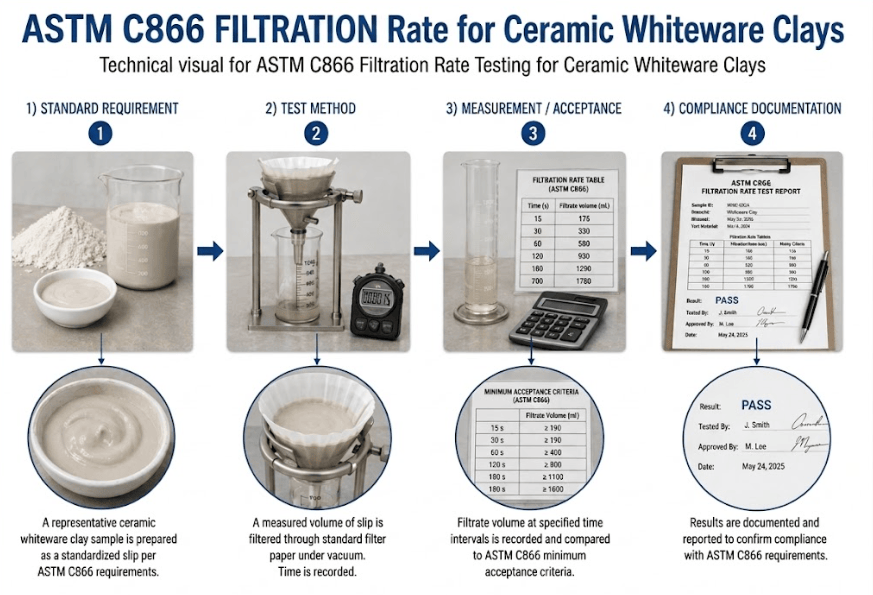

    What is the Scope of ASTM C866 Test Standard?

    ASTM C866 determines the rate at which a layer of clay-water paste forms from a clay-water slip under pressure filtration. This standard-

    Read more

    • Determines the filtering properties of ceramic whiteware clays.
    • Determines the filtration rate associated with the formation of a clay-water paste layer from a clay-water slip under pressure filtration. 
    • Supports comparison of filtration characteristics of ceramic whiteware clays relevant to filter pressing, slip casting, and ware drying. 
    • Assists in ceramic manufacturing process control.
    • Supports material qualification and quality assurance, and product development.

    What is the Use of ASTM C866 Testing?

    ASTM C866 helps ceramic manufacturers evaluate the filtration behavior of whiteware clay-water slips during pressure filtration and related processing operations. The test provides filtration data that can help manufacturers evaluate raw materials and control whiteware processing operations related to filter pressing, slip casting, and drying. Manufacturers can use the results to compare clay sources and track changes in processing behavior.

    • Ceramic manufacturers can use filtration-rate data to evaluate whiteware clay-processing characteristics. 
    • Sanitaryware producers assess clay materials used in forming operations.
    • Tableware manufacturers compare various whiteware clay formulations.
    • Research laboratories study how clay composition affects filtration.
    • Clay suppliers test clay batch consistency.
    • Quality control laboratories can use filtration-rate measurements to monitor relevant whiteware clay-processing characteristics. 

    What Materials Can Be Tested Under ASTM C866?

    ASTM C866 applies to ceramic whiteware clays prepared as clay-water slips for pressure-filtration testing. The method can provide filtration-rate data for ceramic whiteware clays used in applications such as sanitary ware, tableware, and other whiteware products.

    Why is ASTM C866 Important for Filtration Rate Evaluation?

    ASTM C866 offers a uniform method for studying the filtration properties of the clays used in the production of ceramic whiteware. Reliable filtration data can help manufacturers evaluate processing conditions for operations in which water permeability through a clay-water paste affects filter pressing, slip casting, and drying of ware.

    ASTM C866 Equipment and Sample Preparation Guide

    Representative clay-water slip samples and properly set up filtration equipment are important. Standardized sample preparation and standardized test conditions enhance the reliability of test results.

    Read more

    Specimen DetailsThe representative materials used in the production of whiteware products include ceramic whiteware clays, clay mixtures, and other appropriate ceramic raw materials.
    Specimen PreparationTechnicians carefully prepare and mix the clay samples for a uniform mixture. They eliminate unwanted material or contamination that may impact filtration.
    Specimen DimensionsASTM C866 evaluates a clay-water slip using a pressure-filtration apparatus rather than a conventional solid specimen with fixed dimensions
    InstrumentationThe test apparatus includes a pressure-filtration or filter-press assembly with the required filter components and measuring equipment for determining filter-cake dimensions, weight, and filtration time.

    Testing Procedures and Requirements for Filtration Rate Evaluation

    ASTM C866 is a pressure-filtration test method for determining the rate at which a clay-water paste layer forms from a clay-water slip. Engineers achieve reliable, comparable results through proper sample preparation, consistent conditions from one test to the next, and accurate filtrate measurements.

    Read more

    Specimen PreparationTechnicians collect representative ceramic whiteware clay and prepare the clay-water slip according to the specified test procedure.
    Sample ConditioningTechnicians prepare and condition the clay-water slip according to the specified test conditions before pressure filtration.
    Test Apparatus SetupTechnicians set up the pressure-filtration apparatus and verify that the measuring components operate properly before testing.
    Filtration ProcedureTechnicians prepare the clay-water slip, load it into the pressure-filtration apparatus, and apply the specified filtration conditions. The apparatus separates the liquid from the clay-water paste layer during pressure filtration.
    Filtrate CollectionThe operator collects the liquid passing through the filtration system during the designated test period and measures the collected filtrate using the appropriate laboratory equipment.
    Data CollectionEngineers record the specimen identification, clay-water slip condition, filtration time, applicable filtration conditions, filter-cake measurements, and other observations needed to calculate and report the test results.
    Result AnalysisAnalysts use the collected data to calculate the filtration rate of the ceramic whiteware clay according to ASTM C866.
    Documentation and ReportingLaboratory reports contain the specimen or clay-water slip, sample preparation, test conditions, filtration time, applicable filter-cake measurements, calculated filtration rate, equipment information, and ASTM C866 test details.

    ASTM C866 Testing Process and Data Collection

    The first step is to select an appropriate representative ceramic clay sample and prepare it for testing. Technicians prepare and mix the material prior to putting it into the filtering equipment. Technicians apply the specified pressure-filtration conditions and collect the liquid passing through the clay-water paste layer during the specified test period. Analysts use the applicable filtration measurements to calculate the filtration rate according to ASTM C866.

     The image shows laboratory filtration equipment evaluating the rate at which water passes through a prepared ceramic whiteware clay sample according to ASTM C866.
    ASTM C866 Pressure-Filtration Testing of Ceramic Whiteware Clay

    Common Challenges and Troubleshooting

    Inconsistent clay-water slip preparation, variations in solids-to-liquid ratio, unsuitable or clogged filter components, incorrect pressure-filtration conditions, timing errors, or measurement errors can affect results. Sample conditioning, clean equipment, correct filter media, correct measurements, and controlled testing conditions can enhance repeatability.

    Analysis Results and Interpretation

    • The laboratory reports the filtration rate in cm²/s, based on the measured wet filter-cake thickness and filtration time.
    • The analyst evaluates the filtration rate in relation to the applied pressure, void fraction, clay surface area, solids-to-liquid ratio, and water viscosity at the test temperature.
    • A higher filtration rate indicates faster liquid movement through the prepared clay material, while a lower rate indicates slower filtration under the specified conditions.
    • The laboratory compares filtration-rate results obtained under comparable test conditions to evaluate consistency in clay-processing characteristics.
    • Engineers compare the measured filtration rate with internal specifications and production requirements to assess the clay material’s suitability.

    Link to ASTM C866

    Read more

    FAQ

    What is ASTM C866 used for?
    This is used to determine the filtration rate of ceramic whiteware clays in a controlled laboratory environment and is known as ASTM C865.
    The test determines how much liquid flows through the prepared clay material over a designated time period, to assess its filtration properties.
    ASTM C866 is used by ceramic manufacturers to assess clay processing characteristics, to compare raw materials, to optimize dewatering conditions, and to assure production quality.
    Dr Ruchika Yogesh
    About Author
    Dr Ruchika Yogesh
    Dr. Ruchika Yogesh is an entrepreneur, science and AI/ML enthusiast, medicinal chemistry subject matter expert (SME), scientific/medical copyeditor, and an independent researcher.
    Testimonials
    Real results
    Engineers trust us with what matters most
    Start Your Testing
    Project Today
    Define your requirements and get access to
    specialized laboratories ready to deliver results
    Partners with us
    Clients
    Vendors
    Process for testing
    • STEP 01

      You share your testing requirements

    • STEP 02

      You share your sample(s)

    • STEP 03

      We deliver your test reports

    Get your testing done

    Let us known your testing requirements and we will be right back with a solution.

      Let us root for each other. Collaborate to grow, expand, and accelerate our businesses.

      Partner with us

        Contact Us

        Discover more from MaTestLab

        Subscribe now to keep reading and get access to the full archive.

        Continue reading