ASTM C721 Estimating Average Particle Size of Alumina and Silica Powders by Air Permeability

    What is ASTM C721?

    ASTM C721 is a standard test method for estimating the average particle size of alumina and silica powders from air permeability measurements. The technique is an indirect measurement of particle size, measuring the air resistance of a compacted powder sample under controlled conditions. A permeability cell is used to prepare a compact powder bed during testing. The instrument passes the air through the compacted powder bed under controlled conditions and captures the flow characteristics. The measured values are then expressed in terms of the specific surface area, and an approximate average particle size is calculated. ASTM C721 (Standard Test Methods for Estimating Average Particle Size of Alumina and Silica Powders by Air Permeability) offers objective, repeatable particle size measurements for assessing how consistent a powder is, finding the best processing conditions, or ensuring the material is of the correct quality before manufacturing, compared with visual inspection.

    Read more

    Get Certified ASTM C721 Testing for Reliable Particle Size Evaluation

    ASTM C721 estimates the average particle size of alumina and silica powders using the air permeability method. Accredited laboratories evaluate powder characteristics and provide data that help manufacturers assess material uniformity and customer specifications. Manufacturers use ASTM C721 testing for product qualification, quality control, research and development, manufacturing process evaluation, and material comparison. The results help manufacturers evaluate powder characteristics and optimize ceramic processing.

    ASTM C721 Equipment and Sample Preparation Guide

    To obtain accurate and repeatable particle size estimates, proper specimen preparation and calibrated laboratory equipment are essential.

    Specimen DetailsRepresentative specimens include alumina powder, silica powder, refractory powder, advanced ceramic powders, and other fine inorganic powders suitable for air permeability testing.
    Specimen PreparationTechnicians dry the powder as needed, remove contaminants as required, collect a representative sample, and compact it into the permeability cell.
    Specimen DimensionsASTM C721 evaluates a compacted powder bed rather than a solid specimen with fixed dimensions. Technicians prepare the powder bed according to the specimen mass and packing requirements specified in ASTM C721 to obtain proper airflow measurements.
    InstrumentationThe laboratory commonly uses the following instruments: Air permeability apparatus, Permeability cell, Manometers or pressure gauges, Vacuum source or air supply, Analytical balance, Timing device, Specimen compaction tools, Calibration standards, and Digital data acquisition equipment.

    What is the Scope of ASTM C721 Test Standard?

    ASTM C721 provides standard methods for determining the average particle size of alumina and silica powders by the air permeability method. This test standard-

    Read more

    • Estimates the average size of alumina and silica powders.
    • Measures the resistance to airflow of compacted powder beds.
    • Calculates specific surface area using standard calculations.
    • Assists with quality assurance and material qualification.
    • Supports compliance with engineering and manufacturing specifications.

    What are the Uses of ASTM C721 Testing?

    Manufacturers use ASTM C721 to estimate the average particle size of alumina and silica powders before processing. The test provides reliable particle size information, which is useful for raw material selection, manufacturing consistency, and quality assurance. It is also helpful in optimizing powder processing and the properties of ceramic products, for the benefit of the engineers. This test method is used by-

    • Ceramic manufacturers verify raw material consistency before production.
    • Refractory manufacturers evaluate powder characteristics for high-temperature applications.
    • Electronics manufacturers evaluate ceramic powders used in electronic components.
    • Research laboratories explore the effect of particle size on the performance of materials.
    • Product development teams optimize powder formulations to improve processing performance.
    • Quality control laboratories verify compliance with particle size specifications.

    What Materials Can Be Tested Under ASTM C721?

    ASTM C721 applies to alumina and silica powders and provides procedures for estimating their average particle size by the air permeability method, silica powders, refractory powders, advanced ceramic powders, ceramic oxides, electrical ceramic materials, fine inorganic powders, and other powders suitable for air permeability particle size evaluation.

    Why is ASTM C721 Important for Particle Size Evaluation?

    ASTM C721 is a reliable and standardized method for measuring the mean particle size of fine ceramic powders. Standardized testing enables manufacturers to assess the consistency of raw materials, to adjust the processing conditions for better product quality, to minimize manufacturing variability, and ensure product performance accuracy for ceramics.

    Common Challenges and Troubleshooting

    Non-uniform powder compaction, too much moisture in the powder, contamination, errors in equipment calibration, packing density variations, and changes in airflow conditions can cause inaccuracy in the test. Reliable and repeatable results are obtained by specimen preparation, routine instrument calibration, controlled testing conditions, and standardized procedures.

    ASTM C721 Testing Process and Data Collection

    The initial steps in testing involve taking a representative sample of powder and calibrating the air permeability equipment. First, the specimen is placed in a permeable cell and then controlled airflow is injected into the powder bed. The instrument is used to measure the flow properties, and the testing software or analyst uses the specific surface area to estimate the average particle size according to ASTM C721.

    Testing Procedures and Requirements for Average Particle Size Evaluation

    ASTM C721 provides laboratory methods for determining the average particle size by measuring air permeability. Testing conditions are controlled and generate accurate, repeatable, comparable results.

    Read more

    Specimen PreparationTechnicians collect a representative powder sample and remove any foreign matter or moisture that could interfere with airflow measurements. They process the specimen as per the given mass and packing requirement.
    Instrument CalibrationThe air permeability apparatus, pressure gauges, and timing devices are calibrated by the testing team prior to testing to ensure accurate measurement results.
    Powder CompactionThe packing density of the powder in the permeability cell can be adjusted to the desired value by compacting the powder, and the specimen thickness is uniform.
    Air Permeability MeasurementThe instrument passes air through the compacted powder bed under controlled conditions and measures the airflow characteristics required to estimate particle size.
    Data CollectionEngineers record the specimen identification, specimen mass, packing density, pressure readings, airflow readings, testing conditions, and equipment settings.
    Result AnalysisSpecialists calculate the specific surface area and estimate the average particle size from the measured air permeability data using the procedures specified in ASTM C721.
    Documentation and CertificationLaboratory reports are usually submitted with data on specimen identification, material type, specimen mass, air permeability data, calculated specific surface area, estimated average particle size, testing conditions, equipment information, and the applicable ASTM C721 test method used.
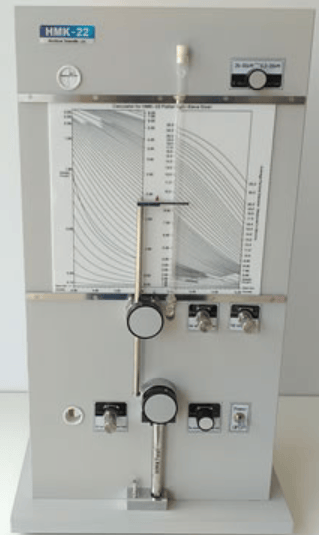
    The image shows a laboratory air permeability apparatus used to estimate the average particle size of alumina and silica powders according to ASTM C721.
    ASTM C721 Air Permeability Particle Size Testing Equipment

    Analysis Results and Interpretation

    • The test report gives the estimated average particle size in µm (micrometers).
    • The laboratory reports the estimated average particle size together with the calculated specific surface area and test conditions.
    • Because ASTM C721 estimates particle size indirectly from air permeability, the reported value represents an average equivalent particle size rather than the actual particle size distribution.
    • Specific surface area is expressed in either cm²/g or m²/kg depending on how and what it is being reported.
    • The higher the airflow resistance, the smaller the particle size, and the smaller the particle size, the greater the specific surface area.
    • The larger the particle size, the more airflow that can be obtained in the compacted specimen.
    • Consistent test results help manufacturers evaluate powder quality and manufacturing consistency.

    Link to ASTM C721

    Read more

    Updated on August 11, 2026

    Malhar Khole
    About Author
    Malhar Khole is a Material Testing Associate at Matestlab Inc. and holds a postgraduate degree in Material Science and Technology from IIT (BHU), Varanasi.
    Know More
    Testimonials
    Real results
    Engineers trust us with what matters most
    Start Your Testing
    Project Today
    Define your requirements and get access to
    specialized laboratories ready to deliver results
    Partners with us
    Clients
    Vendors
    Process for testing
    • STEP 01

      You share your testing requirements

    • STEP 02

      You share your sample(s)

    • STEP 03

      We deliver your test reports

    Get your testing done

    Let us know your testing requirements and we will be right back with a solution.

      Let us root for each other. Collaborate to grow, expand, and accelerate our businesses.

      Partner with us

        Discover more from Matestlab

        Subscribe now to keep reading and get access to the full archive.

        Continue reading