ASTM C424 Standard Test Method for Crazing Resistance of Fired Glazed Whitewares by Autoclave Treatment

    What is ASTM C424?

    ASTM C424 is a standard test method for determining the crazing resistance of fired glazed whitewares by autoclave treatment. It provides a laboratory method for determining whether fired glazed whitewares exhibit crazing after autoclave treatment under the conditions specified by the method. This approach increases the stress that can arise between the ceramic body and glaze during service. Manufacturers use these results to assess glaze quality, compare formulations, improve manufacturing processes, and guarantee long-term product durability.

    Read more

    Get Certified ASTM C424 Crazing Resistance Testing

    Manufacturers can evaluate the crazing resistance of fired glazed whitewares using ASTM C424 to support product quality and performance assessments. Manufacturers use ASTM C424 to determine glaze quality, optimize firing conditions, and ensure reliable performance in commercial and domestic uses.

    What is the scope of ASTM C424?

    ASTM C424 determines the crazing resistance of fired glazed whitewares using autoclave treatment under the conditions specified by the test method. The test accelerates stress that may develop between the ceramic body and glaze and helps manufacturers determine whether the glaze remains free from craze cracks after testing.

    Read more

    • Evaluates the crazing resistance of fired glazed whitewares. 
    • Uses saturated steam under pressure in an autoclave. 
    • Evaluates the tendency of fired glazed whitewares to develop crazing under the specified autoclave treatment conditions.
    • Evaluates durability of glazes under accelerated exposure. 
    • Supports quality control during ceramic manufacturing. 
    • Supports evaluation of glaze formulations and manufacturing processes.
    • Provides a standardized procedure for craze resistance testing.

    What are the Uses of ASTM C424 Testing?

    ASTM C424 evaluates the ability of fired glazed whitewares to resist crazing under the specified autoclave treatment conditions. The test can support product development, quality control, research and development, and evaluation of fired glazed whitewares.

    • Evaluates glaze durability. 
    • Identifies glaze defects prior to product release. 
    • Supports ceramic product quality control. 
    • Compares glaze formulations. 
    • Optimizes firing processes. 
    • Verifies product performance. 
    • Helps manufacturers identify susceptibility to crazing and reduce the risk of crazing-related product issues.

    Which Materials Can Be Tested Under ASTM C424?

    ASTM C424 is suitable for fired whiteware, such as ceramic tableware, sanitary ware, houseware, decorative ceramic products, and other glazed whiteware products.

    Why is ASTM C424 Important?

    ASTM C424 tests the durability of glaze before product marketing. The test helps manufacturers improve glaze formulations, optimize production processes, reduce product failures, and ensure long-term appearance and performance.

    Common Challenges and Troubleshooting

    Accurate results of crazing resistance testing are obtained by clean specimens, careful inspection, and proper operation of the autoclave. Surface contamination, pressure control issues, insufficient exposure time, non-uniform heating, and inadequate lighting to inspect are common problems. Standard procedures, calibrated equipment, and controlled lighting of specimens are used to improve repeatability.

    ASTM C424 Equipment and Sample Preparation Guide

    Accurate evaluation of crazing resistance is obtained by proper specimen preparation and controlled autoclaving conditions. The technician tests representative glazed ceramic samples, cleans the surfaces, and places the samples in saturated steam at a controlled pressure and temperature. Glaze crazing is detected through close visual examination following testing by technicians.

    Read more

    Sample and Specimen DetailsTechnicians choose representative fired whiteware specimens, with finished glazed surfaces, for evaluation.
    Specimen PreparationTechnicians thoroughly clean the glazed surfaces and check for surface defects before the autoclave process.
    Specimen DimensionsTechnicians use finished ceramic products or representative ceramic specimens that meet the requirements of ASTM C424.
    Instrumentation Autoclave, Pressure Gauge, Temperature Indicator, Specimen Rack, Magnifying Glass or Optical Inspection Device, Timer, and Inspection Lighting.

    Testing Procedures and Requirements for ASTM C424

    ASTM C424 measures glaze resistance by placing fired glazed ceramic specimens in saturated steam under controlled conditions in an autoclave. Technicians place the specimens under the desired autoclave conditions, remove them from the autoclave and check for crazing on the surfaces. The results are repeatable if the specimen is prepared, pressure controlled, exposed to light for a specific time, and carefully examined.

    Read more

    Specimen InspectionLaboratories inspect and clean the glazed specimens to ensure that no visible defects or contamination are present on the surfaces.
    Autoclave TreatmentTechnicians place the specimens inside the autoclave and expose them to saturated steam under the conditions specified in ASTM C424.
    Cooling and Examination and Result EvaluationTechnicians remove the specimens after the specified treatment period, cool them safely, examine the glazed surfaces for crazing, and document the observations and applicable autoclave conditions.

    ASTM C424 Testing Process and Data Collection

    Operators select representative fired whiteware specimens and examine the glazed surface for visible defects before testing. Technicians place the specimens in an autoclave and expose them to saturated steam under the specified conditions for the required exposure period. They examine all glazed surfaces after cooling and record the observations. The laboratory notes the specimen identification, autoclave conditions, exposure time, and the presence or absence of craze cracks.

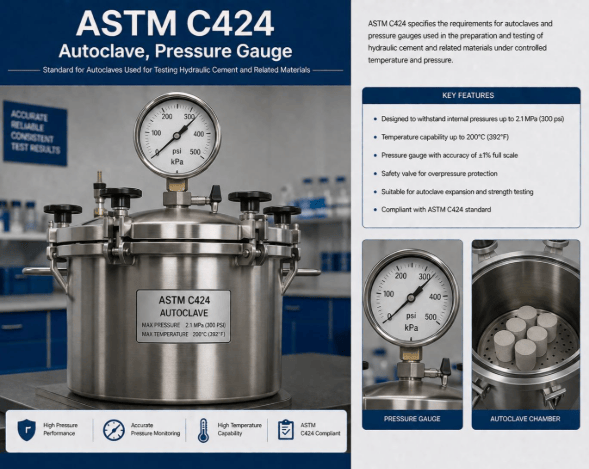
    This image shows an autoclave equipped with a pressure gauge used for ASTM C424 crazing resistance testing of fired glazed whitewares.
    ASTM C424 Autoclave with Pressure Gauge

    Analysis Results and Interpretation

    • ASTM C424 tests the crazing resistance of fired whitewares. 
    • Laboratories report the presence or absence of crazing together with the applicable autoclave conditions and visual examination observations.
    • The absence of crazing after the specified treatment indicates resistance to crazing under the test conditions.

    Link to ASTM C424

    Read more

    FAQ

    Where can I get the astm c424 tested?
    You can share your astm c424 testing requirements with MaTestLab. MaTestLab has a vast network of material testing laboratories, spread across the USA and Canada. We support your all material testing needs ranging from specific astm c424 test to various testing techniques.
    Please contact us for a detailed quote for your astm c424 testing needs. Cost incurred to carry out different astm c424 testing methodology depends on the type of raw material; number of samples, coupons, or specimens; test conditions, turn around time etc. Costs of some ASTM testing methods start from $100 and the final value depends upon the factors listed above. Please contact us for the best and latest prices.
    The required number of samples or specimens should comply with the procedure given in the astm c424 standard. However, the MaTestLab operations team can assist you for your special requirements once you share your testing details with us.
    MaTestLab has a vast testing laboratory network, hence we bring you the best testing facilities in a cost-effective way. We offer considerable discounts (15-20%) to our returning customers based on test volume and frequency.
    The turnaround time for astm c424 test methodology depends upon the test procedure mentioned in the standard test document. However, we at MaTestLab understand your research requirements and hence try to get your test completed within the least possible time.
    Malhar Khole
    About Author
    Malhar Khole
    Malhar Khole is a Material Testing Associate at MaTestLab Inc. and holds a postgraduate degree in Material Science and Technology from IIT (BHU), Varanasi.
    Testimonials
    Real results
    Engineers trust us with what matters most
    Start Your Testing
    Project Today
    Define your requirements and get access to
    specialized laboratories ready to deliver results
    Partners with us
    Clients
    Vendors
    Process for testing
    • STEP 01

      You share your testing requirements

    • STEP 02

      You share your sample(s)

    • STEP 03

      We deliver your test reports

    Get your testing done

    Let us known your testing requirements and we will be right back with a solution.

      Let us root for each other. Collaborate to grow, expand, and accelerate our businesses.

      Partner with us

        Contact Us

        Discover more from MaTestLab

        Subscribe now to keep reading and get access to the full archive.

        Continue reading