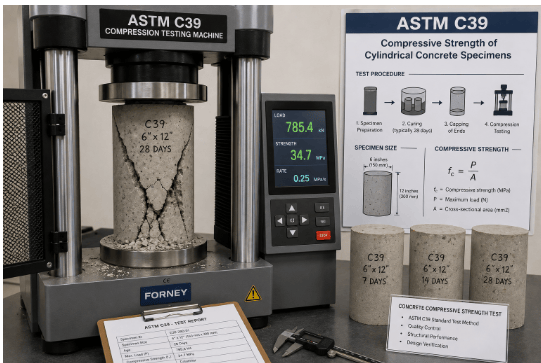
ASTM C39 Compressive Strength of Cylindrical Concrete Specimens
ASTM C39 is a standard test method for determining the compressive strength of cylindrical concrete specimens by applying a continuously increasing axial compressive load at the specified rate until failure. One of the most widely used tests for assessing the quality of concrete in construction projects, ASTM C39 determines the compressive strength of hardened concrete by measuring the maximum load the specimen can withstand before failure. ASTM C39 offers reliable and reproducible compressive strength tests that help with quality control, structural design, material certification, and compliance.
Read More
GET STARTED
What is ASTM C39?
ASTM C39 is a standard laboratory test method that is developed to measure the compressive strength of cylindrical concrete specimens. In the test, a concrete cylinder is loaded under compression in a compression testing machine set to deliver a continuous loading force that is applied until the cylinder shatters. The ultimate load that the specimen can bear is divided by the cross-sectional area of the specimen to obtain its compressive strength.
Compressive strength is one of the most critical mechanical properties of concrete, which directly influences the ability of concrete to carry the loads of the structure. Concrete companies, civil engineering laboratories, concrete producers, and quality assurance organizations use ASTM C39 to verify that concrete meets project specifications and design requirements.
Service Name
Remarks
ASTM C339 Testing
Contact US
Get Certified ASTM C39 Testing for Reliable Concrete Strength Evaluation
Testing in accordance with ASTM C39 helps verify the compressive strength of concrete for quality control, construction acceptance, structural design verification, and compliance with applicable project specifications and regulatory requirements. Concrete specimens tested in accordance with ASTM C39 have been evaluated using the standardized compressive strength testing procedure described in the standard.
ASTM C39 Equipment and Sample Preparation Guide
To obtain true compressive strength measurements, representative concrete samples and standard preparation procedures are crucial. Reliable and repeatable laboratory results are provided by well-prepared specimens and calibrated testing equipment.
Specimen Details
Representative specimens are cylindrical concrete specimens made from freshly mixed concrete for evaluation and quality testing of the structure.
Specimen Preparation
Technicians prepare concrete according to the specified mix design, place it in cylindrical molds in layers, consolidate by rodding or vibration as appropriate, cure it under specified conditions, and test it at the required age.
Specimen Dimensions
Test specimens are usually 150 mm x 300 mm (6 in x 12 in), but 100 mm x 200 mm (4 in x 8 in) cylinders may be used, as specified by project requirements.
Instrumentation
ASTM C39 testing requires a calibrated compression testing machine, specimen capping or end-grinding equipment (where applicable), measuring devices, and properly prepared cylindrical concrete specimens. Cylindrical molds, tamping rods, and vibrating equipment are used during specimen preparation in accordance with ASTM C31 or ASTM C192 rather than during ASTM C39 testing itself.
Testing Procedures and Requirements for Compressive Strength of Cylindrical Concrete Specimens
ASTM C39 is a test procedure that measures the strength of hardened concrete cylinders under axial compression. There are standardized laboratory procedures that provide reliable, repeatable, and comparable strength measurements of concrete. The testing process consists of the following:
Specimen Preparation
Technicians use standardized molds to cast fresh concrete in standardized ways and consolidate and vibrate the concrete in a standard manner to form uniform test specimens.
Curing and Surface Preparation
Technicians cure the molded specimens under specified temperature and moisture conditions until the designated test age, such as 7, 14, or 28 days, or another age specified by the project requirements. Technicians cap the specimen ends with capping materials or grind them to ensure smooth and parallel end surfaces for even load distribution.
Machine Setup and Compression Testing
Technicians place the cylinder at the center of the calibrated compression testing machine to ensure that the machine applies the load uniformly along the length of the cylinder. Technicians gradually increase the compressive load at the prescribed loading rate until the concrete specimen fails.
Strength Calculation
Analysts calculate the compressive strength of the concrete by dividing the maximum applied load by the cross-sectional area of the specimen.
Documentation and Reporting
Contains compressive strength, specimen size, curing conditions, failure properties, and compliance with ASTM C39 in laboratory reports.
ASTM C39 Testing Process and Data Collection
Testing starts with casting samples of concrete in the form of representative concrete cylinders and curing these in standard laboratory conditions. The dimensions are taken, and bearing surfaces are prepared for uniformity before testing. Specimens are each placed at the center of a calibrated compression testing machine, under a steadily increasing axial load applied until the specimen fails. The maximum load, the compressive strength, specimen dimensions, curing age, failure mode, loading rate, and environment will be recorded and documented to meet the ASTM C39 requirements, which help in standardized reporting and reliable material evaluation.
ASTM C39 is a standard that specifies the methods for obtaining compressive strength of a cylindrical specimen of concrete by testing it under compression. The standard offers uniform ways to assess the quality of concrete, structural performance, and compliance with engineering requirements. The scope includes:
Measures the compressive strength of cylindrical concrete specimens.
Carries out evaluation of hardened concrete in structural applications.
Determines the maximum compressive load sustained by the specimen and calculates its compressive strength.
Assists with quality control and material verification on construction sites.
Applies to concrete used in buildings, bridges, roads, dams, and infrastructure.
Establishes a common basis for strength comparisons between concrete in different laboratories and construction projects.
What are the Uses of ASTM C39 Testing?
ASTM C39 testing enables engineers, contractors, concrete producers, and quality control laboratories to verify that hardened concrete meets specified compressive strength requirements for structural applications. The results can be used for construction quality assurance, material acceptance, structural design verification, and regulatory compliance. Common applications include:
ASTM C39 testing is used to verify that hardened concrete specimens achieve the specified compressive strength for structural and non-structural applications such as buildings, bridges, highways, and other infrastructure projects. This is to make sure that the structure is safe and will perform well over time.
Concrete manufacturers regularly conduct ASTM C39 testing as a quality control measure to ensure consistency in the mix and to ensure that the concrete meets engineering requirements. The consistency of the results from regular testing reduces the variation in production lots.
ASTM C39 is used in civil engineering laboratories to test new concrete mixtures, supplementary cementitious materials, and admixtures for research and development. Reliable strength comparisons can be obtained by using the standardized testing.
Compressive strength results obtained using ASTM C39 may be used, when specified by project requirements, to support decisions regarding formwork removal, post-tensioning, or placing structures into service. Correct testing allows for efficient scheduling of projects while staying safe.
ASTM C39 testing is used to ensure concrete quality for government structures, infrastructure, highways, tunnels, airports, dams, and public infrastructure. Standardized testing is one of the tools that can help with regulatory requirements and quality assurance of construction.
What Materials Can Be Tested Under ASTM C39?
ASTM C39 is a standard that is mainly used for hardened concrete produced as cylinders. It is a widely adopted method for normal-weight concrete, lightweight concrete, high-strength concrete, fiber-reinforced concrete, self-consolidating concrete (SCC), roller-compacted concrete (RCC), and various other cementitious materials used in the construction of structures. ASTM C39 is intended for cylindrical concrete specimens. Mortar and grout are generally tested using other ASTM standards specifically developed for those materials.
Why is ASTM C39 Important for Concrete Construction?
ASTM C39 is a standard test that is used to determine the compressive strength of hardened concrete and has become one of the most important parameters in structural engineering. Engineers use reliable compressive strength data to ensure structural safety, improve concrete mix design, ensure construction quality, meet building codes, and minimize the risk of structural failure. Standard testing is another benefit that allows for meaningful comparisons between various concrete mixtures, production batches, and construction projects.
Common Challenges and Troubleshooting
Improper specimen preparation, inadequate curing, uneven specimen ends, incorrect machine alignment, loading rate deviations, equipment calibration errors, and/or operator inconsistencies may result in an inaccurate ASTM C39 test result. Accurate, repeatable, and reliable compressive strength measurements are made through standardized specimen preparation, controlled specimen curing, regular calibration of compressive testing equipment, proper alignment, and trained laboratory personnel.

Analysis Results and Interpretation
The results of the tests are presented as the compression strength of the concrete specimen, usually in megapascals (MPa) or in pounds per square inch (psi).
The compressive strength is the maximum load a concrete cylinder can withstand divided by the cross-sectional area of the cylinder.
In general, the higher the compressive strength, the stronger and better the concrete quality.
Failure patterns are examined to identify unusual specimen behavior or possible testing issues that may have affected the validity of the test results.
The results are compared with project specifications, design requirements, and applicable acceptance criteria to determine whether the concrete meets the required compressive strength.
What are the Factors to Consider for ASTM C39 Testing?
Speed: It takes time to cure specimens, but the compression test itself will only take a few minutes when the concrete has been cured to the specified testing age.
Expertise: The laboratory staff must be competent in the preparation of specimens, maintenance of curing conditions, operation of compression testing equipment, and accurate interpretation of compressive strength results.
Cost: ASTM C39 uses standard concrete testing equipment and offers valuable data to help optimize construction projects, minimize construction risks, and minimize costly project failures.
Malhar Khole is a Material Testing Associate at MaTestLab Inc. and holds a postgraduate degree in Material Science and Technology from IIT...
FAQ's
Where can I get the astm c39 tested?
You can share your astm c39 testing requirements with MaTestLab. MaTestLab has a vast network of material testing laboratories, spread across the USA and Canada. We support your all material testing needs ranging from specific astm c39 test to various testing techniques.
How much do I need to pay for the astm c39 test?
Please contact us for a detailed quote for your astm c39 testing needs. Cost incurred to carry out different astm c39 testing methodology depends on the type of raw material; number of samples, coupons, or specimens; test conditions, turn around time etc. Costs of some ASTM testing methods start from $100 and the final value depends upon the factors listed above. Please contact us for the best and latest prices.
How many samples are required for astm c39?
The required number of samples or specimens should comply with the procedure given in the astm c39 standard. However, the MaTestLab operations team can assist you for your special requirements once you share your testing details with us.
How much discount can I get on the astm c39 test?
MaTestLab has a vast testing laboratory network, hence we bring you the best testing facilities in a cost-effective way. We offer considerable discounts (15-20%) to our returning customers based on test volume and frequency.
How many days will it take to complete the astm c39 test?
The turnaround time for astm c39 test methodology depends upon the test procedure mentioned in the standard test document. However, we at MaTestLab understand your research requirements and hence try to get your test completed within the least possible time.
Where can I get the astm c39 tested?
You can share your astm c39 testing requirements with MaTestLab. MaTestLab has a vast network of material testing laboratories, spread across the USA and Canada. We support your all material testing needs ranging from specific astm c39 test to various testing techniques.
MaTestLab Inc. offers accessible, quick, and affordable material testing, product testing, and failure analysis services. We support your on-demand testing and expert consultation needs with the help of our extensive network of material testing laboratories situated in the US and other parts of the world.
MATERIAL TESTING
We offer destructive and non-destructive tests over a range of mechanical, electrical, chemical, thermal, optical, corrosion, radiation, and biological testing methodologies defined by ASTM, ISO and other organizations.
PRODUCT TESTING
We help you evaluate and ensure your product quality and performance with standard and custom-made testing solutions. All the tests are done at well-equipped testing laboratories using standard testing methods for best output and satisfaction.
FAILURE ANALYSIS
Failure analysis ensures high levels of quality in every manufacturing process. We help you with getting the best failure or root cause analysis to determine the cause of the failure. The results help you identify means to prevent failure recurrences.