ASTM C324 Standard Test Method for Free Moisture in Ceramic Whiteware Clays

    What is ASTM C324?

    ASTM C324 is the established method for determining free moisture in ceramic whiteware clays. Free moisture is the water that dries out without changing the chemical constituents of the clay. This moisture measurement is useful to the manufacturer to ensure consistent raw material quality and to make ceramic processing more efficient. ASTM C324 is useful to ceramic producers, raw materials suppliers, testing laboratories, and research organizations to check the quality of materials received, batch-to-batch comparisons of clay, optimize drying operations, and to optimize production quality.

    Read more

    Get Certified ASTM C324 Moisture Testing for Ceramic Whiteware Clays

    The high moisture content of clay has a significant effect on handling, mixing, drying, forming, and firing. ASTM C324 testing helps manufacturers control the moisture content, minimize processing variation, increase productivity, and ensure a consistent quality for ceramic whiteware.

    ASTM C324 Equipment and Sample Preparation

    A sample is taken that represents the container, measured for its initial mass, dried under controlled laboratory conditions, and the mass of the moisture removed is calculated based on the mass change.

    Sample DetailsCeramic whiteware clays including kaolin, ball clay, china clay, fire clay, and blended ceramic raw materials used for whiteware production.
    Sample PreparationAnalysts collect a representative clay sample, mix thoroughly to obtain uniform moisture distribution, place the specimen in a clean moisture container, determine the initial mass, and prepare it for controlled drying.
    Sample ConfigurationAnalysts test a representative moist clay specimen under controlled laboratory drying conditions until constant mass or the specified drying requirement is achieved.
    InstrumentationLaboratory drying oven, analytical balance, moisture dishes or weighing containers, desiccator, laboratory tongs, thermometer or temperature controller, and computerized weighing or laboratory recording system.

    What is the Scope of ASTM C324?

    ASTM C324 defines the test used to measure free moisture in whiteware ceramics in the manufacturing process. This method allows companies to monitor moisture fluctuations for quality control and to maintain a consistent production process. This test standard-

    Read more

    • Determines the free moisture content of ceramic whiteware clays. 
    • Evaluates the moisture condition of raw materials before processing. 
    • Supports raw material qualification and manufacturing quality control. 
    • Compares moisture levels between different clay sources and production batches. 
    • Assists with ceramic processing, storage, and product development. 
    • Provides standardized moisture data for whiteware manufacturing. 

    What are the Applications of ASTM C324 Testing?

    ASTM C324 is an established method for determining free moisture in ceramic whiteware clays. The results verify the raw material inspection, production control, moisture management, and quality assurance process in ceramic production.

    • Determines the free moisture content of ceramic whiteware clays. 
    • Supports quality control of incoming ceramic raw materials. 
    • Assists moisture control during storage, handling, and processing. 
    • Compares moisture levels among different clay sources and production batches. 
    • Supports ceramic formulation, manufacturing optimization, and research. 
    • Provides moisture data for porcelain, sanitary ware, tableware, electrical ceramics, and other whiteware products. 

    What is Free Moisture in Ceramic Whiteware Clays?

    Free moisture is the water that is present in ceramic whiteware clays that can be removed from the clay without changing the chemistry under laboratory conditions. It has an impact on handling, storage, mixing, forming, drying, and processing of ceramic raw materials. ASTM C324 provides a standard method for accurately measuring this moisture that can be removed.

    Why is ASTM C324 Testing Important?

    The dew point moisture content of the ceramic clays can affect the consistency and the quality of product manufacturing. A too-high or too-low water content may cause poor workability; uneven and irregular drying, resulting in cracking and shrinkage; and operational problems. ASTM C324 allows manufacturers to measure the moisture content, ensure raw material quality, optimize the manufacturing process, enhance the quality of products, and reduce manufacturing defects.

    What Materials Can Be Tested According to ASTM C324?

    ASTM C324 applies to all ceramic whiteware clay products: kaolin (china clay), ball clay, fire clay, a blend of ceramic body clays, and all other clays used in the production of porcelain, sanitary ware, tableware, electrical porcelain, and ceramic tiles.

    How Does ASTM C324 Determine Free Moisture in Ceramic Whiteware Clays?

    ASTM C324 is used to determine the free moisture content in a representative clay sample by weighing the clay before and after a controlled laboratory drying procedure. A laboratory drying oven is used to remove removable moisture without changing the clay minerals, and the mass difference is used to determine the free moisture content by mass. The method measures the initial and final sample weights, drying conditions, drying temperature, and drying time, and calculates the percentage of moisture, providing reliable data for quality control and process optimization.

    Common Challenges and Troubleshooting

    Many factors can impact the accuracy of a test, including improper sample collection, moisture loss before testing, uneven drying, contamination of weighing containers, balance calibration error, and incomplete drying. Laboratories control the problems by taking representative samples, using calibrated balances, setting up controlled conditions for drying samples, and using a desiccator to cool samples before final weighing.

    Testing Procedures and Requirements

    ASTM C324 measures the free moisture content by taking the weight of a representative sample of clay before and after drying under controlled laboratory conditions. The difference in mass is the amount of free moisture that could be removed from the sample and is reported as a percentage of the sample mass.

    Read more

    Sample Preparation and Initial WeighingAnalysts obtain a representative ceramic whiteware clay sample for testing and measure the initial mass of the moist specimen.
    Controlled Drying and Final WeighingAnalysts dry the specimen under specified laboratory conditions until the required endpoint is reached and measure the mass after drying.
    Moisture Calculation and Result AnalysisAnalysts calculate the free moisture content as a percentage of the original sample mass, and evaluate moisture content for quality control and process optimization.

    ASTM C324 Testing Process and Data Collection

    Analysts dry the specimen in a controlled laboratory oven until it reaches the specified endpoint, cool it in a desiccator, and reweigh it. Finally, they calculate and record the free moisture content (%), initial sample weight, final dry weight, drying temperature, and drying time to support quality assessment and reporting.

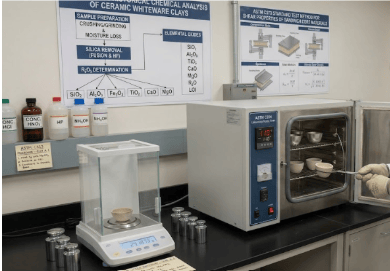
    This image shows a laboratory drying oven and analytical balance used to determine the free moisture content of ceramic whiteware clays according to ASTM C324.
    ASTM C324 Laboratory Drying Oven and Analytical Balance

    Analysis Results and Interpretation

    • Gives free moisture content, initial mass, final dry mass, and total moisture loss of the sample in the controlled drying. 
    • Determines the moisture status, manipulative qualities, and acceptability of ceramic whiteware clays. 
    • Compares moisture levels in various clay sources, suppliers, storage areas, and clay production batches to guarantee the consistency of the raw material. 
    • Enables raw material qualification, quality control, moisture management, manufacturing optimization, ceramic process development, etc. 

    Direct Link to ASTM C324

    Read more

    Updated on August 13, 2026

    Rohit Dhembare
    About Author
    Rohit Dhembare is an Operations Associate at Matestlab Inc., holds a postgraduate degree in Organic Chemistry and is trained in Materials Science testing techniques.
    Know More
    Testimonials
    Real results
    Engineers trust us with what matters most
    Why Choose Matestlab?
    Matestlab is a unified testing services partner based in the USA. Matestlab offers raw material and product testing services through accredited, expert laboratories primarily based in the USA. Matestlab supports physical, thermal, chemical, electrical, mechanical, environmental, and characterization testing needs through its global network of 2200+ accredited testing laboratories. Matestlab's in-house materials science experts curate and design comprehensive testing programs matched to the sample material and specific testing need, with regulatory requirements and confidentiality in mind.

    If you are looking for a managed and trusted testing partner to achieve your research goals, feel free to schedule a meeting with us or send us a request at connect@matestlabs.com to learn more about our services. For a quick quote, call us at (302)244-7710. We are happy to serve you.
    Start Your Testing
    Project Today
    Define your requirements and get access to
    specialized laboratories ready to deliver results
    Partners with us
    Clients
    Vendors
    Process for testing
    • STEP 01

      You share your testing requirements

    • STEP 02

      You share your sample(s)

    • STEP 03

      We deliver your test reports

    Get your testing done

    Let us know your testing requirements and we will be right back with a solution.

      Let us root for each other. Collaborate to grow, expand, and accelerate our businesses.

      Partner with us