
ASTM C323 was a standard test method for the chemical analysis of the clays used for making whiteware ceramics. The procedures determined the chemical constituents of ceramic whiteware clays that could be used to evaluate raw materials and compare their chemical compositions. ASTM C323 provided standardized chemical analysis procedures that could be used to characterize ceramic whiteware clays and support referee analyses and comparison of material compositions. Analysts use the historical analytical procedures to interpret legacy data and older material specifications.
ASTM C323 Standard Test Method for Chemical Analysis of Ceramic Whiteware Clays
What is ASTM C323?
What is the scope of ASTM C323?
ASTM C323 offered specific test techniques for analysis of the chemical composition of clays for the production of porcelain, sanitary ware, electrical porcelain, and other whiteware products. The method was used to assess the principal oxide components that affect firing performance, product quality, and production repeatability. The standard ceased to be in effect in 2024 but is useful for understanding past test data and older material specifications.
- Determines the chemical composition of ceramic whiteware clays.
- Evaluates the major oxide constituents affecting ceramic performance.
- Supports raw material qualification and quality control.
- Compares the chemical composition of clay deposits and production batches.
- Assists with ceramic formulation, research, and product development.
- Provides historical analytical procedures that can support interpretation of legacy chemical analysis data.
What are the Applications of ASTM C323 Testing?
ASTM C323 provides analytical procedures for determining the chemical composition of clays used in ceramic whiteware manufacturing. Analytical data assist manufacturers in controlling raw material quality, formulating, and ensuring the consistent manufacturing of whiteware products.
- Determines the chemical composition of ceramic whiteware clays.
- Supports quality control of ceramic raw materials.
- Assists in the qualification of clay deposits and incoming raw materials.
- Compares the composition of different clay sources and production batches.
- Supports ceramic formulation, research, and product development.
- Provides analytical data for evaluating clays used in ceramic whiteware manufacturing.
What is Chemical Analysis of Ceramic Whiteware Clays?
Chemical analysis of ceramic whiteware clays determines the percentage composition of specified chemical constituents in the clay. These factors affect properties such as firing temperature, color, shrinkage, refractoriness, strength, and vitrification. ASTM C323 provided standardized analytical procedures for determining specified constituents in ceramic whiteware clays before ASTM withdrew the standard in 2024.
Why was ASTM C323 Testing Important?
Manufacturing consistency and product quality of ceramic products are directly related to the chemical composition of ceramic clays. The use of ASTM C323 allowed manufacturers to verify the quality of the raw materials, select clay suppliers, formulate and optimize ceramic bodies, and produce a uniform output of porcelain, sanitary ware, and other whiteware products. The standard is no longer in force, but the test procedures outlined in the standard are still relevant to existing quality data and legacy standards.
What Materials Could Be Tested According to ASTM C323?
ASTM C323 is advantageous for the use of the ceramic whiteware industry, which is the term used for the manufacture of the following: China ware and porcelain, sanitary ware, tableware, electrical porcelain and structural whiteware, which consists of kaolin (China clay), ball clay, fire clay, blended ceramic body clays, or other natural or processed clays.
How Did ASTM C323 Determine the Chemical Composition of Ceramic Whiteware Clays?
ASTM C323 specified classical analytical procedures for determining the chemical composition of ceramic whiteware clays. Analysts determined moisture on the air-dried sample and determined the other percentage compositions on a moisture-free basis. The method determines the loss on ignition (LOI), silica (SiO₂), alumina (Al₂O₃), iron oxide (Fe₂O₃), titanium dioxide (TiO₂), calcium oxide (CaO), magnesium oxide (MgO), sodium oxide (Na₂O), potassium oxide (K₂O), and other constituents.
Common Challenges and Troubleshooting
Moisture contamination, incomplete sample homogenization, weighing errors, reagent impurities, sample contamination during preparation, and incorrect furnace or titration temperatures can affect the accuracy of the analysis. Laboratories can minimize these problems by using representative samples, calibrated analytical equipment, high-purity reagents, and standardized laboratory procedures.
Analysis Results and Interpretation
- The analytical procedures provide results for moisture, loss on ignition, silica, iron oxide, titania, alumina, lime, magnesia, and alkalies with the percentage compositions reported on a moisture-free basis where applicable.
- Analysts can use chemical composition results to compare clay deposits, raw materials, and production samples.
- The analytical results can support raw-material characterization, ceramic formulation studies, manufacturing investigations, and interpretation of historical chemical composition data.
- Qualifies raw materials, supervises their quality, composes ceramic formulation material, enhances manufacturing, visualizes historic data, and conducts investigations with ceramic whiteware clays.
ASTM C323 Equipment and Sample Preparation
Representative clay samples, well-prepared laboratory samples, and calibrated analytical equipment are necessary for an accurate chemical analysis. Technicians prepare representative clay samples and perform the applicable analytical procedures according to the requirements of the historical ASTM C323 method.
| Sample Details | Ceramic whiteware clays, including kaolin, ball clay, china clay, fire clay, and blended ceramic raw materials intended for whiteware production. |
| Sample Preparation | Analysts collect a representative sample, dry the material to the required condition, grind and homogenize the sample, determine moisture content, and prepare test portions for chemical analysis according to laboratory procedures. |
| Sample Configuration | Analysts finely ground, homogeneous ceramic clay sample prepared for moisture determination, loss on ignition, and chemical oxide analysis. |
| Instrumentation | Analytical balance, laboratory drying oven, muffle furnace, desiccator, filtration apparatus, volumetric flasks, burettes, pipettes, crucibles, digestion equipment, chemical reagents, and standard laboratory glassware for wet chemical analysis. |
Testing Procedures and Requirements
ASTM C323 specified classical analytical procedures for determining the chemical composition of clays used in the manufacture of ceramic whitewares. Analysts determined moisture on the sample in its ordinary air-dried condition and determined the other percentage compositions on moisture-free samples. The analytical procedures are arranged in the following order: moisture, loss on ignition, silica, iron, aluminum, and titanium oxides, iron oxide, titania, alumina, lime, magnesia, and alkalies.
| Loss on Ignition (LOI) | Analysts determine weight loss after heating to evaluate volatile components. |
| Chemical Oxide Analysis | Analysts determine silica, alumina, iron oxide, titania, lime, magnesia, and alkalies. |
| Quality Verification and Result Analysis | Analysts report the chemical composition on a moisture-free basis and document the analytical results for comparison with applicable material requirements. |
ASTM C323 Testing Process and Data Collection
A representative sample of clay is taken, dried, homogenized, and its moisture content is determined. Then major oxide constituents are measured by loss on ignition and then by sequential chemical analysis of the sample. During testing, the laboratories document the mass of each sample, moisture content, ignition loss, concentrations of oxides present, analytical observations, and quality control data, and generate a final chemical analysis report.
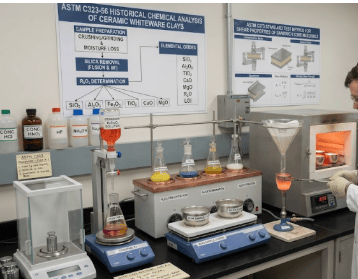
Get Certified Chemical Analysis of Ceramic Whiteware Clays
The chemical composition of the clays used in ceramics, known as ceramic whiteware, affects the way in which they are processed and the properties of the ceramic product. ASTM C323 chemical analysis is used to measure raw material quality, monitor product quality, optimize formulation, and maintain manufacturing consistency.
Updated on August 13, 2026

Testimonials
Real results
Engineers trust us with what matters most
“We had a great experience working with this company for our ASTM E84 testing. They were the first company to respond to our inquiry within just a few minutes of submitting it. From start to finish, the communication was excellent, and the entire process was swift, straightforward, and hassle-free.”

“Very good communication, testing associates were very patient with delays on our end. Reasonable turnaround time for results and nicely detailed report. Analysts were also quick to answer any follow-up questions. Happy with results.”
“Matestlab connected us with an accredited lab within days, cutting weeks off our product validation timeline.”
Why Choose Matestlab?
Matestlab is a unified testing services partner based in the USA. Matestlab offers raw material and product testing services through accredited, expert laboratories primarily based in the USA. Matestlab supports physical, thermal, chemical, electrical, mechanical, environmental, and characterization testing needs through its global network of 2200+ accredited testing laboratories. Matestlab's in-house materials science experts curate and design comprehensive testing programs matched to the sample material and specific testing need, with regulatory requirements and confidentiality in mind.
If you are looking for a managed and trusted testing partner to achieve your research goals, feel free to schedule a meeting with us or send us a request at connect@matestlabs.com to learn more about our services. For a quick quote, call us at (302)244-7710. We are happy to serve you.
If you are looking for a managed and trusted testing partner to achieve your research goals, feel free to schedule a meeting with us or send us a request at connect@matestlabs.com to learn more about our services. For a quick quote, call us at (302)244-7710. We are happy to serve you.
Start Your Testing
Project Today
Project Today
Define your requirements and get access to
specialized laboratories ready to deliver results
specialized laboratories ready to deliver results
Start Testing
Partners with us
Clients
Vendors