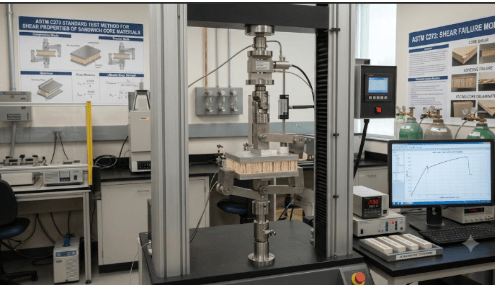
ASTM C273 specifies a procedure for determining the shear properties of sandwich construction core materials associated with shear distortion in planes parallel to the facings. It characterizes the mechanical response of core materials for sandwich composite structures and provides accurate data for material qualification, quality control, engineering design, and product development.
- Determines the shear strength and shear modulus of sandwich core materials.
- Evaluates the shear behavior of core materials under controlled loading conditions.
- Supports material qualification and manufacturing quality assurance.
- Compares the shear performance of different sandwich core materials and production batches.
- Assists with research, product development, and structural engineering design.
- Provides standardized shear property data for sandwich core materials used in sandwich panel design, material specifications research and development, and quality assurance.
What are the Applications of ASTM C273 Testing?
ASTM C273/C273M is used to obtain shear property data for sandwich core materials and sandwich constructions. The findings support material specifications, sandwich panel design, research and development, and quality assurance.
- Determines the shear strength and stiffness of sandwich core materials.
- Supports quality control during sandwich panel manufacturing.
- Assists qualification of new core materials and adhesive bonding systems.
- Compares the performance of honeycomb, foam, balsa, and other structural core materials.
- Supports research and development of advanced lightweight composite structures.
- Provides engineering data for aerospace, marine, automotive, wind energy, rail transportation, and construction applications.
What is the shear strength of sandwich core materials?
Shear strength is the maximum shear stress that a sandwich core material can sustain under the specified test conditions before failure. Shear strength is one of the most important properties of sandwich structures, where the core transfers the load between the face sheets and prevents failure of the structure. ASTM C273 provides a standard test method for determining the shear strength and effective shear modulus of sandwich core materials.
Why is ASTM C273 Testing Important?
The high strength-to-weight ratio of sandwich composite panels makes them suitable for use in various industries, such as aerospace, marine, transportation, and construction, as well as in wind energy systems. ASTM C273 assists manufacturers in assessing the load-bearing capacity of core materials, comparing various core designs, improving manufacturing methods, and assuring that sandwich structures will perform safely under shear loading.
Which Materials Can Be Tested According to ASTM C273?
ASTM C273/C273M covers sandwich construction core materials, including balsa wood foams and honeycomb and other permissible core material forms. These core materials can be used in sandwich constructions with facings to provide lightweight structural configurations.
How Does ASTM C273 Measure the Shear Properties of Sandwich Core Materials?
ASTM C273 determines the shear properties of sandwich core materials by bonding the core material directly to loading plates or bonding sandwich facings to the loading plates as applicable. A testing machine applies the specified loading to produce shear distortion in the core while the force-deflection response is measured. The method also measures the shear strength (MPa), shear modulus (GPa), maximum load (N or kN), and shear strain (%) and generates the shear stress-strain curve and records the failure mode of the specimen. The results help engineers determine the performance of their structures and choose appropriate core materials for sandwich composite designs.
Common Challenges and Troubleshooting
Inadequate bonding, specimen misalignment, uneven loading, premature adhesive failure, and inaccurate displacement measurement can affect the accuracy of the test. Laboratories minimize these problems by using appropriate adhesives, properly curing the bonded assembly, maintaining specimen alignment, and calibrating the testing equipment according to laboratory procedures.