
ASTM C1875 is the standard practice for the determination of major and minor elements in aqueous pore solutions of cementitious pastes by inductively coupled plasma optical emission spectroscopy (ICP-OES). It establishes a uniform analytical method for determining the concentrations of elements in the pore solutions of cementitious materials. ICP-OES analyzes aqueous pore solutions obtained from cementitious materials at different hydration times. Laboratories use this method to measure the concentrations of aluminum (Al), calcium (Ca), potassium (K), silicon (Si), sodium (Na), and sulfur (S). Laboratories use the results to investigate cement hydration, assess cementitious material reactivity, monitor pore solution chemistry, and support cement and concrete research.
ASTM C1875 Determination of Major and Minor Elements in Aqueous Pore Solutions of Cementitious Pastes by Inductively Coupled Plasma Optical Emission Spectroscopy (ICP-OES)
What is ASTM C1875?
What is the scope of ASTM C1875?
ASTM C1875 is a standard practice for the determination of major and minor elements in aqueous pore solutions obtained from cementitious materials by ICP-OES. The practice provides guidance for collecting, preparing, and analyzing aqueous pore solutions obtained from cementitious materials at different hydration times.
- Determines major and minor elements in cementitious pore solutions.
- Uses ICP-OES for elemental analysis.
- Samples aqueous pore solutions of various hydration times.
- Measures aluminum, calcium, potassium, silicon, sodium, and sulfur.
- Facilitates cement hydration research.
- Assists quality control and research.
- Establishes uniform analytical procedures for cementitious materials.
What are the Uses of ASTM C1875 Testing?
ASTM C1875 determines the concentrations of major and minor elements dissolved in aqueous pore solutions of cementitious pastes. Laboratories use this method to monitor cement hydration, evaluate supplementary cementitious materials, investigate chemical reactions, and support quality control and research.
- Measures elemental concentration in pore solutions.
- Determines the characteristics of cement hydration.
- Studies supplementary cementitious materials.
- Supports cement and concrete research.
- Assists quality control during cement production.
- Observes chemical changes during hydration.
- Assists in the preparation of materials and assessment of performance.
What Materials Can Be Tested Under ASTM C1875?
ASTM C1875 applies to aqueous pore solutions obtained from cementitious materials that may include portland cement, limestone, fly ash, ground granulated blast-furnace slag, or other cementitious components.
Why is ASTM C1875 Important?
ASTM C1875 provides a standardized analytical practice for measuring dissolved elements in cementitious pore solutions. The method provides manufacturers and researchers with information about hydration reactions, cement quality and reactivity, and the behavior of readily soluble components in cementitious systems.
Common Challenges and Troubleshooting
Clean sample collection, filtration, handling, and calibrated instrumentation are required to obtain accurate ICP-OES results. Contaminated samples, incomplete filtration, matrix interferences, instrument drift, and incorrect calibration can affect elemental measurements. Laboratories use high-purity reagents, prepare new calibration standards, periodically check instrument performance, and apply a standardized analytical procedure to increase accuracy.
Analysis Results and Interpretation
- ASTM C1875 measures the concentrations of major and minor elements in aqueous pore solutions of cementitious pastes.
- Laboratories report the concentrations of aluminum (Al), calcium (Ca), potassium (K), silicon (Si), sodium (Na), sulfur (S), and other measured elements using SI units.
- These results help evaluate chemistry, hydration, material reactivity, and cementitious system performance.
ASTM C1875 Equipment and Sample Preparation Guide
Accurate elemental analysis depends on representative pore solution sampling, handling, and calibration of ICP-OES instrumentation. Representative pore solution samples are collected, particle suspension is removed from the pore solution by filtration, and calibration standards are prepared prior to ICP-OES analysis. Elemental measurements are reliable and reproducible due to the correct sample preparation and instrument calibration.
| Sample and Specimen Details | Take representative aqueous pore solution samples from cementitious pastes at the desired hydration ages. |
| Specimen Preparation | Laboratory personnel filter the extracted pore solution to remove suspended solids, preserve samples, and prepare calibration standards before ICP-OES analysis. |
| Sample Characteristics | Analysts analyze aqueous pore solution samples rather than physical specimens with defined dimensional requirements. |
| Instrumentation | Inductively Coupled Plasma Optical Emission Spectrometer (ICP-OES), Sample Filtration Unit, Syringes or Pipettes, Volumetric Flasks, Analytical Balance, Calibration Standards, and Laboratory Glassware. |
Testing Procedures and Requirements
The ASTM C1875 describes a standard analytical practice for ICP-OES analysis of aqueous pore solutions. The laboratory takes representative samples of the pore solution, filters out suspended particles, prepares calibration solutions, and analyzes elemental concentrations with a calibrated ICP-OES instrument. Accurate and repeatable analytical results are obtained through careful sample handling, contamination control, and instrument calibration.
Other ASTM-referenced documents include ASTM C219, C305, C511, C1005, D1193, and E177.
| Pore Solution Collection | Technicians collect representative aqueous pore solution samples from cementitious materials at specified hydration times. |
| Sample filtration and preparation | Technicians filter the pore solution, prepare calibration standards, and dilute the sample when necessary before ICP-OES analysis. |
| ICP-OES Elemental Analysis | Analysts use a calibrated ICP-OES instrument to determine the concentrations of major and minor dissolved elements in the sample. |
| Data Verification and Reporting | Analysts check calibration performance, review analytical results, and report elemental concentrations with the required testing information. |
ASTM C1875 Testing Process and Data Collection
The technician prepares the calibration standards, calibrates the ICP-OES instrument, and measures the pore solution for the required elements. The technician analyzes the pore solution for the required elements using the calibrated ICP-OES instrument. The laboratory records the sample identification, hydration time, analytical conditions, calibration information, and elemental concentration for each sample.
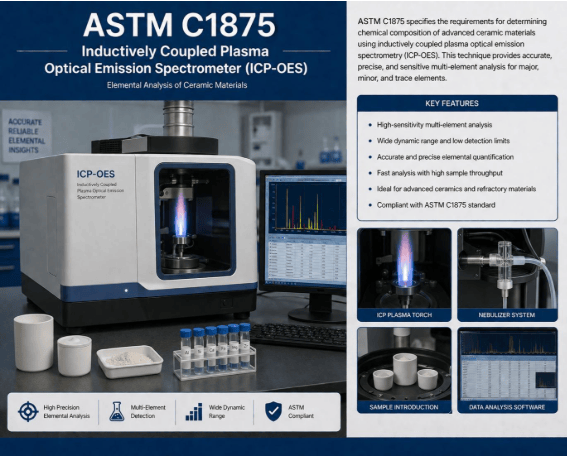
Get Certified ASTM C1875 ICP-OES Chemical Analysis
The chemical composition of the pore solutions directly affects cement hydration, durability, and long-term performance. ASTM C1875 is a standard analytical practice for ICP-OES, which provides guidance for determining the concentrations of readily soluble elements in aqueous pore solutions. Reliable testing facilitates quality control, product development, and material qualification in the cementitious sector, as well as in research.
Updated on August 11, 2026


Project Today
specialized laboratories ready to deliver results