ASTM C1863 Hoop Tensile Strength of Continuous Fiber-Reinforced Advanced Ceramic Composite Tubular Test Specimens at Ambient Temperature Using Direct Pressurization

    What is ASTM C1863?

    ASTM C1863 is the standard test method for hoop tensile strength of continuous fiber-reinforced advanced ceramic composite tubular test specimens at ambient temperature using direct pressurization. The test determines the hoop tensile behavior and strength of advanced ceramic composite tubes by applying monotonically increasing internal pressure until fracture occurs. This test is often referred to as the tube burst test and evaluates hoop tensile strength, hoop fracture strength, hoop tensile strain, proportional limit stress, and hoop modulus of elasticity. Engineers use the results to compare materials, optimize composite designs, qualify manufacturing processes, and verify structural performance. The tube burst test is also known as ASTM C1863, as it is loaded through internal pressure of the specimen to burst. The method is based on measuring the circumferential stresses that result from the pressure and deriving the hoop tensile properties.

    Read more

    Get Certified ASTM C1863 Hoop Tensile Strength Testing

    Advanced ceramic composite tubes are used in aerospace, energy, defense, and industrial systems under high internal pressure. ASTM C1863 offers a standardized tube burst test to help manufacturers assess hoop tensile properties, increase product reliability, and prove structural integrity before use. Independent laboratory testing provides material qualification, quality assurance, and engineering confidence.

    What is the scope of the ASTM C1863 test standard?

    ASTM C1863 provides a standardized test method for measuring the hoop tensile strength of continuous fiber-reinforced advanced ceramic composite tubular specimens under direct internal pressurization at ambient temperature. The method assesses the circumferential mechanical properties of ceramic composite tubes and provides reliable data for qualifying materials, developing products, quality control, and structural design.

    Read more

    • Measures the hoop tensile strength of ceramic composite tubular specimens. 
    • Applies direct internal pressurization at room temperature. 
    • Evaluates continuous fiber-reinforced ceramic matrix composite (CMC) tubes. 
    • Evaluates the hoop stress-strain response and fracture behavior of composite tubes under internal pressurization. 
    • Supports material qualification and quality control. 
    • Compares the performance of different ceramic composite materials. 
    • Provides standardized engineering property data for material qualification and structural design.

    What are the Uses of ASTM C1863 Testing?

    The ASTM C1863 test method is used to measure the hoop tensile strength and circumferential mechanical properties of continuous fiber-reinforced advanced ceramic composite tubes. Manufacturers use this method to qualify composite materials, optimize the manufacturing processes, and assess the performance of the tubular ceramic components under internal pressure.

    • Measures hoop tensile strength of ceramic composite tubes. 
    • Qualifies ceramic matrix composite materials. 
    • Assists in the development of aerospace and energy components. 
    • Assists quality control during manufacturing. 
    • Compares different composite tube designs. 
    • Supports engineering design and material selection. 
    • Assesses the structural response of ceramic composite tubes subjected to internal pressure loading.

    What Materials Can Be Tested Under ASTM C1863? 

    The method is mainly suited for continuous fiber-reinforced ceramic matrix composite tubes with unidirectional, bidirectional, and tridirectional fiber architecture, such as filament-wound, woven, braided, and tape-layup constructions.

    Why is ASTM C1863 Important? 

    ASTM C1863 is a standard test method for evaluation of hoop tensile characteristics of ceramic composite tubes subjected to direct internal pressurization. The test helps manufacturers ensure products can withstand structural performance, improve product quality, optimize composite design, and perform in challenging engineering applications.

    Common Challenges and Troubleshooting 

    Proper specimen alignment, leak-free pressurization, proper pressure control, and reliable strain measurement are critical to the accurate hoop tensile test. Specimen misalignment, sealing leaks, early end failures, false pressure readings, and specimen flaws can all affect the results. Errors are reduced in laboratories by using calibrated equipment, precise sample preparation, and following standard testing procedures. The analysis of fracture surfaces using fractography can aid in identifying failure mechanisms, material defects, and damage accumulation processes that can impact the performance of the hoop tensile.

    ASTM C1863 Equipment and Sample Preparation Guide 

    Accurate hoop tensile testing requires properly manufactured tubular specimens, accurate specimen alignment, and calibrated pressurization equipment. A sample composite tube specimen is selected, mounted in the pressurization fixture, and hoop strain is recorded during testing. To ensure reliability and repeatability, proper specimen preparation and a controlled loading environment are required.

    Read more

    Sample and Specimen DetailsRepresentative continuous fiber-reinforced advanced ceramic composite tubular samples in compliance with ASTM C1863. The specimens should be free from visible defects and representative of the production material.
    Specimen preparation Technicians inspect the specimen, verify the required dimensions, install the sealing components, and securely mount the specimen in the direct pressurization fixture before testing.
    Specimen dimensions Technicians prepare tubular specimens according to ASTM C1863 requirements and measure the outside diameter, inside diameter, wall thickness, and gauge length before testing.
    Instrumentation Direct Pressurization System, Hydraulic or Pneumatic Pressure Supply, Pressure Transducer, Hoop Strain Measurement Device (Strain Gauges or Extensometer), Data Acquisition System, Universal Testing Controller, Vernier Caliper, and Micrometer.

    Testing Procedures and Requirements

    ASTM C1863 establishes a standard direct pressurization method for determining hoop tensile properties of continuous fiber-reinforced ceramic composite tubes. The tubular specimen is installed in a pressurization fixture, pressurized at a controlled rate, and the stress-strain response of the hoop stress is recorded until failure. 

    Read more

    Specimen InstallationTechnicians install the tubular composite specimen in the direct pressurization fixture and verify proper sealing and alignment.
    Internal PressurizationTechnicians apply internal fluid pressure continuously at the specified rate until the specimen fractures.
    Hoop Strain MeasurementTechnicians measure hoop strain throughout the test using appropriate strain-measurement instrumentation.
    Strength and Failure EvaluationAnalysts determine hoop tensile strength, hoop fracture strength, hoop modulus, proportional limit stress, and record fracture behavior from the test results.

    ASTM C1863 Testing Process and Data Collection

    The laboratory selects representative specimens and tube dimensions before testing. Technicians place the specimens in the direct pressurization fixture, apply pressure at a controlled loading rate, and continuously record pressure and hoop strain until failure. Laboratories record specimen dimensions, pressure history, hoop stress, hoop strain, fracture location, fracture mode, proportional limit stress, hoop modulus, and hoop tensile strength for analysis.

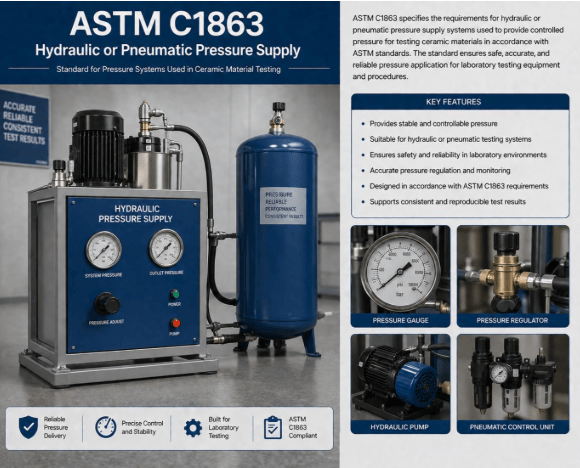
    This image shows a hydraulic or pneumatic pressure supply system providing controlled pressure for laboratory testing of advanced ceramic materials as per ASTM C1863.
    ASTM C1863 Hydraulic/ Pneumatic Pressure Supply

    Analysis Results and Interpretation 

    • ASTM C1863 specifies the hoop tensile properties of continuous fiber-reinforced advanced ceramic composite tubular specimens. 
    • Laboratories usually report hoop tensile strength in MPa or psi, hoop strain in %, and internal pressure in MPa or psi.
    • An increase in hoop tensile strength means resistance to circumferential loading is increased, and structural performance is improved.

    Link to ASTM C1863

    Read more

    FAQ

    Where can I get the astm c1863 tested?
    You can share your astm c1863 testing requirements with MaTestLab. MaTestLab has a vast network of material testing laboratories, spread across the USA and Canada. We support your all material testing needs ranging from specific astm c1863 test to various testing techniques.
    Please contact us for a detailed quote for your astm c1863 testing needs. Cost incurred to carry out different astm c1863 testing methodology depends on the type of raw material; number of samples, coupons, or specimens; test conditions, turn around time etc. Costs of some ASTM testing methods start from $100 and the final value depends upon the factors listed above. Please contact us for the best and latest prices.
    The required number of samples or specimens should comply with the procedure given in the astm c1863 standard. However, the MaTestLab operations team can assist you for your special requirements once you share your testing details with us.
    MaTestLab has a vast testing laboratory network, hence we bring you the best testing facilities in a cost-effective way. We offer considerable discounts (15-20%) to our returning customers based on test volume and frequency.
    The turnaround time for astm c1863 test methodology depends upon the test procedure mentioned in the standard test document. However, we at MaTestLab understand your research requirements and hence try to get your test completed within the least possible time.
    Malhar Khole
    About Author
    Malhar Khole
    Malhar Khole is a Material Testing Associate at MaTestLab Inc. and holds a postgraduate degree in Material Science and Technology from IIT (BHU), Varanasi.
    Testimonials
    Real results
    Engineers trust us with what matters most
    Start Your Testing
    Project Today
    Define your requirements and get access to
    specialized laboratories ready to deliver results
    Partners with us
    Clients
    Vendors
    Process for testing
    • STEP 01

      You share your testing requirements

    • STEP 02

      You share your sample(s)

    • STEP 03

      We deliver your test reports

    Get your testing done

    Let us known your testing requirements and we will be right back with a solution.

      Let us root for each other. Collaborate to grow, expand, and accelerate our businesses.

      Partner with us

        Contact Us

        Discover more from MaTestLab

        Subscribe now to keep reading and get access to the full archive.

        Continue reading