ASTM C1862 Nominal Joint Strength of End-Plug Joints in Advanced Ceramic Tubes at Ambient and Elevated Temperatures

    What is ASTM C1862?

    ASTM C1862 is a standard test method for determining the nominal joint strength of end-plug joints in advanced ceramic tubes at ambient and elevated temperatures. The method involves measurement of the force needed to force a bonded end plug out of a ceramic tube and subsequent calculation of the nominal joint strength and nominal burst pressure of the tube-joint configuration under test. ASTM C1862 (Standard Test Method for Nominal Joint Strength of End-Plug Joints in Advanced Ceramic Tubes at Ambient and Elevated Temperatures) assists manufacturers, aerospace companies, nuclear organizations, and research laboratories in comparing joining methods, qualifying joining systems, and assessing the quality of bonded ceramic tube assemblies before service. 

    Read more

    Get Certified ASTM C1862 Testing for Advanced Ceramic Tube Assemblies

    Bonded end plugs used on these advanced ceramic tubes have many applications, including nuclear reactors, aerospace systems, energy equipment, and high-temperature industrial applications where leak-tight sealing and structural reliability are critical. ASTM C1862 testing can be used to validate joint performance, enhance bonding processes, and guarantee reliable operation in ambient conditions as well as under elevated temperatures. 

    What is the scope of ASTM C1862?

    ASTM C1862 is a standard test method for determining the nominal joint strength of bonded end-plug joints in advanced ceramic tubes at ambient and elevated temperatures. The method assesses the mechanical integrity of ceramic tube-to-plug joints and offers accurate strength data for material qualification, quality control, product development, and engineering design. The test standard-

    Read more

    • Determines the nominal joint strength of bonded end-plug joints in advanced ceramic tubes. 
    • Evaluates joint performance at ambient and elevated temperatures. 
    • Assesses the structural integrity and reliability of ceramic tube assemblies. 
    • Supports material qualification and manufacturing quality assurance. 
    • Compares the performance of different joining materials and bonding processes. 
    • Provides standardized joint strength data for engineering applications. 

    What are the Applications of ASTM C1862 Testing?

    Bonded ceramic tube assemblies are tested to evaluate the strength and reliability of the assembly under axial loading using ASTM C1862. The results enable engineers to optimize the design of joints, choose the proper material for joint production, optimize the manufacturing process, and to qualify the ceramic parts for severe service conditions. This test standard-

    • Determines the nominal joint strength of bonded ceramic tube assemblies. 
    • Supports quality control of ceramic joining and bonding processes. 
    • Assists in the qualification of joining materials and end-plug designs. 
    • Compares the performance of different adhesives, brazes, or joining techniques. 
    • Supports research and development of advanced ceramic joining technologies. 
    • Provides engineering data for aerospace, nuclear, energy, industrial furnace, and high-temperature ceramic applications. 

    What is Nominal Joint Strength?

    Nominal joint strength is the maximum calculated stress that a bonded end-plug joint can withstand under axial loading before failure. It is an important mechanical property that is used to assess the integrity and reliability of ceramic tube assemblies in applications that operate at high temperatures and pressures. ASTM C1862 provides a standardized method for measuring this property at ambient and elevated temperatures.

    Why is ASTM C1862 Testing Important?

    Ceramic tube assemblies for aerospace, energy, and nuclear applications are highly complex, and bonding end plugs is a key component of these assemblies. The entire component may fail if the bonded end-plug joint does not provide adequate mechanical strength. ASTM C1862 helps manufacturers calculate the reliability of joints, compare bonding techniques, and optimize bonding processes, as well as ensure ceramic assemblies meet engineering and performance requirements.

    What Materials can be Tested According to ASTM C1862?

    ASTM C1862 applies to advanced ceramic tubes that have bonded end plugs, made of silicon carbide, silicon nitride, alumina, zirconia, oxide ceramics, or other advanced ceramic materials that are bonded together with a ceramic adhesive, brazing, or other proper bonding process. They are frequently employed in the aerospace, nuclear, energy, and other high-temperature industrial sectors.

    How does ASTM C1862 Measure the Nominal Joint Strength of End-Plug Joints?

    ASTM C1862 uses the End-Plug Push-Out (EPPO) method to determine the nominal joint strength. A Universal Testing Machine (UTM) imposes a controlled compression on the bonded end plug until the bond fails or the end plug is pushed out of the ceramic tube. Technicians measure the push-out force to calculate the nominal joint strength (MPa) and nominal burst pressure, while also recording the failure mode, displacement, test temperature, and maximum applied load. These results can be used to assess joint performance, to compare joining methods, and for engineering design.

    Common Challenges and Troubleshooting

    Some factors can impact the quality of the bond, including specimen alignment, tolerances, adhesive thickness, curing, and temperature changes. Laboratories try to avoid such issues by designing the bonded assemblies carefully, controlling the alignment, calibration of test equipment, and the standardization of test procedures and specimen preparation.

    ASTM C1862 Equipment and Sample Preparation Guide

    Ceramic tube assemblies should be properly fabricated, specimen dimensions must be correct, and test equipment must be calibrated to provide reliable strength measurements of the joints. The bonded joint is subjected to controlled axial loading until failure while technicians examine the joint, measure specimen dimensions, and mount the specimen assembly in the End-Plug Push-Out (EPPO) fixture.

    Read more

    Sample DetailsAdvanced ceramic tubes with bonded end plugs prepared according to ASTM C1862 dimensional requirements. The joining material may include ceramic adhesives, brazing materials, glass-ceramic joining materials, or other high-temperature bonding systems compatible with advanced ceramic tube assemblies.
    Sample PreparationFabricate the tube and end-plug assembly using the specified joining material, inspect the bonded joint for defects, clean the specimen, verify dimensions, and condition the specimen at the required test temperature before testing.
    Sample ConfigurationBonded advanced ceramic tubular assembly tested using the End-Plug Push-Out (EPPO) method under ambient or elevated temperature conditions.
    InstrumentationUniversal Testing Machine (UTM), End-Plug Push-Out (EPPO) fixture, high-temperature furnace (when required), specimen alignment fixture, calibrated load cell, thermocouples, digital micrometer, vernier caliper, computerized data acquisition system, and testing software.

    Testing Procedures and Requirements

    Bonded ceramic end plug joints are tested according to ASTM C1862 with the End-Plug Push-Out (EPPO) method. The ceramic tube is firmly fixed in a fixture, and an axial compression load is applied to the end plug until the joint fails. The nominal joint strength and nominal burst pressure of the assembly are calculated using the measured push-out force. 

    Read more

    Specimen PreparationThe technician prepares bonded ceramic tube and end-plug assemblies according to ASTM C1862 requirements.
    Dimensional VerificationThe technician measures tube dimensions, plug geometry, and bonded joint dimensions.
    Fixture InstallationThe technician secures the specimen in the EPPO fixture with proper alignment.
    Push-Out TestingThe technician applies an axial compressive load until joint failure or plug push-out occurs.
    Data Collection and AnalysisThe technician records push-out force, displacement, temperature, and failure mode, and calculates nominal joint strength and nominal burst pressure and evaluates joint performance.

    ASTM C1862 Testing Process and Data Collection

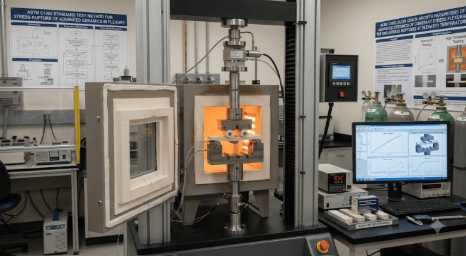
    The engineers construct the bonded ceramic tube specimen, check the dimensions of the tube and end plug, and place the specimen in the End-Plug Push-Out (EPPO) fixture. For elevated-temperature testing, the specimen is preheated to the test temperature. A controlled axial load is then applied until failure, during which load, displacement, temperature, push-out force, and failure characteristics are recorded continuously.

    The image shows a universal testing machine evaluating the nominal joint strength of bonded end-plug joints in advanced ceramic tubes according to ASTM C1862.
    ASTM C1862 Universal Testing Machine 

    Analysis Results and Interpretation

    • The laboratory reports nominal joint strength (MPa), push-out force, nominal burst pressure, displacement at failure, and failure mode of the bonded end-plug joint. 
    • Engineers evaluate the mechanical strength and bond integrity of ceramic tube assemblies at ambient and elevated temperatures.
    • Engineers compare the performance of various joining materials, adhesives, brazes, bonding processes, and production batches to determine joint quality. 
    • The observed failure modes are documented because cohesive failure within the joining material, adhesive failure at the interface, and fracture of the ceramic components provide valuable information about joint performance and manufacturing quality.
    • The test results support material qualification, quality control, engineering design, product development, and reliability evaluation of advanced ceramic tube assemblies.

    Link to ASTM C1862

    Read more

    FAQ

    Where can I get the astm c1862 tested?
    You can share your astm c1862 testing requirements with MaTestLab. MaTestLab has a vast network of material testing laboratories, spread across the USA and Canada. We support your all material testing needs ranging from specific astm c1862 test to various testing techniques.
    Please contact us for a detailed quote for your astm c1862 testing needs. Cost incurred to carry out different astm c1862 testing methodology depends on the type of raw material; number of samples, coupons, or specimens; test conditions, turn around time etc. Costs of some ASTM testing methods start from $100 and the final value depends upon the factors listed above. Please contact us for the best and latest prices.
    The required number of samples or specimens should comply with the procedure given in the astm c1862 standard. However, the MaTestLab operations team can assist you for your special requirements once you share your testing details with us.
    MaTestLab has a vast testing laboratory network, hence we bring you the best testing facilities in a cost-effective way. We offer considerable discounts (15-20%) to our returning customers based on test volume and frequency.
    The turnaround time for astm c1862 test methodology depends upon the test procedure mentioned in the standard test document. However, we at MaTestLab understand your research requirements and hence try to get your test completed within the least possible time.
    Malhar Khole
    About Author
    Malhar Khole
    Malhar Khole is a Material Testing Associate at MaTestLab Inc. and holds a postgraduate degree in Material Science and Technology from IIT (BHU), Varanasi.
    Testimonials
    Real results
    Engineers trust us with what matters most
    Start Your Testing
    Project Today
    Define your requirements and get access to
    specialized laboratories ready to deliver results
    Partners with us
    Clients
    Vendors
    Process for testing
    • STEP 01

      You share your testing requirements

    • STEP 02

      You share your sample(s)

    • STEP 03

      We deliver your test reports

    Get your testing done

    Let us known your testing requirements and we will be right back with a solution.

      Let us root for each other. Collaborate to grow, expand, and accelerate our businesses.

      Partner with us

        Contact Us

        Discover more from Matestlab Inc

        Subscribe now to keep reading and get access to the full archive.

        Continue reading