ASTM C1773 Monotonic Axial Tensile Behavior of Continuous Fiber-Reinforced Advanced Ceramic Tubular Specimens

    What is ASTM C1773?

    ASTM C1773 is a standard method for fiber-reinforced ceramics that specifies how to determine the monotonic axial tensile behavior of continuous fiber-reinforced advanced ceramic tubular test specimens at ambient temperature. The method produces accurate mechanical property information for ceramic matrix composite tubes. ASTM C1773 assists manufacturers, aerospace companies, research laboratories, and material developers in assessing material performance, comparing manufacturing methods, qualifying materials, and providing engineering design assistance for tubular ceramic composite components.

    Read more

    Get Certified ASTM C1773 Testing for Ceramic Matrix Composite Tubes

    Continuous fiber-reinforced ceramic tubes are frequently used in the aerospace, energy, defense, and high-temperature industrial sectors, where high tensile strength, damage tolerance, and thermal stability are essential. ASTM C1773 testing helps manufacturers ensure mechanical performance, improve manufacturing quality, and guarantee product performance in axial tensile loading.

    What is the scope of ASTM C1773?

    ASTM C1773 is a standard test method for monotonic axial tensile testing at ambient temperature of continuous fiber-reinforced (CF) advanced ceramic tubular products. The test standard-

    Read more

    • Measures the monotonic axial tensile behavior of continuous fiber-reinforced ceramic tubular specimens. 
    • Determines tensile properties under controlled ambient temperature conditions. 
    • Supports material qualification and manufacturing quality assurance. 
    • Compares the mechanical performance of different ceramic matrix composite materials and production batches. 
    • Assists research, product development, and engineering design. 
    • Provides standardized tensile property data for structural ceramic composite applications. 

    What are the Applications of ASTM C1773 Testing?

    ASTM C1773 testing is used to assess the performance of continuous fiber-reinforced ceramic matrix composite tubes in terms of their axial tensile capabilities. The results provide guidance for material selection, product qualification, process optimization, and engineering design of tensile-loaded components used in harsh service conditions. The test standard-

    • Determines the tensile properties of ceramic matrix composite tubular components. 
    • Supports quality control during composite manufacturing. 
    • Assists material qualification for high-performance structural applications. 
    • Compares the tensile performance of different fiber architectures, matrices, and manufacturing processes. 
    • Supports research and development of advanced ceramic matrix composites. 
    • Provides engineering data for aerospace, energy, defense, industrial, and high-temperature applications. 

    What is Monotonic Axial Tensile Behavior?

    An axial tensile response is the response of a material to a continuous tensile loading applied up to failure, and is called monotonic as the loading is steadily applied. For continuous fiber-reinforced ceramic matrix composites (CMCs), this includes mechanical properties such as tensile strength, failure strain, elastic modulus, and damage progression. ASTM C1773 offers a standardized approach to characterize these properties of tubular specimens at ambient temperature.

    Why is ASTM C1773 Testing Important?

    Continuous fiber-reinforced ceramic tubes are used in demanding applications that require high strength, low weight, and thermal stability. ASTM C1773 supports manufacturers in evaluating tubular material tensile properties, comparing material systems, optimizing processes, and confirming the engineering and quality of tubular CMC materials.

    What Materials can be Tested According to ASTM C1773?

    ASTM C1773 applies to continuous fiber-reinforced advanced ceramic tubular specimens, including ceramic matrix composites reinforced with continuous silicon carbide (SiC), carbon, or oxide fibers. They are often used in aerospace, energy, defense, automotive, and high-temperature industrial sectors for lightweight components with high strength and oxidation-protective coatings. 

    How does ASTM C1773 Measure the Axial Tensile Behavior of Ceramic Tubular Specimens?

    ASTM C1773 is used to evaluate the monotonic axial tensile properties of ceramic matrix composite tubes by applying an increasing axial tensile load to the tube in a Universal Testing Machine (UTM) with special tubular grips, fixtures for assistance with alignment, and an extensometer or non-contact strain measurement system until the specimen fails. The method measures ultimate tensile strength (MPa), elastic modulus (GPa), strain to failure (%), proportional limit, and the entire stress-strain curve; the mechanical property data obtained from the test are reliable and are used for material qualification and design.

    Common Challenges and Troubleshooting

    Test results may be affected by misalignment of the specimen, damage from gripping, poor strain measurement and dimensional errors, and failure at the grips. The problems are minimized in laboratories by using precision alignment fixtures, special tubular grips, calibrated instrumentation, and specimens prepared to meet the requirements of ASTM C1773.

    ASTM C1773 Equipment and Sample Preparation Guide

    For accurate measurement of tensile properties, it is necessary to have properly formed tubular specimens and calibrated testing equipment. Technicians measure the dimensions of the specimen, position the tubular specimen in special gripping apparatus, apply a controlled axial tensile force, and capture stress-strain data throughout the test.

    Read more

    Sample DetailsContinuous fiber-reinforced advanced ceramic tubular specimens manufactured according to ASTM C1773 dimensional requirements.
    Sample PreparationAnalysts machine or fabricate tubular specimens to the specified dimensions, inspect for machining defects or surface damage, clean the specimen, and verify all critical dimensions before testing.
    Sample ConfigurationContinuous fiber-reinforced ceramic matrix composite (CMC) tubular specimen tested under monotonic axial tensile loading at ambient temperature.
    InstrumentationUniversal Testing Machine (UTM), specialized tubular tensile grips, specimen alignment fixture, extensometer or non-contact strain measurement system, calibrated load cell, digital micrometer, vernier caliper, computerized data acquisition system, and testing software.

    Testing Procedures and Requirements

    ASTM C1773 tests the tensile properties of tubular ceramic matrix composite materials by systematically increasing the tensile load on the specimen until failure. Optimal specimen orientation, strain measurement, and loading conditions provide repeatable and reliable mechanical property measurements.

    Read more

    Specimen PreparationAnalysts prepare tubular ceramic composite specimens according to ASTM C1773 requirements.
    Dimensional VerificationAnalysts measure specimen dimensions before testing.
    Specimen AlignmentAnalysts mount the tubular specimen using specialized grips and alignment fixtures.
    Monotonic Tensile LoadingAnalysts apply a continuous axial tensile load until specimen failure.
    Data Collection and AnalysisAnalysts record load, strain, displacement, and fracture behavior throughout the test, and calculate tensile properties and evaluate the mechanical behavior of the tubular specimen.

    ASTM C1773 Testing Process and Data Collection

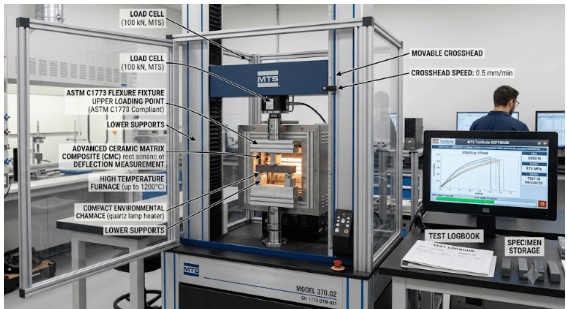
    Representative tubular samples are prepared, checked for dimensions, and mounted in specially designed fixtures that allow for proper axial alignment. The tensile load increases steadily, and the load, strain, displacement, and response of the specimen are measured as a function of time until the specimen fails. The recorded data is analyzed by the engineers to find out the tensile properties and the mechanical behavior of the ceramic matrix composite.

    The image shows a universal testing machine evaluating the monotonic axial tensile behavior of continuous fiber-reinforced advanced ceramic tubular specimens according to ASTM C1773.
    ASTM C1773 Universal Testing Machine (UTM)

    Analysis Results and Interpretation

    • The laboratory reports the ultimate tensile strength (MPa), elastic modulus (GPa), proportional limit, strain to failure, and complete stress-strain curve of the tubular ceramic specimen.
    • Engineers analyze the tensile response, stiffness, damage evolution, and fracture behavior of continuous fiber-reinforced ceramic matrix composites.
    • Fracture location and failure mode are evaluated to confirm that specimen failure occurred within the valid test section and was not influenced by gripping or alignment errors.
    • The results support material qualification, quality control, engineering design, product development, and long-term performance evaluation of ceramic composite tubular components.

    Link to ASTM C1773

    Read more

    Updated on August 14, 2026

    Malhar Khole
    About Author
    Malhar Khole is a Material Testing Associate at Matestlab Inc. and holds a postgraduate degree in Material Science and Technology from IIT (BHU), Varanasi.
    Know More
    Testimonials
    Real results
    Engineers trust us with what matters most
    Start Your Testing
    Project Today
    Define your requirements and get access to
    specialized laboratories ready to deliver results
    Partners with us
    Clients
    Vendors
    Process for testing
    • STEP 01

      You share your testing requirements

    • STEP 02

      You share your sample(s)

    • STEP 03

      We deliver your test reports

    Get your testing done

    Let us know your testing requirements and we will be right back with a solution.

      Let us root for each other. Collaborate to grow, expand, and accelerate our businesses.

      Partner with us

        Discover more from Matestlab

        Subscribe now to keep reading and get access to the full archive.

        Continue reading