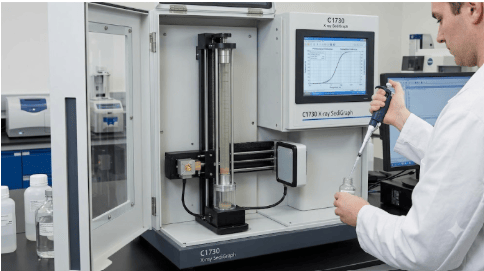
This ASTM C1730 standard specifies a method of determining the particle size distribution of advanced ceramic powders by X-ray monitoring of gravity sedimentation. The method provides particle size distribution data for fine ceramic powders to support raw material evaluation, manufacturing process optimization, and quality control. The test standard-
- Determines the particle size distribution of advanced ceramic powders.
- Evaluates powder consistency and particle size uniformity.
- Supports quality control during ceramic powder manufacturing.
- Assists raw material qualification and product development.
- Compares particle size distributions between production batches.
- Provides standardized particle characterization data for research and engineering applications.
What are the Applications of ASTM C1730 Testing?
ASTM C1730 testing aids advanced ceramic powder manufacturers and researchers in determining the particle size distribution of powders for high-performance applications. The results help manufacturers qualify raw materials, optimize processing, support product development, and evaluate powder consistency before ceramic processing. The test standard-
- Determines the particle size distribution of advanced ceramic powders.
- Supports quality control during powder production and incoming material inspection.
- Assists with raw material qualification for advanced ceramic manufacturing.
- Supports research and development of engineered ceramic materials.
- Improves the powder processing, compaction, and sintering capabilities.
- Generates particle characterization data for aerosols, electronics, medical devices, energy, and industrial ceramics.
What is Particle Size Distribution?
The particle size distribution of a ceramic powder refers to the percentage of particles of each size in the powder. One of the most important powder properties that influence the flowability, packing density, sintering behavior, and mechanical properties of advanced ceramic components. ASTM C1730 is a standard X-ray gravity sedimentation method for measuring this distribution.
Why is ASTM C1730 Testing Important?
The particle size distribution of the ceramic powders directly influences the manufacturing efficiency and ceramic product performance. ASTM C1730 assists manufacturers in validating the consistency of powders, process optimization, and raw material quality control according to product requirements. The method also supports quality assurance, material qualification, and research involving advanced ceramic powders.
Which Materials can be Tested According to ASTM C1730?
ASTM C1730 is used for high-performance ceramic powders that can be dispersed in an appropriate liquid to permit gravity sedimentation analysis. Manufacturers use the method to evaluate alumina, zirconia, silicon carbide, silicon nitride, aluminum nitride, boron carbide, and other engineering ceramic powders for structural, electronic, biomedical, and high-temperature applications.
How does ASTM C1730 Measure Particle Size Distribution by X-Ray Gravity Sedimentation?
Technicians disperse the powder sample in an appropriate liquid, allow the particles to settle under gravity, and calculate the particle size distribution according to ASTM C1730. An X-ray sedimentation particle size analyzer measures the sedimentation particle size continuously during sedimentation. The system determines the particle size distribution using Stokes’ law and reports the properties, including D10, D50 (median particle size), D90, cumulative particle size distribution, and particle diameter, normally in micrometers (µm). The results help manufacturers evaluate powder quality and optimize ceramic processing.
Common Challenges and Troubleshooting
There are several sources of errors in the particle size measurement, including particle agglomeration, incomplete dispersion, air bubbles, temperature fluctuations, and instrument miscalibration. In laboratories, these problems are reduced by selecting suitable dispersing agents, ultrasonic dispersion, setting the testing temperatures, and using the X-ray sedimentation analyzer that has been calibrated regularly.