ASTM C1684 Flexural Strength of Advanced Ceramics at Ambient Temperature-Cylindrical Rod Strength

    What is ASTM C1684?

    ASTM C1684 defines a standardized method for determining the flexural strength of cylindrical advanced ceramic rod specimens under controlled bending conditions. This method is specifically for testing cylindrical rods, which is appropriate for ceramic materials produced in a rod or pin shape, as opposed to a rectangular bar configuration used in flexural tests. Manufacturers, researchers, and testing laboratories use ASTM C1684 to compare the performance of different materials, verify manufacturing quality, qualify ceramic products, and provide valid strength data for use in engineering applications. ASTM C1684 (Standard Test Method for Flexural Strength of Advanced Ceramics at Ambient Temperature-Cylindrical Rod Strength) applies to cylindrical rod specimens and is supplemental to ASTM C1161, which is intended for flexural strength of advanced ceramics using rectangular bar specimens.

    Read more

    Get Certified ASTM C1684 Testing for Advanced Ceramic Rods

    Bending strength is widely used in advanced ceramic rods in structural, electrical, medical, and high-temperature applications. The ASTM C1684 testing is used by manufacturers to assess mechanical properties of ceramic rod components, improve manufacturing processes, and aid product quality control.

    What is the Scope of ASTM C1684?

    The method in ASTM C1684 specifies a standard procedure for measuring the flexural strength of advanced ceramics at ambient temperature, when testing in the form of cylindrical rods. The method tests the bending strength of ceramic rods under controlled loading conditions to provide reliable data for material qualification, quality control, and engineering design. The test standard-

    Read more

    • Measures the flexural strength of cylindrical advanced ceramic rod specimens. 
    • Evaluates the mechanical performance of ceramics under bending loads at ambient temperature. 
    • Supports material qualification and provides data for manufacturing quality assurance.
    • Compares the flexural strength of different ceramic materials and production batches. 
    • Assists research, product development, and engineering design. 
    • Provides standardized strength data for structural ceramic applications. 

    What are the Applications of ASTM C1684 Testing?

    ASTM C1684 testing provides manufacturers and researchers with a standardized test procedure to determine the flexural strength of advanced ceramic cylindrical rods. The results are used to select materials, control the manufacturing process, qualify products, and support the engineering design of parts under bending stress. The test standard-

    • Measures the flexural strength of advanced ceramic rod materials. 
    • Supports quality control during ceramic manufacturing and machining. 
    • Assists material qualification for structural and high-performance applications. 
    • Compares the mechanical performance of different ceramic compositions and production batches. 
    • Supports research and development of advanced ceramic materials. 
    • Provides engineering data for aerospace, medical, energy, electronics, and industrial ceramic components. 

    What is Flexural Strength in Advanced Ceramics?

    The flexural strength of a ceramic material is the maximum stress it will endure when bent before it breaks. One of the more critical mechanical properties for advanced ceramics is that they are strong in compression, while relatively brittle under tension. ASTM C1684 determines this property specifically for cylindrical rod specimens, providing reliable data for material evaluation and structural design.

    Why is ASTM C1684 Testing Important?

    Many advanced ceramic components are produced as rods, pins, shafts, or structural parts in the form of cylinders that are subject to bending loads in service. ASTM C1684 helps manufacturers evaluate mechanical performance, compare material quality, and optimize production processes for engineering design and quality assurance.

    What Materials Can be Tested According to ASTM C1684?

    ASTM C1684 applies to monolithic advanced ceramic cylindrical rod specimens, including materials such as alumina, silicon nitride, silicon carbide, zirconia, aluminum nitride, boron carbide, and other engineering ceramics used in aerospace, medical, energy, electronics, and industrial applications.

    How Does ASTM C1684 Measure the Flexural Strength of Cylindrical Ceramic Rods?

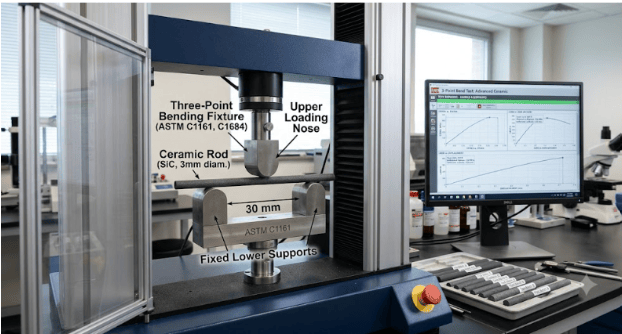
    Technicians determine the flexural strength of cylindrical ceramic rods according to ASTM C1684 by applying a controlled bending load until fracture occurs using a Universal Testing Machine (UTM) equipped with three-point or four-point flexural fixtures. The method measures the fracture load, specimen size, and test span to determine flexural strength, usually measured in megapascals (MPa). Engineers use the test results to evaluate mechanical performance, compare materials, support product qualification, and assist engineering design.

    Common Challenges and Troubleshooting

    Possible factors that can affect flexural strength results include improper specimen alignment, dimensional error, flaws in the specimen surface, incorrect support span, and equipment miscalibration. Laboratories try to minimize these errors in their preparations that comply with ASTM C1684, with the use of calibrated instruments and proper loading alignment during testing.

    ASTM C1684 Equipment and Sample Preparation

    It is necessary to prepare the rod specimens properly and use a calibrated testing apparatus to obtain accurate flexural strength readings. The technicians measure the size of the specimen, mount it on the bending fixture, and put the specimens under a controlled loading rate until the specimen is broken and record the mechanical response.

    Read more

    Sample DetailsCylindrical rod specimens manufactured from monolithic advanced ceramics according to ASTM C1684 dimensional requirements.
    Sample PreparationMachine the ceramic rods to the specified diameter and length, inspect the surface for defects, clean the specimens, and verify all dimensions before testing.
    Sample ConfigurationTechnicians test cylindrical rod specimens using three-point or four-point flexural bending at ambient temperature with the specified support span.
    InstrumentationUniversal Testing Machine (UTM), three-point or four-point flexural bending fixture for cylindrical rods, calibrated load cell, specimen alignment fixture, digital micrometer, vernier caliper, data acquisition system, and computerized testing software.

    Testing Procedures and Requirements

    ASTM C1684 determines flexural strength of cylindrical ceramic rods by applying a controlled bending load to cause failure. Proper specimen preparation, accurate dimensional measurements, and calibrated testing equipment ensure reliable and repeatable strength measurements.

    Read more

    Specimen PreparationThe analyst prepares cylindrical ceramic rod specimens according to the specified dimensions.
    Dimensional VerificationThe analyst measures rod diameter, span length, and specimen geometry before testing.
    Specimen PositioningThe analyst places the cylindrical rod on the three-point or four-point bending fixture.
    Flexural Strength TestingThe analyst applies a controlled load until specimen fracture occurs.
    Data Collection and Result CalculationFinally, the analyst records fracture load, specimen dimensions, and fracture characteristics and calculates flexural strength and evaluates the mechanical performance of the ceramic rod.

    ASTM C1684 Testing Process and Data Collection

    Technicians make cylindrical ceramic rod samples, check dimensions, and place samples on a flexural fixture. A controlled bending load is applied until fracture occurs, and the testing system is programmed to continuously record the load applied and the response of the specimen. Technicians determine flexural strength and record fracture properties and testing procedures.

    The image shows a universal testing machine performing flexural strength testing on cylindrical advanced ceramic rod specimens according to ASTM C1684.
    ASTM C1684 Universal Testing Machine with Three-Point Bending Fixture Ceramic Rods

    Analysis Results and Interpretation

    • The laboratory report includes flexural strength values usually expressed in megapascals (MPa), fracture load, specimen dimensions, and fracture observations.
    • The test determines the ambient temperature bending characteristics and fracture resistance of advanced ceramics. 
    • Engineers evaluate flexural properties to compare ceramic materials, manufacturing processes, and production batches for material quality assessment.
    • Engineers use the test results for material qualification, quality assurance, engineering design, and product development of structural ceramic components.
    • Flexural strength results are interpreted together with specimen geometry, support span, loading configuration, and fracture origin because these factors influence the measured strength values.

    Link to ASTM C1684

    Read more

    Updated on July 30, 2026

    Dr Ruchika Yogesh
    About Author
    Dr. Ruchika Yogesh is a serial entrepreneur, material science and AI/ML enthusiast, medicinal chemistry subject matter expert (SME), scientific/medical copyeditor, and a researcher.
    Know More
    Testimonials
    Real results
    Engineers trust us with what matters most
    Start Your Testing
    Project Today
    Define your requirements and get access to
    specialized laboratories ready to deliver results
    Partners with us
    Clients
    Vendors
    Process for testing
    • STEP 01

      You share your testing requirements

    • STEP 02

      You share your sample(s)

    • STEP 03

      We deliver your test reports

    Get your testing done

    Let us know your testing requirements and we will be right back with a solution.

      Let us root for each other. Collaborate to grow, expand, and accelerate our businesses.

      Partner with us

        Discover more from Matestlab

        Subscribe now to keep reading and get access to the full archive.

        Continue reading