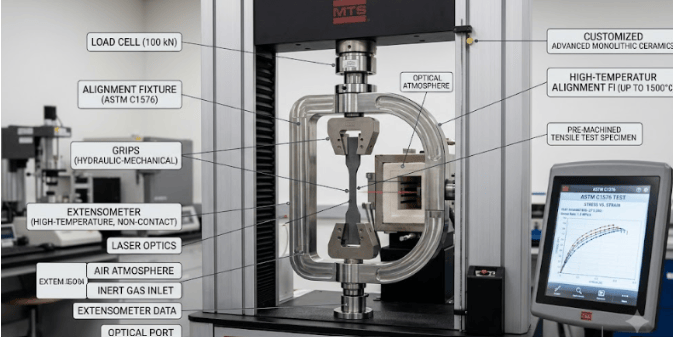
ASTM C1576 establishes a standard for measuring the slow crack growth parameters of advanced ceramics by constant-stress flexural (stress rupture) testing at ambient temperature. The method evaluates the effect of sustained flexural loading on crack propagation and provides data for estimating the long-term mechanical reliability of ceramic materials. The test standard-
- Determines the slow crack growth parameters of advanced ceramics under constant flexural stress.
- Evaluates the long-term mechanical reliability of structural ceramic materials.
- Assesses the influence of sustained loading on crack propagation and time to failure.
- Supports material qualification, quality assurance, and lifetime prediction.
- Compares the durability of different ceramic materials under identical loading conditions.
- Provides standardized data for engineering design and research.
What are the Applications of ASTM C1576 Testing?
Advanced ceramics manufacturers and researchers use ASTM C1576 testing to assess the long-term behavior of advanced ceramics under continuous flexural loading. The results apply to material selection, product development, reliability evaluation, and the engineering design of mechanical components subjected to continuous mechanical loading. The test standard-
- Evaluates the long-term durability of advanced ceramic materials.
- Supports quality control and material qualification programs.
- Predicts the service life of structural ceramic components.
- Assists research and development of high-performance ceramic materials.
- Supports engineering design for aerospace, automotive, energy, electronics, medical, and industrial applications.
- Compares the stress rupture performance of different ceramic materials.
What is Slow Crack Growth in Advanced Ceramics?
Slow crack growth (SCG) occurs when the microscopic cracks in a ceramic material grow slowly under a long-term mechanical load. The stress applied is less than the material’s immediate fracture strength, but there is enough time for the cracks to continue growing and eventually cause failure. ASTM C1576 measures slow crack growth behavior to help estimate the long-term reliability and service life of advanced ceramics.
Why is ASTM C1576 Testing Important?
The service life of advanced ceramic components can be shortened due to slow crack growth under continuous mechanical loads. ASTM C1576 is useful for manufacturers to assess long-term durability, to compare the durability of various materials, and to guide product design for increased durability and reliability. The standardized method can be used for quality assurance and engineering design as well.
What Materials Can be Tested According to ASTM C1576?
ASTM C1576 is used for monolithic advanced ceramics for structural applications with sustained flexural loading. The method is widely used to assess the characteristics of materials like alumina, silicon nitride, silicon carbide, zirconia, aluminum nitride, and other engineering ceramics used in the aerospace, energy, automotive, electronics, and industrial sectors.
How Does ASTM C1576 Determine Slow Crack Growth Parameters?
ASTM C1576 determines slow crack growth parameters by applying a constant flexural stress to ceramic specimens until fracture occurs at ambient temperature. Technicians perform the test using a universal testing machine (UTM) or a stress-rupture testing system equipped with three-point or four-point flexural fixtures to determine the slow crack growth parameter (SCG exponent), applied stress, and time to failure.
Common Challenges and Troubleshooting
Various factors, such as specimen preparation, surface defects, misalignment, load, and environment, influence the results of the stress rupture test. Laboratory personnel reduce these problems by employing calibrated equipment, well-prepared specimens, standard testing procedures, and controlled testing conditions.
ASTM C1576 Testing Process and Data Collection
Representative ceramic specimens are assembled, and the dimensions are verified prior to testing. The specimen is bent using a three- or four-point bending or loading setup until it breaks to produce a constant flexural stress. The values of applied stress, time-to-failure, fracture surface characteristics, and testing conditions are recorded for the tests in the lab for the calculation of the slow crack growth parameters.