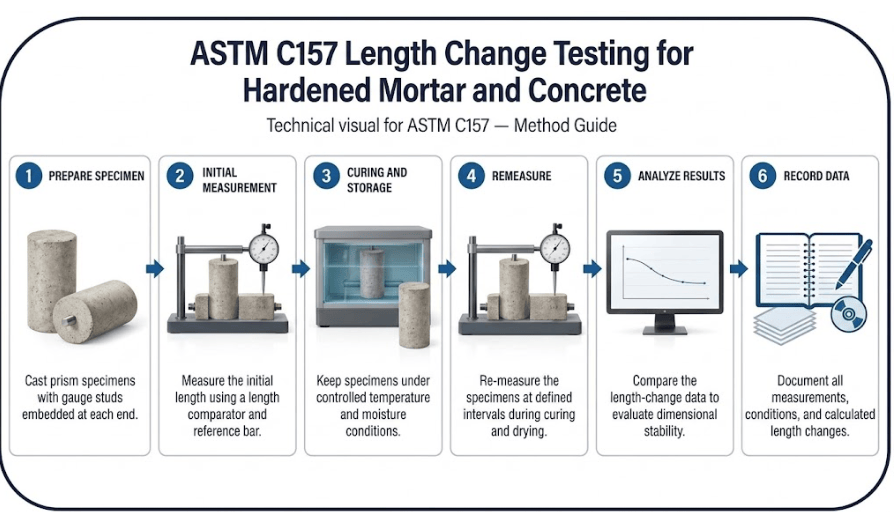
ASTM C157 is a test standard that describes the procedure for determining length changes of hardened hydraulic-cement mortar and concrete. The method evaluates dimensional changes in laboratory-fabricated specimens exposed to specified curing and storage conditions. ASTM C157 mainly determines length changes from drying, internal reactions, and other sources, excluding changes caused by external force or temperature differences. The standard includes procedures for specimen preparation, initial length measurement, controlled curing and storage, periodic length measurements, and calculation of length change. The scope of ASTM C157 includes:
- Material type: Hardened hydraulic-cement mortar and concrete fabricated as laboratory specimens.
- Purpose: Determination of length changes in mortar and concrete under specified curing and storage conditions.
- Properties evaluated: Expansion and contraction, including length changes associated with drying and internal reactions.
- Testing method: Measures the length of prismatic specimens at specified intervals using a length comparator and reference bar.
- Results: Results include the percentage change in specimen length relative to the original gauge length at the specified measurement ages.
- Test limitations: ASTM C157 does not measure length changes caused by externally applied forces or temperature changes.
- Use conditions: Technicians expose specimens to the specified moist-curing and air-storage conditions and record measurements at the required intervals.
- Applications: Concrete mixture comparison, dimensional-stability evaluation, quality control, research, and development of mortar and concrete mixtures.
What are the Uses of ASTM C157 Testing?
ASTM C157 testing helps engineers assess dimensional changes in hardened hydraulic-cement mortar and concrete. Analysts compare measurements collected at different stages to determine how a mixture expands or contracts under the selected curing and storage conditions. This standard-
- Assesses length changes in hardened mortar and concrete.
- Evaluates expansion and contraction behavior.
- Assists in comparing different concrete mixtures.
- Supports cementitious-material research and development.
- Helps engineers evaluate dimensional stability.
- Assists quality-control and material-comparison programs.
- Supports evaluation of selected curing and storage conditions.
Which Materials Can Be Tested Under ASTM C157?
ASTM C157 applies to hardened hydraulic-cement mortar and concrete specimens fabricated and cured in laboratory conditions. The test method suits cementitious mixtures where dimensional stability, rather than strength or response to applied loads, is the focus. Before testing, a technician casts prism specimens with a gauge stud embedded at each end and demolds them within the timeframe specified for the initial length reading.
Why is ASTM C157 Important?
ASTM C157 provides a means for engineers to identify dimensional instability of a mortar or concrete mixture prior to construction. Shrinkage or expansion of a mixture that goes unnoticed can cause cracks or distortion to a structure long after it has been constructed and placed into service. ASTM C157 follows a long-term assessment of a specimen’s length change over the curing and drying period, capturing more information than a short-term evaluation and giving engineers a fuller picture than a single early-age measurement would provide.