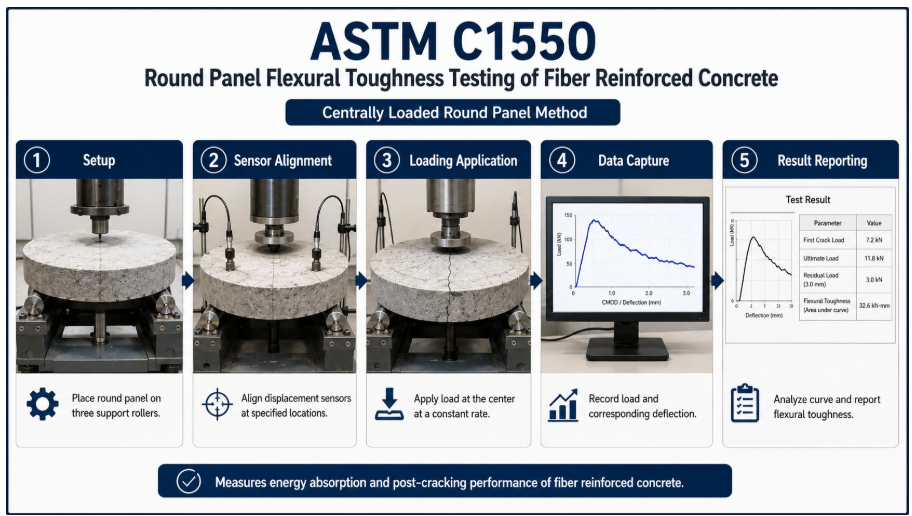
According to ASTM C1550, the test measures the energy that a circular fiber-reinforced concrete panel absorbs while the test setup centrally deflects the panel. The method quantifies toughness up to a specified central deflection limit, usually 5, 10, 20, or 40 mm.
- Material Type: Fiber-reinforced concrete (FRC), including steel fiber, synthetic fiber, and hybrid fiber-reinforced shotcrete or cast concrete.
- Applications: The method determines post-crack flexural energy absorption, toughness performance, and batch quality control for structural applications.
- Properties Measured: The test measures peak load capacity, crack patterns, post-crack residual strength, and total energy absorption in Joules.
- Test Method: The test setup applies a central displacement-controlled load to a round panel with a diameter of 750 mm and a thickness of 75 mm, using three radial pivot supports positioned at 120-degree intervals.
- Result: The test calculates energy absorption values in Joules at specified central deflections from the load-deflection curve.
- Test Limitations: The method applies only to fiber-reinforced mixtures. Unreinforced concrete panels fail prematurely and therefore do not provide meaningful energy absorption data.
- Environmental Conditions: Technicians cure and condition the test specimens under standard moist conditions that represent field conditions.
- Applications: Engineers use the results for underground tunnel linings, mining support, ground support shotcrete, heavy-duty industrial pavements, quality assurance, and performance verification.
What are the Uses of ASTM C1550 Testing?
ASTM C1550 testing helps structural engineers and testing laboratories determine the behavior of fiber-reinforced concrete mixes after cracking. The Standard –
- Determine actual energy absorption curves (in Joules) at specific deflections.
- Optimize the types, geometries, and dosages of synthetic or steel fibers for FRC formulation.
- Assess ductility and load redistribution under extreme post-cracking deformations.
- Compare the structural performance of different fiber types and concrete matrices.
- Validate shotcrete mix designs for underground ground control and tunnel support.
- Select raw materials that provide suitable performance for structural applications involving high-impact and dynamic loading.
What Materials Can Be Tested Under ASTM C1550?
The test evaluates fiber-reinforced concrete mixtures with steel, synthetic, glass, or natural fibers, designed to enhance toughness and reduce cracking under mechanical stresses, commonly used in industrial flooring, tunnel shotcrete, and precast concrete with high fiber dosages.
Why is ASTM C1550 Important?
ASTM C1550 provides a standard test method for evaluating the flexural toughness of fiber-reinforced concrete using centrally loaded round panels. Engineers use a centrally loaded round panel specimen with three pivots placed symmetrically around its perimeter to model the behavior of plate-like fiber-reinforced concrete structural members after cracking. During the test, a point load at the center causes the panel to undergo biaxial bending, and the panel fails in a mode that relates to in-situ structural behavior. Engineers approximate the post-crack performance of round panels by measuring the energy they absorb up to a certain central deflection. This measurement shows fiber-reinforced concrete’s ability to redistribute stress after cracking. Manufacturers and engineers use the results to assess material performance, compare different fiber types and amounts, and ensure consistent structural performance in high-demand applications.