
ASTM C1494 is a standard test method for measuring the content of carbon, nitrogen, and oxygen in silicon nitride powders. The impurities of these elements may greatly influence the sintering characteristics, mechanical performance, thermal stability, and service life of advanced ceramic products. ASTM C1494 (Standard Test Methods for Determination of Mass Fraction of Carbon, Nitrogen, and Oxygen in Silicon Nitride Powder) allows for the inspection of powders, the comparison of powder lot-to-lot, and the adjustment of the ceramic process. This method is appropriate to produce silicon nitride components with superior mechanical and electrical performance utilized in aerospace, automobile, electronics, medical, and industrial applications.
ASTM C1494 Mass Fraction of Carbon, Nitrogen, and Oxygen in Silicon Nitride Powder
What is ASTM C1494?
What is the scope of ASTM C1494?
ASTM C 1494 lists the standard testing techniques for determining the amount of carbon, nitrogen, and oxygen in silicon nitride powder. This test was used to aid companies in verifying if the powder was pure, determining if elemental impurity levels were acceptable, and checking material quality before ceramic processing and component fabrication.
- Calculate the percentage composition of Si₃N₄ powder by carbon, nitrogen, and oxygen.
- Determines the purity of powders for quality assurance.
- Qualifies raw materials and verifies suppliers.
- Compares the elemental compositions of different production batches.
- Supports research, product development, and process optimization.
What are the uses of ASTM C1494 testing?
ASTM C1494 testing is used to help manufacturers and researchers quantify the elemental composition of silicon nitride powders before processing. Accurate measurements of carbon, nitrogen, and oxygen can be used to support the qualification of material, enhance manufacturing consistency, and verify the performance of final ceramic parts.
- Tests for silicon nitride powders.
- Assists in the quality control process while manufacturing powder.
- Helps qualify and evaluate raw material suppliers.
- Assists in optimizing the ceramic processing and sintering performance.
- Compares the composition of the elements between various powder batches.
- Enables advanced ceramic manufacturing, research, and development.
What is Elemental Analysis of Silicon Nitride Powder?
Elemental analysis is used to quantify the amount of C, N, and O in the silicon nitride powder. These components are critical because they profoundly influence the powder’s purity, sintering behavior, and the mechanical properties and function of high-performance ceramic components. The ASTM C1494 sets the standard analytical procedures for obtaining accurate and repeatable analytical data of elemental composition.
Why is ASTM C1494 Testing Important?
The quality and reliability of advanced ceramic products are directly affected by the purity of silicon nitride powder. ASTM C1494 helps manufacturers to establish elemental compositions, detect impurities, and ensure that production is consistent. The standardized procedure also allows suppliers to be qualified and to research and meet customer specifications.
Which Materials Can Be Tested According to ASTM C1494?
ASTM C1494 specifically applies to silicon nitride powders used for manufacturing advanced ceramic components.
- Silicon nitride (Si₃N₄) powder
- High-purity silicon nitride ceramic powders
- Engineering ceramic raw materials
- Research-grade silicon nitride powders
- Silicon nitride powders used for structural ceramic applications
How Does ASTM C1494 Determine Carbon, Nitrogen, and Oxygen Content?
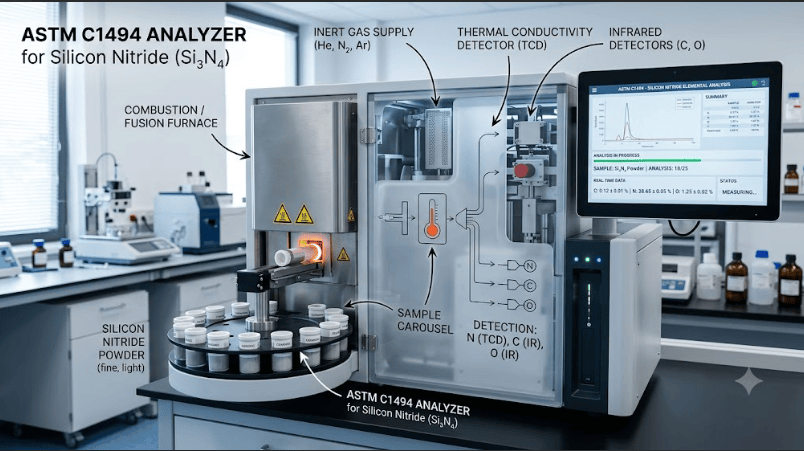
ASTM C1494 provides measurements of the elemental composition of silicon nitride powder by special analytical equipment under controlled laboratory conditions. Carbon is measured using a high-temperature combustion analyzer, and nitrogen and oxygen are measured by inert gas fusion or an oxygen/nitrogen analyzer. The method covers the determination of the mass fraction of carbon, nitrogen, and oxygen as weight percent (wt.%)/mass fraction.
Common Challenges and Troubleshooting
Several factors can cause an error in elemental analysis results, including sample contamination, moisture absorption, improper calibration, incomplete combustion, and inaccurate sample weighing. These problems are reduced in laboratories using certified reference materials, calibrated analyzers, and controlled testing environments, as well as clean sample handling procedures.
Analysis Results and Interpretation
- The test results report the mass fractions of carbon, nitrogen, and oxygen (wt.%) in the silicon nitride powder.
- Engineers use the test results to evaluate the purity and consistency of the silicon nitride powder.
- Engineers compare the test results from different production batches to assess manufacturing consistency.
- The test results support raw material qualification and quality control in ceramic manufacturing.
ASTM C1494 Equipment and Sample Preparation
Elemental analysis is only accurate if the samples are representative and the analytical instruments are properly calibrated. Clean powder samples are prepared, the contaminating elements are removed, and cleaned-up samples are then analyzed precisely using special analyzers to measure the quantities of carbon, nitrogen, and oxygen.
| Sample Details | Silicon nitride (Si₃N₄) powder intended for advanced ceramic applications. |
| Sample Preparation | Analysts collect a representative powder sample, dry it if required, prevent contamination during handling, and weigh the required quantity for elemental analysis. |
| Sample Requirements | Fine, homogeneous silicon nitride powder meeting the specified sample mass requirements. |
| Instrumentation | Carbon analyzer, oxygen/nitrogen analyzer, inert gas fusion analyzer, high-temperature combustion furnace, analytical balance, calibration standards, sample crucibles, and computerized data acquisition software. |
Testing Procedures and Requirements
The ASTM C1494 method uses a series of specialized elemental analyzers optimized for advanced ceramic powders to determine the mass fractions of carbon, nitrogen, and oxygen. The technicians prepare representative powder samples and analyze each element by means of an appropriate combustion or inert gas fusion method under controlled laboratory conditions. Elemental concentrations measured are used to validate the purity of the powder and to guarantee uniformity of production.
| Sample Preparation | Analysts collect and prepare a representative silicon nitride powder sample. |
| Carbon Analysis | Analysts determine carbon content using a high-temperature combustion analyzer. |
| Nitrogen Analysis | Analysts measure nitrogen concentration using an elemental analyzer. |
| Oxygen Analysis | Then, analysts determine oxygen content using inert gas fusion analysis. |
| Data Verification and Report Generation | Analysts validate analytical results through calibration and quality control procedures, and document elemental concentrations, specimen identification, and testing conditions. |
ASTM C1494 Testing Process and Data Collection
The elemental analysis results can be affected by a variety of factors, including sample contamination, moisture absorption, incorrect calibration, insufficient combustion, and incorrect sample weighing. These factors are controlled in laboratories using clean sample handling procedures, certified reference materials, calibrated analyzers, and controlled testing conditions.
Get Certified ASTM C1494 Testing for Silicon Nitride Powder Analysis
The chemical composition of silicon nitride powders has an impact on the quality and consistency of advanced ceramic products manufactured. ASTM C1494 is a precision chemical assay, and manufacturers can use it to qualify raw materials, maintain stable manufacturing, and comply with customer and industry standards. It can be utilized for research, product development, and quality assurance in independent laboratories.
Updated on August 9, 2026

Testimonials
Real results
Engineers trust us with what matters most
“We had a great experience working with this company for our ASTM E84 testing. They were the first company to respond to our inquiry within just a few minutes of submitting it. From start to finish, the communication was excellent, and the entire process was swift, straightforward, and hassle-free.”

“Very good communication, testing associates were very patient with delays on our end. Reasonable turnaround time for results and nicely detailed report. Analysts were also quick to answer any follow-up questions. Happy with results.”
“Matestlab connected us with an accredited lab within days, cutting weeks off our product validation timeline.”
Start Your Testing
Project Today
Project Today
Define your requirements and get access to
specialized laboratories ready to deliver results
specialized laboratories ready to deliver results
Start Testing
Partners with us
Clients
Vendors