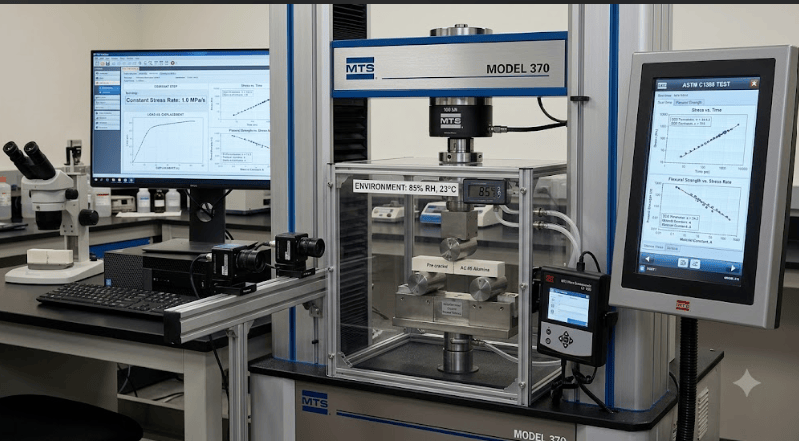
ASTM C1368 is a standard test method for measuring the slow crack growth parameters of advanced ceramics by constant stress rate ambient temperature strength testing. The technique can be used to assess the long-term reliability of materials, to compare ceramic materials, and to predict the service life of materials by measuring the propagation of cracks under various loading rates.
- Measures the SCG parameters of advanced ceramics.
- Assesses the effects of stress rate on fracture strength.
- Participates in material qualification and quality assurance programs.
- Assists with lifetime prediction and structural reliability assessments.
- Compares the toughness of high-tech ceramics.
- Produces consistent information for research, product development, and engineering design.
What are the applications of ASTM C1368?
Many times, long-duration mechanical reliability is required, and advanced ceramics are employed. ASTM C1368 is a standard for measuring the resistance of a material to slow crack growth in ambient conditions that can be used to compare materials, estimate service life, and enhance product performance. The standardized method is also used for quality control and material qualification. The test standard-
- Evaluates the slow crack growth behavior of advanced ceramics.
- Supports quality control during ceramic manufacturing.
- Assists in the research and development of high-performance ceramic materials.
- Helps predict long-term reliability and service life.
- Compares crack growth resistance among different ceramic materials.
- Supports material qualification and engineering design for critical applications.
What is Slow Crack Growth in Advanced Ceramics?
Slow crack growth (SCG) refers to the incremental growth of microcracks in a ceramic material when exposed to a constant or increasing load below its instantaneous fracture strength. This process can slowly progress to an eventual failure. ASTM C1368 is used to study the process and predict the long-term reliability of advanced ceramics.
Why is ASTM C1368 Testing Important?
Many times, long-duration mechanical reliability is required, and advanced ceramics are employed. ASTM C1368 is a standard for measuring the resistance of a material to slow crack growth in ambient conditions that can be used to compare materials, estimate service life, and enhance product performance.
What Materials can be Tested According to ASTM C1368?
ASTM C1368 applies to monolithic advanced ceramics that are susceptible to slow crack growth under mechanical loading at ambient temperature. The method is commonly used to evaluate materials such as alumina, silicon nitride, silicon carbide, zirconia, aluminum nitride, boron carbide, and other engineering ceramics used in structural, aerospace, biomedical, and energy applications.
How does ASTM C1368 Determine Slow Crack Growth Parameters?
ASTM C1368 tests monolithic advanced ceramics by conducting constant stress rate strength testing at ambient temperature under three-point or four-point flexural fixtures in a universal testing machine (UTM). Specimens are tested under various stress rates, and the fracture strength values are compared and used to obtain the parameters associated with the slow crack growth, such as the susceptibility of the material to stress corrosion. The results enable engineers to predict long-term strength retention, estimate service life, evaluate the reliability of the structure, and qualify materials for critical applications.
Common Challenges and Troubleshooting
Slow crack growth measurements can be affected by surface flaws, machining damage, improper specimen alignment, inaccurate loading rates, and equipment calibration errors. The number of these problems can be reduced in laboratories by carefully preparing specimens, keeping calibrated testing equipment, and applying the required loading procedures during evaluation.