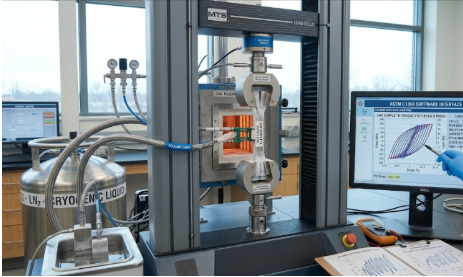
ASTM C1360 offers a standard practice for testing the constant-amplitude, axial tension-tension cyclic fatigue resistance of continuous fiber-reinforced advanced ceramic matrix composites at ambient temperature. The practice provides fatigue durability information to compare composite materials and to provide reliable fatigue performance data for material qualification, research, and structural design. ASTM C1360-
- Tests the cyclic fatigue of continuous fiber-reinforced ceramic matrix composites (CMCs).
- Calculates fatigue life under constant-amplitude (axial tension-tension) loading.
- Assists in the qualification and quality assurance of materials.
- Compares the fatigue performance of the various ceramic composite materials.
- Supports repeated tensile loading of parts in terms of design.
- Provides standardized fatigue data for research and engineering applications.
ASTM C1360 uses constant-amplitude, axial tension-tension cyclic loading at ambient temperature to assess the fatigue behavior of continuous fiber-reinforced advanced ceramic matrix composites (CMCs). The method can be performed on a servo-hydraulic fatigue testing machine to determine fatigue life, stress ratio, loading frequency, and number of cycles to failure, which can be used to provide valuable information on material qualification, durability, quality control, and structural design.
What are the applications of ASTM C1360 testing?
ASTM C1360 testing helps manufacturers and researchers assess the repeated tensile behavior of advanced ceramic composites. Manufacturers use fatigue data for material selection, product development, structural design, and quality assurance of components subjected to cyclic loading. ASTM C1360 testing-
- Evaluates silicon carbide (SiC) fiber-reinforced ceramic matrix composites (CMCs) to determine their mechanical performance, durability, and suitability for structural applications.
- Assesses oxide fiber-reinforced ceramic composites used in high-temperature environments where oxidation resistance and thermal stability are critical.
- Measures the mechanical properties of carbon fiber-reinforced ceramic composites for lightweight components requiring high strength and thermal resistance.
- Characterizes continuous fiber-reinforced silicon nitride composites to support material qualification, engineering design, and quality control.
- ASTM C1360 is widely used to evaluate advanced ceramic matrix composites for aerospace, energy, automotive, and defense applications.
- Manufacturers use ASTM C1360 to evaluate ceramic matrix composites for aerospace, energy, automotive, and defense applications.
What is Tension-Tension Cyclic Fatigue?
Tension-tension cyclic fatigue is progressive damage that develops when a material experiences repeated tensile loading without reversing into compression. Under repeated loading and unloading, over thousands or millions of cycles, microscopic damage builds up and can cause failure. ASTM C1360 provides a standardized practice for performing tension-tension cyclic fatigue tests on continuous fiber-reinforced ceramic matrix composites at ambient temperature.
Why is ASTM C1360 Testing Important?
Most of the advanced ceramic composites are subjected to repeated loading in service. ASTM C1360 is used to select materials for use, assess their fatigue resistance, predict service life, and compare the durability of various composite materials. The standardized practice also enables material qualification, product development, and reliable design of engineering products for fatigue-critical applications.
What Materials Can be Evaluated According to ASTM C1360?
ASTM C1360 applies to continuous fiber-reinforced advanced ceramic matrix composites intended for structural applications subjected to cyclic tensile loading.
- Silicon carbide fiber-reinforced ceramic matrix composites.
- Oxide fiber-reinforced ceramic matrix composites.
- Carbon fiber-reinforced ceramic matrix composites.
- Continuous fiber-reinforced silicon nitride composites.
- Continuous fiber-reinforced alumina composites.
- Advanced ceramic matrix composites (CMCs) used in aerospace, energy, automotive, and defense industries
ASTM C1360 tests fatigue under repetitive application of constant-amplitude axial tensile loads at a certain stress ratio and loading frequency to a test specimen. The fatigue testing machine keeps track of the amount of load applied and the number of cycles endured by the specimen until the specimen breaks or reaches the end of the desired test. Engineers use the test results to evaluate fatigue life and long-term mechanical performance.
What are Common Challenges and Troubleshooting
Fatigue test results can be affected by specimen misalignment, grip damage, improper loading frequency, inaccurate stress control, and specimen defects. Calibrated fatigue testing equipment, precision grips, specimen alignment, and monitoring throughout the test are all employed by the laboratories to reduce these factors.
ASTM C1360 Testing Process and Data Collection
The composite specimen is prepared and inspected before mounting in a servo-hydraulic fatigue testing machine. The system applies multiple tensile loads at the desired stress level and frequency and records the specimen response in real time. Engineers analyze the data to calculate fatigue life, number of cycles to failure, and overall fatigue performance.