ASTM C1359 Standard Test Method for Monotonic Tensile Strength Testing of Fiber-Reinforced Advanced Ceramics

    What is ASTM C1359?

    ASTM C1359 is a standard test method that covers the determination of tensile strength, including stress-strain behavior, under monotonic uniaxial loading of continuous fiber-reinforced advanced ceramics at elevated temperatures. The tensile strength obtained in this test method is the tensile strength under monotonic uniaxial loading. It is defined as the test in which the loading direction (tensile) is never reversed from the start of the test to final fracture. The test method covers several proposed test specimen configurations, fabrication techniques, testing modes, testing rates, allowable bending, temperature control, temperature gradients, and data collection. Continuous fiber-reinforced ceramic matrix composites are candidate materials for applications with high levels of wear and corrosion resistance, and high levels of inherent damage tolerance at elevated temperatures.

    Read more

    Get Certified ASTM C1359 Testing for Reliable Advanced Ceramic Performance

    The tensile strength of continuous fiber-reinforced advanced ceramics has a direct impact on the reliability and integrity of the structures in extreme environments. ASTM C1359 certification provides materials with performance standards for power generation, automotive, and aerospace applications. Qualified laboratory testing yields accurate and repeatable data for material development, material comparison, quality assurance, characterization, reliability testing, and generation of design data. 

    What is the Scope of ASTM C1359?

    ASTM C1359 is a standard for the determination of tensile strength, including the stress-strain behavior, of continuous fiber-reinforced advanced ceramics at high temperatures under monotonic uniaxial loading conditions. The standard is for advanced ceramic matrix composites reinforced in unidirectional (1D), bidirectional (2D), and tridirectional (3D) configurations. 

    Read more

    The scope of ASTM C1359 includes:

    • Material type: The ASTM C1359 specifications are for advanced ceramic matrix composites (AMC) containing continuous fibres (1D, 2D, 3D, and other multi-directional fibre reinforcement) and a glass (amorphous) matrix. 
    • Purpose: ASTM C1359 measures tensile strength and stress–strain properties used for material development, material comparison, quality assurance, material characterization, material reliability, and generation of design data.Properties measured: under thermal loading, tensile strength, stress-strain behavior, fracture strength, strain at fracture, elastic modulus.
    • Method: ASTM C1359 is a uniaxial tensile test with controlled testing mode (force, displacement, or strain control), rate (force rate, stress rate, displacement rate, or strain rate), and elevated temperature.
    • Result: The testing laboratory obtains tensile strength and stress-strain data from the specimens it tests.
    • Test Limitations: This test method is not directly applicable to discontinuous fiber-reinforced, whisker-reinforced, or particulate-reinforced ceramics.
    • Environmental conditions: The test program contains elevated temperature with controlled temperature gradients and thermocouple calibration. 
    • Applications: Items subject to this application include Electronic thermal management components, power generation systems and turbines, automotive high-temperature ceramic components, and aerospace structural and thermal components. 

    What are the Uses of ASTM C1359 Testing?

    ASTM C1359 testing assists laboratories in obtaining accurate tensile strength data to evaluate advanced ceramic quality. Engineers and manufacturers use these results for material development, quality assurance, and design validation. 

    This standard-

    • Measuring tensile strength and stress-strain relationships at high temperatures
    • Developing and comparing supporting materials
    • Advanced ceramics are used to enable quality assurance and characterization.
    • Generating design data for high-temperature structural applications.
    • Comprehensive evaluation of the reliability of continuous fiber-reinforced ceramics in extreme environments.
    • Supporting component qualification for aerospace, automotive, and power generation applications

    Which materials can be tested under ASTM C1359?

    ASTM C1359 applies to advanced ceramic matrix composites with one unidirectional (1D), bidirectional (2D), or tridirectional (3D), or other multidirectional configuration of continuous fiber reinforcement. The technique is also applicable to composites in which the matrix is glass (amorphous) and the reinforcement is continuous fiber. This test does not directly address discontinuous fiber-reinforced, whisker-reinforced, or particulate-reinforced ceramics. 

    Why is ASTM C1359 Important?

    ASTM C1359 Standard Test Method for Tensile Strength of Continuous Fiber-Reinforced Advanced Ceramics at High Temperature gives a standard method for testing the tensile strength of continuous fiber-reinforced advanced ceramics at elevated temperatures. While the monolithic advanced ceramics typically break catastrophically from a key flaw, CFCCs generally follow a cumulative damage process and break with ductile-like stress-strain behavior. Uniaxially loaded tensile strength tests give mechanical behavior and strength information of a material that is loaded uniformly. This standard allows material qualification, aids in the generation of design data, and aids industries in assuring the structural integrity of material under some extreme conditions. 

    ASTM C1359 Equipment and Sample Preparation Guide

    The ASTM C1359 test specifies a high-temperature tensile testing machine, appropriate grip interfaces, a furnace, an extensometer, and a data acquisition system. The samples are made on the basis of solid rectangular cross sections in standard preparation.

    Read more

    Sample and Specimen Details
    Technicians prepare continuous fiber-reinforced advanced ceramic specimens with solid rectangular cross sections for controlled elevated temperature tensile testing. 
    Specimen PreparationTechnicians fabricate specimens according to suggested geometries listed in the appendices, with grip interfaces matching the specimen geometry and reinforcement type  
    Specimen DimensionsTechnicians measure the gauge section width to 0.02 mm accuracy; the standard addresses various suggested test specimen geometries  
    InstrumentationThe test uses a high-temperature tensile testing machine with load accuracy of ±1.0% of load range, a high-temperature furnace with temperature control, an extensometer suitable for ambient or elevated temperatures, thermocouples, and a data acquisition and control system  

    Testing Procedures and Requirements for ASTM C1359

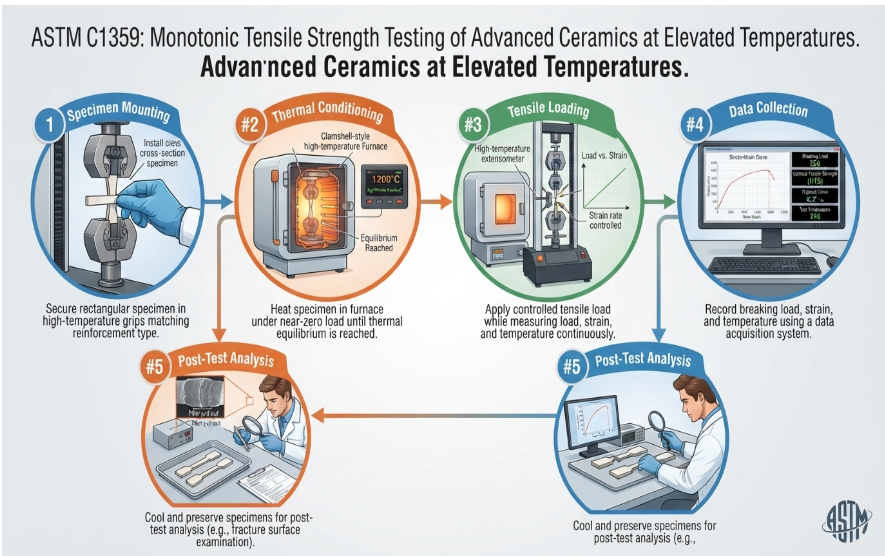
    ASTM C1359 uses monotonic uniaxial tensile loading at elevated temperatures to determine tensile strength and stress-strain behavior. The test is based on SI units. This process is done as follows:

    Read more

    Specimen Mounting Technicians install specimens in the load train using grip interfaces that match the specimen geometry and reinforcement type  
    Thermal Conditioning Technicians heat specimens in a furnace under near-zero load until thermal equilibrium at the test temperature is reached  
    Tensile Loading Technicians apply a controlled tensile load while continuously measuring load, strain, and temperature until fracture occurs  
    Data Collection Technicians record the breaking load, strain, and temperature using a data acquisition system  
    Post-Test Analysis Technicians cool and preserve specimens for post-test analysis  

    ASTM C1359 Testing Process and Data Collection

    The testing process first involves fabricating specimens having solid rectangular cross sections to conform to suggested geometries. Technicians use appropriate load train grips to install the specimen into the load train. Thermal conditioning is carried out in the furnace under near-zero load up to thermal equilibrium at the test temperature. The controlled tensile load is applied, and the load, the strain, and the temperature are measured continuously until the material fractures. The data acquisition system records the breaking load, strain, and temperature. Techs freeze and store specimens for testing after the activity. Analysts gather and use data to determine tensile strength and stress-strain relationships. 

     The image shows a high-temperature tensile testing machine used to perform monotonic tensile strength testing of a ceramic matrix composite specimen in a furnace to ASTM C1359 standard.
    ASTM C1359 Elevated Temperature Tensile Testing of Continuous Fiber-Reinforced Advanced Ceramics

    Common Challenges and Troubleshooting in ASTM C1359

    Proper specimen alignment and gripping mechanisms are essential to achieving accurate ASTM C1359 results. Misalignment results in false tensile strength readings and causes damage to the composite material. The nonuniform stress distribution of flexure test specimens and dissimilar mechanical behavior in tension and compression for CFCCs lead to ambiguity in the interpretation of strength results. Scientific laboratories obtain reliable data using special grips, uniform load distribution, routine equipment calibration, calibration of the thermocouples according to ASTM E220, and the verification of the extensometer according to ASTM E83. 

    ASTM C1359 Analysis Results and Interpretation

    ASTM C1359 reports in SI units. The test generates the tensile strength and stress-strain data on continuous fiber-reinforced advanced ceramics.

    Read more

    • The tensile strength values reported in the laboratory are the maximum stress that the material can withstand under monotonic uniaxial loading.
    • The Analyst takes notes on the engineering stress-strain curves, which give information about mechanical behavior under uniaxial tensile stresses.
    • The report records the fracture strength, strain at fracture, and elastic modulus under thermal loading.
    • Laboratory records test conditions, such as testing mode, testing rate, temperature gradients, and temperature.
    • Mechanical performance data and material comparison are available with temperature dependence for qualification.
    • According to ASTM C1359, engineers rely on the evaluation results for design validation, quality assurance, and reliability assessment. 

    Link to ASTM C1359 

    FAQ

    What is required for ASTM C1359 testing equipment?
    It is required that the high-temperature tensile testing machine have a load range accuracy of +-1% of the test load range; a high-temperature furnace, an extensometer, thermocouples, and a data acquisition system are required for these tests, as specified in ASTM C1359.
    The uniaxially loaded tensile strength tests yield information about the mechanical behavior and strength of a uniformly stressed material. There is a nonuniform stress distribution in flexure test specimens, and CFCCs have different mechanical properties in compression and tension, which introduce ambiguity in the interpretation of strength.
    CFCCs are more likely to have a graceful, non-catastrophic failure from a cumulative damage process instead of catastrophic failure from a single flaw. ASTM C1359 is the standard for tensile strength data that is needed for design, quality control, and reliability evaluation in critical applications.

    Updated on November 9, 2026

    Dr Ruchika Yogesh
    About Author
    Dr. Ruchika Yogesh is a serial entrepreneur, material science and AI/ML enthusiast, medicinal chemistry subject matter expert (SME), scientific/medical copyeditor, and a researcher.
    Know More
    Testimonials
    Real results
    Engineers trust us with what matters most
    Why Choose Matestlab?
    Matestlab is a unified testing services partner based in the USA. Matestlab offers raw material and product testing services through accredited, expert laboratories primarily based in the USA. Matestlab supports physical, thermal, chemical, electrical, mechanical, environmental, and characterization testing needs through its global network of 2200+ accredited testing laboratories. Matestlab's in-house materials science experts curate and design comprehensive testing programs matched to the sample material and specific testing need, with regulatory requirements and confidentiality in mind.

    If you are looking for a managed and trusted testing partner to achieve your research goals, feel free to schedule a meeting with us or send us a request at connect@matestlabs.com to learn more about our services. For a quick quote, call us at (302)244-7710. We are happy to serve you.
    Start Your Testing
    Project Today
    Define your requirements and get access to
    specialized laboratories ready to deliver results
    Partners with us
    Clients
    Vendors
    Process for testing
    • STEP 01

      You share your testing requirements

    • STEP 02

      You share your sample(s)

    • STEP 03

      We deliver your test reports

    Get your testing done

    Let us know your testing requirements and we will be right back with a solution.

      Let us root for each other. Collaborate to grow, expand, and accelerate our businesses.

      Partner with us