MaTestLab > ASTM Methods > Glass > ASTM C1350M Measurement of Viscosity of Glass Between Softening Point and Annealing Range (Approximately 108 Pa·s to Approximately 1013 Pa·s) by Beam Bending
ASTM C1350M Measurement of Viscosity of Glass Between Softening Point and Annealing Range (Approximately 108 Pa·s to Approximately 1013 Pa·s) by Beam Bending
ASTM C1350M is the standard test method for measurement of viscosity of glass between softening point and annealing range (approximately 10⁸ pa·s to approximately 10¹³ pa·s) by beam bending (metric). The standard defines a beam bending procedure for the viscosity measurement of glass using the bending rate of a simply supported glass beam under a constant load at high temperatures. This method measures the viscosity of glass in the range of approximately 10⁸ Pa·s to 10¹³ Pa·s and is suitable for evaluating glass viscosity between the softening point and the annealing range. ASTM C1350M is widely used in the glass manufacturing, research, quality control, and materials development industries.
Read More
GET STARTED
What is ASTM C1350M?
ASTM C1350M is the standard test method for viscosity of glass between the softening point and annealing range by bending (metric). It establishes a standard laboratory method for measuring the viscosity of glass by measuring the bending rate or deflection of a loaded glass beam under controlled temperature conditions. This method enables manufacturers to evaluate glass flow behavior, optimize forming and annealing processes, and characterize viscosity over the softening-to-annealing temperature range. This method is especially suitable for viscosity ranges that exceed those measured by rotational or parallel-plate viscometry methods.
Get Certified ASTM C1350M Glass Viscosity Testing
The viscosity of glass is an important property that affects the forming, annealing, and dimensional stability during manufacture. ASTM C1350M provides a reliable beam-bending method for accurately determining viscosity over the softening-to-annealing temperature range and helps manufacturers to optimize processing conditions, improve product quality, and ensure consistent glass performance.
Service Name
Remarks
ASTM C1350M Testing
Contact US
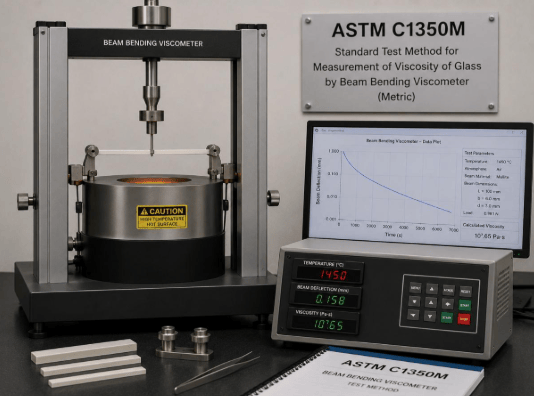
ASTM C1350M Beam Bending Viscometer
ASTM C1350M Equipment and Sample Preparation Guide
The requirements for accurate viscosity measurement of glass beam specimens include careful preparation of the specimens, control of furnace temperature, careful selection of loading conditions, and accurate measurement of the furnace deflection. Reliable and repeatable beam-bending viscosity results are obtained by using specimen dimensions, thermal conditioning, and calibrated instrumentation.
Samples and Specimen Details
Prepare representative glass beam specimens made from the material being tested for viscosity.
Specimen preparation
Technicians prepare glass beam specimens with smooth, defect-free surfaces and condition them according to ASTM C1350M before beam-bending testing.
Specimen Dimensions
Beam specimen dimensions shall comply with ASTM C1350M. The length, width, and thickness of the beam need to be accurately measured for viscosity calculation.
Instrumentation
Beam Bending Viscometer, High-Temperature Furnace, Loading Fixture, Specimen Supports, Deflection Measuring Device (LVDT/Dial Gauge), Thermocouples, Temperature Controller, Data Acquisition System.
Standard Test Methods and Requirements for ASTM C1350M
ASTM C1350M specifies a standard beam bending test method for measuring the viscosity of glass. Reliable and repeatable viscosity values require proper specimen preparation, controlled furnace heating, constant loading, and accurate deflection measurements.
Glass Beam Preparation
Make a representative glass beam specimen of suitable dimensions and smooth surfaces for the beam bending process.
Controlled Heating and Loading
Place the beam on the support, apply a constant load, and heat the specimen under controlled temperature conditions.
Beam Deflection Measurement
Technicians measure the beam deflection as the heated glass undergoes viscous deformation under the applied load.
Viscosity Calculation
Measure the beam-bending rate and calculate the glass viscosity based on applied load, specimen geometry, and test temperature.
What is the scope of the ASTM C1350M standard test?
ASTM C1350M establishes a beam bending test for the viscosity range of glass from about 108 Pa·s to 1013 Pa·s. The method assesses the behavior of glass in the softening point to annealing range and is applicable for quality control, product development, and glass research. This test method-
Covers viscosity measurement of glass by bending.
Measures viscosity from approximately 10⁸ Pa·s to 10¹³ Pa·s.
Evaluates glass between the softening point and annealing range.
Uses a simply supported loaded glass beam.
Uses controlled heating and precise deflection measurement.
Supports glass manufacturing, research, and quality assurance.
Standardized viscosity determination in metric units.
What are the Uses of ASTM C1350M Testing?
ASTM C1350M measures the viscosity of glass between the softening point and the annealing range using the beam-bending method. The test assesses the flow properties of glass and helps manufacturers determine appropriate thermal processing conditions and evaluate product quality. This test method-
Uses the beam-bending method to determine the viscosity of glass.
Describes the characteristics of glass in the softening point to the annealing range.
Supports optimization of the glass manufacturing process.
Helps develop materials and product qualification.
Checks the thermal processing properties of glass.
Compares the viscosity of different glass compositions.
Assists with quality assurance and research applications.
What Materials Can Be Tested Under ASTM C1350M?
ASTM C1350M is applicable to glass materials with viscosities between approximately 10⁸ Pa·s and 10¹³ Pa·s. The laboratory can use this method for commercial, specialty, laboratory, and engineering glasses rated in the softening point to the annealing range.
Why is ASTM C1350M Important?
ASTM C1350M is the standard that specifies viscosity measurement of glass during thermal processing. It aids manufacturers in optimizing forming and annealing operations, enhancing product quality, and achieving uniformity in the characteristics of their processing.
Common Challenges and Troubleshooting
Properly prepared glass beam specimens, furnace temperatures, loading, and deflections are essential for accurate viscosity measurements. Frequent issues include specimen dimensional inaccuracies, support alignment in uneven positions, temperature variations, surface defects, instrument calibration errors, and inconsistent loading conditions. Accurate and repeatable viscosity measurements are achieved through proper specimen preparation, calibrated equipment, and controlled heating.
ASTM C1350M Testing Process and Data Collection
The testing procedure begins with the preparation of a representative specimen of a glass beam of desired dimensions. The glass beam sample is placed on two supports in a high-temperature furnace, and a predetermined constant load is applied to the beam to induce bending. The temperature is maintained within the desired range, and the beam slowly bends as a result of viscous flow. Some of the data recorded in the lab are beam deflection, load applied, furnace temperature, time elapsed, and the rate of bending. This information is used by the laboratories to determine the viscosity of the glass per ASTM C1350M.

Analysis Results and Interpretation
ASTM C1350M determines the viscosity of glass by measuring beam deflection under controlled loading.
Laboratories report viscosity in pascal-seconds (Pa·s) over the range of approximately 10⁸ Pa·s to 10¹³ Pa·s, together with the corresponding test temperature and beam deflection.
Testing laboratories also report the applied load, specimen dimensions, support span, and test duration because these parameters are required for calculating viscosity using the beam-bending method.
Engineers use these results to evaluate glass processing behavior, optimize forming and annealing operations, and compare different glass formulations.
What are the factors to consider for the ASTM C1350M testing?
Speed: Beam-bending viscosity testing requires controlled heating and sufficient time for measurable specimen deformation.
Expertise: Precision glass beam samples need to be prepared by specialized laboratory staff, using a high-temperature bending beam apparatus to obtain accurate viscosity values.
Cost: The longterm production costs are reduced; standardized viscosity testing optimizes the manufacturing process of glass, reduces manufacturing defects, and ensures product consistency, requiring special equipment.
Dr. Ruchika Yogesh is an entrepreneur, science and AI/ML enthusiast, medicinal chemistry subject matter expert (SME), scientific/medical copyeditor, and an independent researcher.
FAQ's
Where can I get the astm c1350m tested?
You can share your astm c1350m testing requirements with MaTestLab. MaTestLab has a vast network of material testing laboratories, spread across the USA and Canada. We support your all material testing needs ranging from specific astm c1350m test to various testing techniques.
How much do I need to pay for the astm c1350m test?
Please contact us for a detailed quote for your astm c1350m testing needs. Cost incurred to carry out different astm c1350m testing methodology depends on the type of raw material; number of samples, coupons, or specimens; test conditions, turn around time etc. Costs of some ASTM testing methods start from $100 and the final value depends upon the factors listed above. Please contact us for the best and latest prices.
How many samples are required for astm c1350m?
The required number of samples or specimens should comply with the procedure given in the astm c1350m standard. However, the MaTestLab operations team can assist you for your special requirements once you share your testing details with us.
How much discount can I get on the astm c1350m test?
MaTestLab has a vast testing laboratory network, hence we bring you the best testing facilities in a cost-effective way. We offer considerable discounts (15-20%) to our returning customers based on test volume and frequency.
How many days will it take to complete the astm c1350m test?
The turnaround time for astm c1350m test methodology depends upon the test procedure mentioned in the standard test document. However, we at MaTestLab understand your research requirements and hence try to get your test completed within the least possible time.
Where can I get the astm c1350m tested?
You can share your astm c1350m testing requirements with MaTestLab. MaTestLab has a vast network of material testing laboratories, spread across the USA and Canada. We support your all material testing needs ranging from specific astm c1350m test to various testing techniques.
MaTestLab Inc. offers accessible, quick, and affordable material testing, product testing, and failure analysis services. We support your on-demand testing and expert consultation needs with the help of our extensive network of material testing laboratories situated in the US and other parts of the world.
MATERIAL TESTING
We offer destructive and non-destructive tests over a range of mechanical, electrical, chemical, thermal, optical, corrosion, radiation, and biological testing methodologies defined by ASTM, ISO and other organizations.
PRODUCT TESTING
We help you evaluate and ensure your product quality and performance with standard and custom-made testing solutions. All the tests are done at well-equipped testing laboratories using standard testing methods for best output and satisfaction.
FAILURE ANALYSIS
Failure analysis ensures high levels of quality in every manufacturing process. We help you with getting the best failure or root cause analysis to determine the cause of the failure. The results help you identify means to prevent failure recurrences.