ASTM C1341 Flexural Properties of Continuous Fiber-Reinforced Advanced Ceramic Composites

    What is ASTM C1341?

    ASTM C1341 is the standard test method for flexural properties of continuous fiber-reinforced advanced ceramic composites. It establishes a standard laboratory method for determining the flexural properties of continuous fiber-reinforced ceramic composites using rectangular specimens loaded in three- or four-point bending. The method determines important mechanical properties such as flexural strength, flexural stress-strain response, and flexural modulus. This method applies to continuous fiber-reinforced ceramic matrix composites with 1-D, 2-D, 3-D, and other continuous fiber architectures, as well as certain continuous fiber-reinforced glass matrix composites.

    Read more

    Get Certified ASTM C1341 Flexural Property Testing

    High strength-to-weight ratio and flexural properties are important mechanical properties of ceramic matrix composites for high-performance structural applications. The ASTM C1341 bending test is used to evaluate material stiffness, flexural strength, and material deformation for product development, quality control, and engineering design.

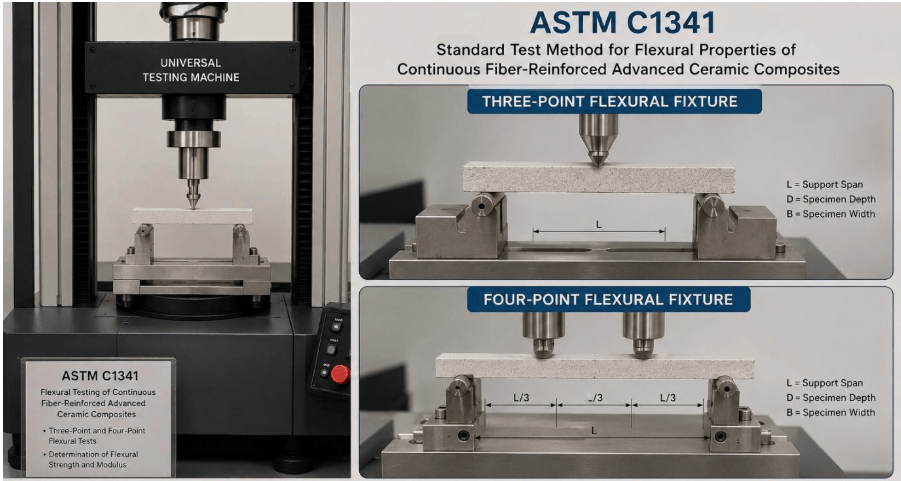
    This image shows a three-point and four-point flexural fixture mounted on a universal testing machine for testing continuous fiber-reinforced advanced ceramic composites according to ASTM C1341.
    ASTM C1341 Three-Point and Four-Point Flexural Fixture

    What is the Scope of ASTM C1341 Test Standard?

    ASTM C1341 specifies standard methods of testing flexural properties of continuous fiber-reinforced ceramic composites in rectangular bar specimens. The standard includes one three-point bending configuration and two four-point bending configurations for evaluating the flexural properties of continuous fiber-reinforced ceramic composites. This test standard-

    Read more

    • Covers continuous fiber-reinforced ceramic matrix composites (CMCs).
    • Works with rectangular bar specimens. 
    • Includes three-point and four-point flexural testing methods. 
    • Evaluates the flexural strength, modulus, and stress-strain characteristics. 
    • Can be used at ambient or elevated temperatures, depending on the test conditions.
    • Assists in material qualification and quality control. 
    • Can be used for 1-D, 2-D, 3-D, and other continuous fiber architectures.

    What is the Use of ASTM C1341 Testing?

    ASTM C1341 determines the flexural properties of continuous fiber-reinforced advanced ceramic composites under bending loads. The test measures the flexural strength, flexural modulus, and stress-strain properties of the material, important factors for determining the performance of a structure and for selecting appropriate composite materials for specific engineering applications. The test standard-

    • Measures the bend strength of ceramic matrix composites. 
    • Determines flexural modulus and stress-strain properties. 
    • Evaluates the flexural behavior of composite materials under bending loads.
    • Supports material qualification and product development.
    • Helps with quality control in composite manufacturing. 
    • Compares the mechanical performance of different composite systems. 
    • Assists engineering design and structural reliability assessment.

    What Materials Can Be Tested Under ASTM C1341? 

    ASTM C1341 applies to continuous fiber-reinforced advanced ceramic matrix composites (CMCs) with 1-D, 2-D, 3-D, and multidirectional fiber architectures. 

    Why is ASTM C1341 Important? 

    ASTM C1341 determines the flexural properties of advanced ceramic composites. It helps manufacturers evaluate mechanical properties, assess product consistency, and generate reliable design data for structural applications.

    Common Challenges and Troubleshooting 

    Accurate testing of flexural properties requires properly machined specimens, correct fixture alignment, calibrated testing equipment, and controlled loading conditions. Common issues include chipping at specimen edges, machining-induced surface defects, support misalignment, incorrect spans, uneven loading, and incorrect deflection measurements. Proper specimen preparation, fixture calibration, and dimensional verification ensure reliable and repeatable flexural test results.

    ASTM C1341 Equipment and Sample Preparation Guide

    Carefully machined rectangular test specimens, accurate dimensional measurements, correct alignment, and calibrated loading equipment are important factors for accurate flexural testing. Specimen preparation and loading procedures are defined in ASTM C1341 in order to ensure that reliable, repeatable measurement of the flexural property is obtained.

    Read more

    Sample and Specimen DetailsTechnicians prepare representative continuous fiber-reinforced ceramic composite specimens as rectangular bars by forming them directly or cutting them from sheets, plates, or molded components.
    Specimen PreparationTechnicians machine the specimen to the required dimensions, inspect it for machining defects, verify the dimensions, and prepare smooth loading and support surfaces before testing.
    Specimen DimensionsRectangular bar specimens must comply with the shape and size that ASTM C1341 specifies for the three- or four-point flexural test method.
    InstrumentationUniversal Testing Machine (UTM), three-point and four-point flexural fixture, Load cell, Deflection measuring device/Extensometer, Vernier caliper, Micrometer, data acquisition system.

    Testing Procedures and Requirements for ASTM C1341

    ASTM C1341 specifies standard procedures to determine flexural properties of continuous fiber-reinforced ceramic composites by bending. Reliable, repeatable flexural property data is obtained when specimens are prepared properly, the fixtures are aligned properly, loading is controlled, and continuous measurement of load and deflection is used.

    Read more

    Specimen PreparationTechnicians machine the rectangular composite specimen to the specified dimensions and inspect the surface for defects before testing.
    Flexural Loading TestThe technician applies the load using either the specified three-point or one of the approved four-point bending configurations until specimen failure or completion of the test.
    Load and Deflection MeasurementThe technician continuously measures the applied load and specimen deflection (or strain) throughout the flexural test and records the data for subsequent analysis.
    Flexural Property CalculationEngineers calculate the flexural strength, flexural stress, flexural strain, and flexural modulus using the recorded test data and specimen dimensions specified in ASTM C1341.

    ASTM C1341 Testing Process and Data Collection 

    Manufacturers select a representative rectangular ceramic composite sample according to the specified dimensions. The operator places the specimens in a three-point or four-point bending fixture in a universal testing machine. The operator applies a control load until specimen failure or completion of the test while continuously recording load and deflection (or strain). Laboratories assess the mechanical properties by recording the specimen dimensions, support span, applied load, maximum load, flexural stress, flexural strain, flexural modulus, and fracture characteristics during testing.

    Analysis Results and Interpretation 

    • ASTM C1341 tests the flexural properties of continuous fiber-reinforced ceramic composites. 
    • Engineers evaluate the load-deflection curve to characterize the flexural response of the composite material.
    • Laboratories typically report results as flexural strength (MPa), flexural modulus (GPa), flexural stress (MPa), flexural strain (%), maximum load (N or kN), and load-deflection curves. 
    • The fracture behavior provides useful information about the damage tolerance and failure mechanisms of continuous fiber-reinforced ceramic composites.
    • Flexural modulus is determined from the linear portion of the load-deflection or stress-strain response in accordance with ASTM C1341.
    • Manufacturers use these values to compare material performance, support engineering design, and evaluate manufacturing consistency.

    Link to ASTM C1341

    Read more

    Updated on July 30, 2026

    Malhar Khole
    About Author
    Malhar Khole is a Material Testing Associate at Matestlab Inc. and holds a postgraduate degree in Material Science and Technology from IIT (BHU), Varanasi.
    Know More
    Testimonials
    Real results
    Engineers trust us with what matters most
    Why Choose Matestlab?
    Matestlab is a unified testing services partner based in the USA. Matestlab offers raw material and product testing services through accredited, expert laboratories primarily based in the USA. Matestlab supports physical, thermal, chemical, electrical, mechanical, environmental, and characterization testing needs through its global network of 2200+ accredited testing laboratories. Matestlab's in-house materials science experts curate and design comprehensive testing programs matched to the sample material and specific testing need, with regulatory requirements and confidentiality in mind.

    If you are looking for a managed and trusted testing partner to achieve your research goals, feel free to schedule a meeting with us or send us a request at connect@matestlabs.com to learn more about our services. For a quick quote, call us at (302)244-7710. We are happy to serve you.
    Start Your Testing
    Project Today
    Define your requirements and get access to
    specialized laboratories ready to deliver results
    Partners with us
    Clients
    Vendors
    Process for testing
    • STEP 01

      You share your testing requirements

    • STEP 02

      You share your sample(s)

    • STEP 03

      We deliver your test reports

    Get your testing done

    Let us know your testing requirements and we will be right back with a solution.

      Let us root for each other. Collaborate to grow, expand, and accelerate our businesses.

      Partner with us