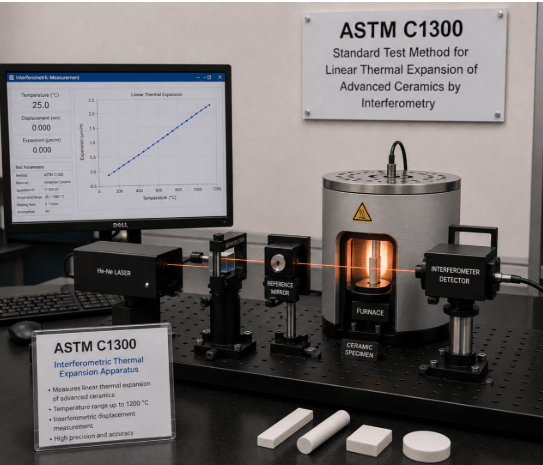
The standard offers methods for measuring dimensional changes during controlled heating to determine the coefficient of thermal expansion (CTE) and assess material compatibility when working in ceramic applications. The ASTM C1300 standard-
- Applies to glaze frits and ceramic whiteware materials.
- Measures linear thermal expansion interferometrically.
- Calculates the coefficient of thermal expansion.
- Uses controlled heating and precision optical measurements.
- Supports characterization of glaze frits and ceramic whiteware materials.
- Provides thermal expansion data that help evaluate glaze-to-body compatibility.
- Provides standard expansion data.
What is the Use of ASTM C1300 Testing?
ASTM C1300 is a method for determining the linear thermal expansion of glaze frits and ceramic whiteware materials by the interferometric technique. This test is used to compare thermal expansion properties of glaze frits and ceramic bodies, optimize glaze formulation, and make glaze products more reliable during thermal changes. ASTM C1300 testing-
- Determines the linear thermal expansion of ceramic materials.
- Calculates the coefficient of thermal expansion.
- Assesses glaze/body fit.
- Assists with product development and quality control of ceramic products.
- Assists in material selection for thermal applications.
- Compares thermal expansion characteristics of different formulations.
- Ensures that materials meet specifications.
Why is ASTM C1300 Important?
ASTM C1300 is a standard ASTM test method for determining accurate thermal expansion of ceramics. Manufacturers use this test to reduce thermal stresses, minimize defects such as crazing and shivering, and improve the quality and durability of ceramic products.
Common Challenges and Troubleshooting
Inconsistent expansion measurements are avoided by properly preparing the specimens, using a stable heating rate, maintaining correct temperature control, and aligning the optical components correctly. Common problems are surface irregularities in the specimen, temperature changes, optical misalignment, contamination, and calibration errors. Reliable and repeatable measurements are obtained with regular equipment calibration and careful specimen preparation.
ASTM C1300 Testing Process and Data Collection Guide
The first step in testing is to take a representative ceramic sample with parallel smooth surfaces for interferometric analysis. The specimen is placed in the interferometric thermal expansion apparatus and heated under certain conditions, and the dimensional changes and thermal expansion of the sample are recorded continuously. The collected data is used to calculate the coefficient of linear thermal expansion (CLTE) and to evaluate material compatibility.