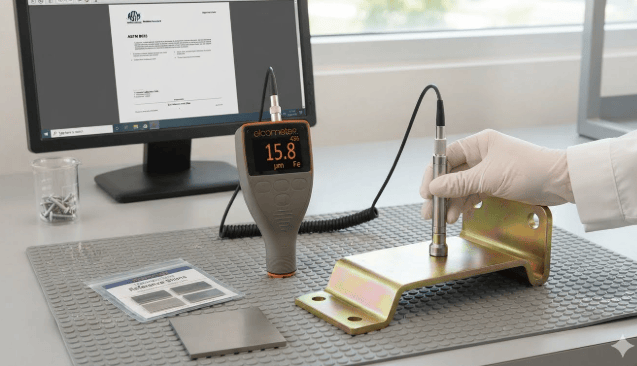
ASTM B633 covers the production, finish, examination, and quality of electrodeposited zinc coatings on iron and steel articles. The standard defines coating thickness classes and other finishing options and quality verification processes, which need to be used to provide consistent corrosion protection on coated parts. The ASTM B633 testing
- Applies electrodeposited zinc to iron and steel articles.
- Defines four standard classes of coating thickness.
- Contains several additional finish types.
- Details surface preparation and post-treatment requirements.
- Includes adhesion testing, coating thickness and appearance testing, and corrosion testing.
- Considers hydrogen embrittlement relief requirements (if applicable).
- Provides sacrificial corrosion protection for electrodeposited zinc-coated iron and steel articles.
- Defines coating designation codes that specify the coating thickness class and supplementary chromate or conversion coating requirements for plated components.
What is the Use of ASTM B633 Testing?
ASTM B633 testing is used to ensure that electrodeposited zinc coatings on iron and steel parts are of the required thickness, adhere to the metal surface, provide sufficient corrosion protection, and are of adequate workmanship. The testing process assures that the zinc coating offers an effective sacrificial corrosion barrier and durability during use. Adhering to ASTM B633 provides a way for manufacturers to ensure uniform coating thickness and longer service life for plated parts. The ASTM B633 standard
- Checks for uniform and correct zinc coating thickness.
- Determines the quality of coating bonding to the steel surface.
- Establishes and verifies corrosion resistance of plated parts.
- Evaluates the quality and surface of the coating. Confirms hydrogen embrittlement relief treatment (if necessary).
- Encourages quality control in electroplating.
- Supports product certification for corrosion-resistant steel products.
What Materials Can Be Tested Under ASTM B633?
ASTM B633 is used for electrodeposited zinc coating of iron and steel for corrosion protection. ASTM B633 applies to iron and steel articles such as fasteners, brackets, fittings, automotive components, electrical hardware, and general industrial products that require electrodeposited zinc coatings for corrosion protection.
Why is ASTM B633 Important?
ASTM B633 specifies the requirements for zinc electroplating that provide the same thickness of plating, corrosion protection, and product reliability. Compliance with the specification helps to prevent accelerated corrosion, extend the service life of the component, and ensure quality assurance throughout many industrial applications.
Common Challenges and Troubleshooting
To successfully perform ASTM B633 testing, surface preparation, electroplating conditions, and inspection equipment must be controlled. Common problems are inadequate coating thickness, adhesion, uneven coating distribution, surface defects, inadequate hydrogen embrittlement relief treatment, and inconsistent corrosion resistance. Reliable and repeatable results are achieved through proper process control, equipment calibration, and following ASTM inspection procedures.
ASTM B633 Testing Process and Data Collection Guide
Testing is carried out following the electroplating and any additional finishing operations. Coating thickness, coating appearance, adhesion evaluation results, corrosion test results, and supplemental finish type are recorded in the laboratory along with any defects during the inspection. The data collected are compared with the requirements for acceptance in ASTM B633 before the product is certified.