
ASTM B311 is a standard test method that outlines the water displacement method for the density of powder metallurgy (PM) materials with less than 2% porosity and cemented carbides. This test method is based on the water displacement method (Archimedes’ principle). In PM materials with less than 2% porosity, density measurement helps determine whether the part has densified enough for the application, either overall or in a critical area. For cemented carbides, a density measurement normally helps determine whether there is any significant deviation in the carbide grade composition. Engineers use density as a primary screening tool for cemented carbide grades, and they combine it with composition analysis to confirm the exact grade with precision. Unless otherwise specified, the values given in SI units are the standard values; the density values (g/cm³) and mass (g) are the units traditionally used by the industry.
ASTM B311 Density of Powder Metallurgy Materials Containing less Than two Percent Porosity
What is ASTM B311?
What is the Scope of the ASTM B311 Test Standard?
This procedure for water displacement is used to calculate the density of powder metallurgy (PM) materials with less than two percent porosity, as well as cemented carbides, according to ASTM B311. The test method includes the entire process from specimen preparation to density calculation. The standard specifies the requirements for mass measurement, water immersion, and determining the density. ASTM B311 covers:
- Material type: Powder metallurgy materials with less than two percent porosity and cemented carbides.
- Purpose: Determination of density for quality control and material verification.
- Property measured: Density using the water displacement method.
- Method: Measuring specimen mass in air and apparent mass in water, then calculating density.
- Result: Report density in grams per cubic centimetre (g/cm³).
- Test Limitations: The method is not applicable if the specimen gains mass when immersed in water, which indicates surface-connected porosity.
- Units: Density values use g/cm³, and mass values use grams (g) units as the long-standing industry practice.
- Applications: Powder metallurgy structural components, sintered metal parts, automotive PM components, aerospace precision parts, cemented carbide tooling and wear parts.
What are the Uses of ASTM D4186 Testing?
ASTM B311 testing helps manufacturers and quality control laboratories assess the density of powder metallurgy products and cemented carbides. The test results are used for quality control, material checking, and product development. The standard is widely used in the powder metallurgy, automotive, aerospace, and tooling industries. This standard-
- Gives an indication of whether PM parts have been densified sufficiently.
- Detects major composition variations in cemented carbide.
- Helps with quality assurance within the PM component manufacturing process.
- Facilitates the verification and certification of materials.
- Helps develop products and optimizes processes.
- Helps standardize the density measurements in various laboratories.
- Ensures material meets specifications.
Which materials can be tested under ASTM B311?
ASTM B311 is used for powder metallurgy materials with under 2% porosity and cemented carbides. The test method is applicable to near-full-density PM components and grades of carbide. The common applications are automotive PM components, aerospace structural parts, cemented carbide tooling and wear parts, metal injection molded (MIM) parts, and powder forged (PF) parts.
Why is ASTM B311 important?
A standard method for measuring the density of powder metallurgy materials and cemented carbides by water displacement is described in ASTM B311. The test method sets requirements for testing that assist manufacturers in checking densification and composition deviations. The standard provides a consistent procedure for testing and interpretation of test data throughout laboratories. The correlation of density with composition is simple for straight grades of tungsten carbide cobalt grades. With complex carbide grades, the situation is more complex – density measurements help determine if the composition is outside specified limits. If the density measured is outside the specified density range, the composition is outside of the specified composition range. This standard is used by quality control engineers to maintain product quality and material performance.
ASTM B311 Equipment and Sample Preparation Guide
ASTM B311 requires precision balances, water immersion apparatus, and temperature measurement equipment for density determination. Representative specimens are carefully prepared in laboratories for water displacement testing and evaluation. Analytical balances, water containers, and temperature-measuring equipment are all featured on the equipment.
| Sample and Specimen Details | Powder metallurgy materials with less than two percent porosity and cemented carbides. Specimens are representative of the production lot. Regular geometry is required for accurate measurement. |
| Specimen Preparation | Technicians clean specimens to remove surface contaminants. They ensure specimens are dry before weighing. |
| Specimen Dimensions | Specimen size varies with testing requirements. Regular geometry is required for accurate dimensional measurement. |
| Instrumentation | Precision analytical balance (0.01% accuracy of test specimen mass), water container (glass beaker), distilled or deionized water (preferably degassed), wetting agent (0.05 to 0.1 volume percent), thermometer for water temperature measurement, specimen support apparatus, calibration standards, vernier calipers or micrometers. |
Testing Procedures and Requirements for ASTM B311
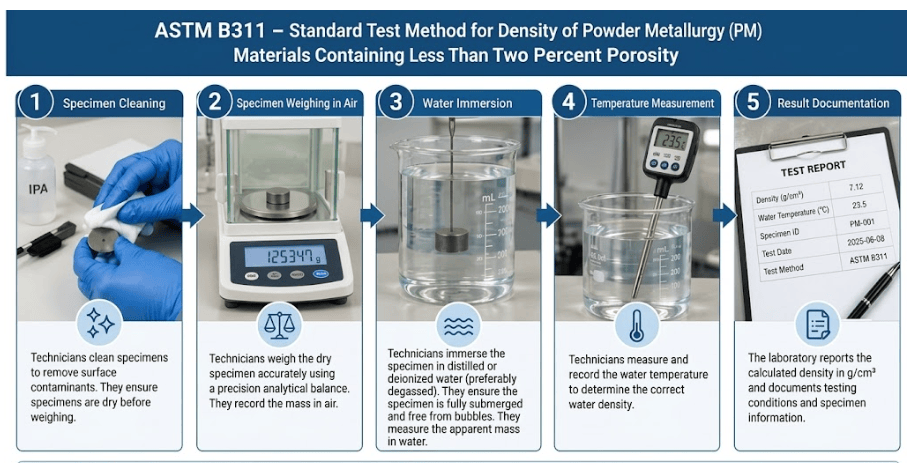
ASTM B311 uses standard water-displacement procedures to test the density of powder metallurgy materials and cemented carbides. The tests are conducted in laboratories with standardized procedures, which ensure reliable and accurate results. Technicians make preparations, measure mass in air and water, and calculate density. The ASTM B311 test method includes the following test procedure:
| Specimen Cleaning | Technicians clean specimens to remove surface contaminants. They ensure specimens are dry before weighing |
| Specimen Weighing in Air | Technicians weigh the dry specimen accurately using a precision analytical balance. They record the mass in air |
| Water Immersion | Technicians immerse the specimen in distilled or deionized water (preferably degassed). They ensure the specimen is fully submerged and free from bubbles. They measure the apparent mass in water. |
| Temperature Measurement | Technicians measure and record the water temperature to determine the correct water density |
| Result Documentation | The laboratory reports the calculated density in g/cm³ and documents testing conditions and specimen information |
ASTM B311Testing Process and Data Collection
The first step in testing is to clean the specimen to remove surface contaminants. The technician precisely weighs the dry specimen using a precision analytical balance and records its weight in air. They place the specimen in distilled or deionized water and determine its apparent mass, making sure the specimen is completely submerged and that there are no air bubbles. They measure and record the water temperature to know the proper water density. Analysts calculate the density based on the mass in air, apparent mass in water, and water density at the measured temperature. Laboratories collect data for quality control, material verification, and product development.
Common Challenges and Troubleshooting
Some typical issues with ASTM B311 testing are surface-connected porosity, surface air bubbles, and wrong temperatures. These problems can impact density determination. Surface-connected porosity means the specimen takes in water and gains weight, leading to an incorrect reading of its density. Air bubbles can cause an erroneous determination of apparent mass, and improper temperature readings can result in an incorrect determination of water density. Evacuation, boiling or ultrasonic agitation of the water will degas the water, thus minimizing the air bubbles on the specimen. These problems can be minimized by proper examination of the specimens, careful immersion, and correct temperature readings.
ASTM B311 Analysis Results and Interpretation
The report summarizes the density determination test performed for the tested material (powder metallurgy or cemented carbide). It shows the measured values, units, and specimen information. The interpretation compares these measured values against specification requirements or performance benchmarks. Quality control engineers use these results to ensure material compliance and product performance.
- The laboratory reports density in grams per cubic centimetre (g/cm³) to the nearest 0.01 g/cm³.
- The laboratory provides dimensional measurement records, mass measurement data, and quality control reports.
- Results for PM materials show whether the part has been densified to the desired level, while results for cemented carbides pinpoint key composition differences.
- If the measured density falls outside specified limits, the composition falls outside the specified limits.
- A measured density within the desired limits does not guarantee correct composition, as compensation between constituents may lead to the desired density with the wrong composition, and the grade of a cemented carbide cannot be determined by density alone.
Get Certified ASTM B311 Testing for Reliable Powder Metallurgy Density Analysis
Certification assures accurate evaluation of powder metallurgy materials and cemented carbides with standardized density testing procedures. Laboratory testing is available for experienced manufacturers to ensure that the densification achieved matches the target and to identify compositional changes. ASTM B311 certified testing is used to enhance quality control, material verification, and product development of PM components. Standard requirements are met, and the results of the test are trusted with the help of professional laboratory services. In critical applications, certified testing is used to verify material integrity and performance for quality control engineers and metallurgists.
FAQ
Updated on September 14, 2026


If you are looking for a managed and trusted testing partner to achieve your research goals, feel free to schedule a meeting with us or send us a request at connect@matestlabs.com to learn more about our services. For a quick quote, call us at (302)244-7710. We are happy to serve you.
Project Today
specialized laboratories ready to deliver results