By Dr Ruchika Yogesh | Last updated 10th June 2026

ASTM B209 Standard Specification for Aluminum and Aluminum Alloy-Sheet Plate

ASTM B209 provides the basic standard specification for aluminum and aluminum alloy flat sheet, coiled sheet, and plate, covering chemical composition, mechanical properties, and dimensional tolerances. Material compliance is assessed based on chemical composition verification, tensile property testing, dimensional inspection, and temper identification. The tests include tensile testing, dimensional measuring, and chemical analysis. Reports contain alloy designation, temper, chemical composition, tensile strength, yield strength, elongation, and finish requirements. The results are usually expressed in inch-pound units, such as ksi and percentage, enabling manufacturers to choose the appropriate aluminum product for challenging industrial applications.

Read More

GET STARTED

    Share your requirements *

    Provide your contact information *

    Introduction to ASTM B209

    ASTM B209 (Standard Specification for Aluminum and Aluminum-Alloy Sheet and Plate) covers the requirements for aluminum and aluminum alloy flat sheet, coiled flat sheet, and plate in various alloys and tempers, with various surface finishes. It applies to all heat-treatable and non-heat-treatable alloys in the aerospace, transportation, construction, electrical, packaging, and industrial applications. Product performance is directly affected by material properties such as chemical composition, tensile strength, yield strength, elongation, temper condition, and surface finish. Thus, ASTM B209 assists manufacturers in verifying conformance, ensuring consistent product production, and selecting the proper aluminum material for structural and fabricated products.

    Get Certified ASTM B209 Testing for Reliable Aluminum Product Quality

    Aluminum sheets and plates are frequently used in critical structural and fabricated applications. This can lead to variations in strength, corrosion resistance, and the manufacturing process. The chemical and mechanical properties of products supplied are professionally tested. Furthermore, certification aids quality assurance programs and customer confidence.

    Service NameRemarks
    ASTM B209 Testing
    Contact US

    Testing Procedure and Requirements

    Technicians check alloy chemistry within the specified limits. They conduct tensile testing as specified by the temper. Lastly, they evaluate and confirm compliance based on measured properties and specification requirements.

    Other ASTM standards mentioned in this specification are ASTM B548, B557, B594, B597, B660, E3, E29, E34, E55, E101, E227, E290, E407, E527, E607, E716, E1004, E1251, G47, and G66.

    Chemical Composition VerificationTechnicians analyze alloy chemistry and compare results with specified composition limits. Values are rounded in accordance with ASTM E29 requirements before compliance evaluation.
    Tensile Property EvaluationOperators determine tensile strength, yield strength, and elongation requirements for applicable alloys and tempers. Certain F-temper products do not require tensile testing.
    Temper VerificationInspectors confirm that supplied material matches the specified temper designation and associated mechanical property requirements.
    Dimensional and Finish InspectionPersonnel verify sheet or plate dimensions, thickness, surface condition, and specified finish requirements before acceptance.
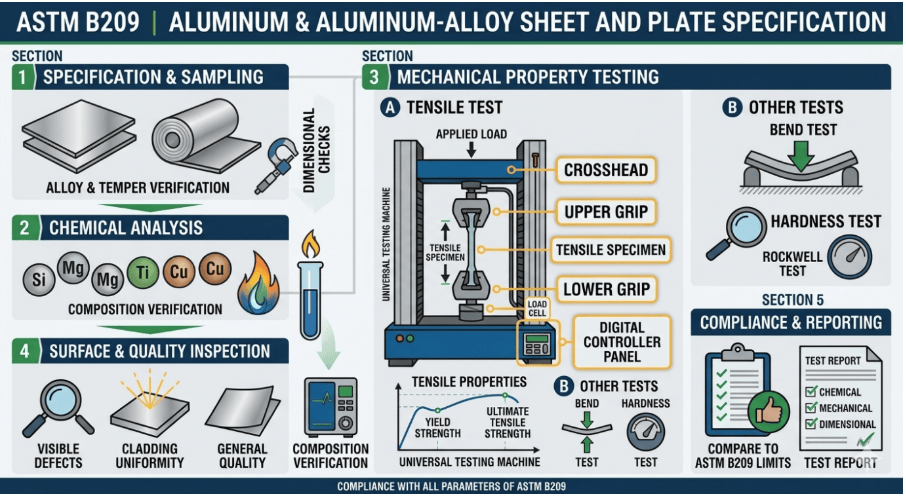
    The image shows a universal testing machine used to evaluate the mechanical, dimensional, and chemical properties of aluminum materials in accordance with ASTM B209.
    ASTM B209 Universal Testing Machine (UTM)

    Scope of ASTM B209 Test Standard

    • Covers aluminum and aluminum alloy flat-sheet products for transportation and industrial applications.
    • Aluminum and aluminum alloy plates for structural, aerospace, and fabricated parts.
    • Contains all plate mill-finish alloys and all heat-treatable mill-finish alloy sheet products.
    • Bright finish sheet products of nonheat-treatable aluminum alloys.
    • Defines chemistry and mechanical property specifications for a defined grade of alloys.
    • Applies only to products supplied in inch-pound units.

    Equipment and Sample Preparation

    Sample and Specimen DetailsThe specification applies to aluminum and aluminum-alloy flat sheet, coiled sheet, and plate products supplied in designated alloys and tempers. Samples must represent the supplied production material.
    Specimen DimensionsTensile specimen dimensions depend on product thickness and applicable mechanical property requirements. For plates 0.500 inches and thicker, the tensile specimen is machined from the core material.
    Specimen PreparationTechnicians prepare specimens from representative material sections. For clad products, core specimens used for tensile testing exclude the cladding layer when required by the specification.
    Tensile Testing MachineOperators use a UTM to determine tensile strength, yield strength, and elongation values.
    Dimensional Measuring ToolsInspectors use calibrated gauges and measuring instruments to verify thickness and dimensional compliance.

    Applications of ASTM B209 

    • Qualifies fabricated aircraft components using aerospace aluminum sheet and plate.
    • Inspects transportation materials of rail cars, trailers, and automotive structures.
    • Assesses the use of aluminum in the construction industry.
    • Helps implement quality control programs in aluminum processing and fabrication plants.
    • Helps manufacturers choose the appropriate alloy and temper.
    • Checks incoming aluminum materials prior to machining, forming, or assembly operations.

    How Do Mechanical Properties Affect Material Selection?

    The mechanical properties describe the behavior of aluminum products under applied loads. Tensile strength refers to the maximum load, and yield strength refers to the limit of permanent deformation. In addition, elongation values are used in forming and fabrication operations to assess the ductility of a material.

    Common Challenges and Troubleshooting

    There are a number of factors that may influence compliance evaluation. Variations in chemical composition can occur due to manufacturing inconsistencies or mix-up of alloys. Furthermore, the measurements of tensile properties can be affected by improper specimen preparation. Laboratories overcome these by using representative sampling, calibrated equipment, and standardized testing procedures. This means that tests are more accurate and enhance the decisions about compliance, minimizing the chances of material being rejected.

    ASTM B209 Testing Technique, Process, and Data Collection

    Testing starts with the identification of materials and the collection of samples from representative production lots. Then, technicians analyze the chemicals and prepare specimens for mechanical testing as needed. Then, they conduct tensile testing and measurements. Lastly, laboratories compare the data they collect to specification requirements and record the comparison to assess compliance. Having consistent procedures increases the repeatability and reliability of data.

    Analysis Results and Interpretation

    ASTM B209 uses inch-pound units as the primary units. The report of tensile strength and yield strength values is given in ksi (thousands of pounds per square inch) and rounded to 0.1 ksi. Elongation values are reported as percentages and rounded to the nearest 0.5%. Chemical composition percentages are weight percents. Engineers use these results to compare against the specified alloy and temper requirements to decide if the material is accepted or rejected.

    Factors to Consider for ASTM B209 Testing

    • Speed: Rapid testing helps in production schedules and material release events. Improve laboratory workflows for efficiency without compromising accuracy.
    • Expertise: Skilled technicians are familiar with alloy types, temper characteristics, and mechanical property analyses.
    • Cost: Testing programs are cost-effective, ensure quality assurance, and limit inspection costs.

    Link to ASTM B209 Standard

    FAQ's

    Where can I get the astm b209 tested?

    You can share your astm b209 testing requirements with MaTestLab. MaTestLab has a vast network of material testing laboratories, spread across the USA and Canada. We support your all material testing needs ranging from specific astm b209 test to various testing techniques.

    How much do I need to pay for the astm b209 test?

    Please contact us for a detailed quote for your astm b209 testing needs. Cost incurred to carry out different astm b209 testing methodology depends on the type of raw material; number of samples, coupons, or specimens; test conditions, turn around time etc. Costs of some ASTM testing methods start from $100 and the final value depends upon the factors listed above. Please contact us for the best and latest prices.

    How many samples are required for astm b209?

    The required number of samples or specimens should comply with the procedure given in the astm b209 standard. However, the MaTestLab operations team can assist you for your special requirements once you share your testing details with us.

    How much discount can I get on the astm b209 test?

    MaTestLab has a vast testing laboratory network, hence we bring you the best testing facilities in a cost-effective way. We offer considerable discounts (15-20%) to our returning customers based on test volume and frequency.

    How many days will it take to complete the astm b209 test?

    The turnaround time for astm b209 test methodology depends upon the test procedure mentioned in the standard test document. However, we at MaTestLab understand your research requirements and hence try to get your test completed within the least possible time.

    Where can I get the astm b209 tested?

    You can share your astm b209 testing requirements with MaTestLab. MaTestLab has a vast network of material testing laboratories, spread across the USA and Canada. We support your all material testing needs ranging from specific astm b209 test to various testing techniques.

    POPULAR TESTS
    ONE-STOP FOR ALL
    MATERIAL TESTING NEEDS
    MaTestLab Inc. offers accessible, quick, and affordable material testing, product testing, and failure analysis services. We support your on-demand testing and expert consultation needs with the help of our extensive network of material testing laboratories situated in the US and other parts of the world.
    MATERIAL TESTING
    We offer destructive and non-destructive tests over a range of mechanical, electrical, chemical, thermal, optical, corrosion, radiation, and biological testing methodologies defined by ASTM, ISO and other organizations.
    PRODUCT TESTING
    We help you evaluate and ensure your product quality and performance with standard and custom-made testing solutions. All the tests are done at well-equipped testing laboratories using standard testing methods for best output and satisfaction.
    FAILURE ANALYSIS
    Failure analysis ensures high levels of quality in every manufacturing process. We help you with getting the best failure or root cause analysis to determine the cause of the failure. The results help you identify means to prevent failure recurrences.
    Process for testing
    • STEP 01

      You share your testing requirements

    • STEP 02

      You share your sample(s)

    • STEP 03

      We deliver your test reports

    Get your testing done

    Let us known your testing requirements and we will be right back with a solution.

      Let us root for each other. Collaborate to grow, expand, and accelerate our businesses.

      Partner with us

        close

        Please share your requirement with us

          ×

          Contact Us

          Discover more from MaTestLab

          Subscribe now to keep reading and get access to the full archive.

          Continue reading