
ASTM B152 Standard Specification for Copper Sheet, Strip, Plate, and Rolled Bar

    What is ASTM B152?

    ASTM B152 is a standard specification covering requirements for copper sheet, strip, plate, and rolled bar produced from specified wrought copper grades. The specification covers copper UNS C10100, C10200, C10300, C10400, C10500, C10700, C10800, C10910, C11000, C11300, C11400, C11600, C12000, C12200, C12300, C14200, C14420, and C14530. It covers chemical composition, temper, tensile properties, hardness data (when specified), grain size (for applicable annealed products), and product dimensions. ASTM B152 (Standard Specification for Copper Sheet, Strip, Plate, and Rolled Bar) provides requirements in inch-pound and SI units. The specification is used to ensure consistent assessment of copper products for manufacturing and purchasing.

    Read more

    Get Certified ASTM B152 Testing for Reliable Copper Product Quality

    ASTM B152 testing and inspection offer a uniform way to certify copper sheet, strip, plate, and rolled bar to meet chemically, mechanically, physically, and dimensionally specified requirements. Other tests and examinations are dependent on the applicable specification, copper grade, temper, and purchase requirements; these include tensile strength and Rockwell hardness. Therefore, engineers and buyers can use ASTM B152 results to ensure material compliance before fabrication or service.

    What is the Scope of the ASTM B152 Test Standard?

    ASTM B152 includes copper sheet, strip, plate, and rolled bar, made from the specific copper grades and supplied in applicable tempers. The specification defines requirements on chemical composition, electrical resistivity, tensile strength, hardness, and applicable product properties. The scope of ASTM B152 includes:

    Read more

    • Copper Products: The specification covers copper sheet, strip, plate, and rolled bar.
    • Copper Grades: It covers specified UNS copper grades from C10100 through C14530, including several oxygen-free, tough-pitch, phosphorized, silver-bearing, and tellurium-bearing types.
    • Chemical Composition: The chemical composition must conform to the requirements specified for the applicable copper UNS designation.
    • Temper: Copper products may be supplied in hot-rolled, cold-rolled, or annealed tempers.
    • Electrical Properties: Applicable products must meet the specified maximum electrical resistivity requirements.
    • Mechanical Properties: Tensile strength and Rockwell hardness requirements apply according to the specified product condition and temper.
    • Plate Requirements: Plate products must satisfy the applicable requirements established for the product.
    • Microstructural Evaluation: The material must be capable of meeting applicable microscopic examination requirements when such evaluation applies.
    • Embrittlement Resistance: Copper products for the applications must have the ability to withstand the embrittlement test specified.
    • Product Limitations: The specification does not establish requirements for material rolled to ounce-weight thicknesses.
    • Measurement Systems: SI and inch-pound values are treated separately and should not be combined when determining conformity.

    What are the Uses of ASTM B152 Testing?

    ASTM B152 testing provides a consistent basis for verifying copper product quality and conformity. The ASTM B152 standard:

    • Checks the chemical composition of certain types of copper.
    • Verifies the product temperature and state.
    • Assesses tensile strength of appropriate copper products.
    • Measures Rockwell hardness when necessary.
    • Compares electrical resistivity with the maximum values.
    • Supports the evaluation of applicable grain-size requirements.
    • Checks conformance of copper sheet, strip, plate, and copper rolled bar.
    • Assists in checking the quality of materials prior to fabrication and service.

    Which materials can be tested under ASTM B152?

    ASTM B152 is applicable to copper sheet, strip, plate, and rolled bar produced from the designated UNS copper grades. These are oxygen-free electronic copper (OFeCu), oxygen-free copper (OFCu), oxygen-free phosphorus-bearing copper (OFPhCu), low-oxygen copper (LoCu), electrolytic tough-pitch copper (ETPCu), silver-bearing tough-pitch copper (STPCu), phosphorized copper (PhCu), phosphorus-deoxidized arsenical copper (PDAsCu), and tin-bearing tellurium copper (TeCu).

    Why is ASTM B152 Important?

    The importance of ASTM B152 is that it establishes uniform requirements for copper composition, mechanical properties, electrical performance, and product condition. Thus, testing assists engineers in ensuring material compliance and choosing appropriate copper materials for the manufacturing and service that each requires.

    ASTM B152 Equipment and Sample Preparation Guide

    ASTM B152 testing necessitates appropriate equipment for chemical, mechanical, electrical, dimensional, and metallographic evaluations as applicable. Thus, technicians create representative samples based on the form, temper, and the evaluation that is needed. ASTM B248 and ASTM B248M provide related general requirements for wrought copper and copper-alloy plate, sheet, strip, and rolled bar, including sampling, dimensional, mechanical, electrical, chemical, and grain-size requirements.

    Read more

    Related standards for ASTM B152 include ASTM E8/E8M for tensile testing, ASTM B193 for electrical resistivity, ASTM E112 for grain size, and ASTM B577 for hydrogen embrittlement. ASTM B248/B248M provides applicable dimensional requirements for copper products.

    Sample and Specimen DetailsSamples are selected from the specified copper product, grade, temper, and product form. Specimens are ready for chemical, tensile, hardness, electrical, grain-size, or other necessary evaluations.
    Specimen PreparationOperators cut and prepare the specimen without altering the conditions in a way that could significantly affect the measured properties. When a microscopical examination is needed, metallographic specimens are prepared, if applicable.
    Specimen DimensionsASTM B152 does not prescribe a single specimen size for all tests. The dimensions vary according to the form of the product, its thickness, and the test requirements.
    InstrumentationThe equipment can include chemical evaluation tools, universal testing machines, a Rockwell hardness instrument, equipment for the measurement of electrical resistivity, equipment for metallographic preparation and evaluation, and dimensional measurement tools.

    Testing Procedures and Requirements for ASTM B152

    ASTM B152 is used to test copper products according to the requirements applicable to their specified grade, form, temper, and required properties. Hence, the suitable evaluations are chosen by the technicians based on the material requirements. The procedure outlined in ASTM B152 is as follows-

    Read more

    Specimen PreparationTechnicians choose representative samples and prepare specimens according to the product form, temper, and test required. Write down the copper grade and product information prior to evaluation.
    Chemical Composition EvaluationAnalysts check the chemical makeup of the copper and then compare each element to the limits as per the applicable UNS copper grade.
    Tensile Strength EvaluationTechnicians conduct tensile tests on appropriate specimens and compare the tensile strength of the test specimens to the strength required by the product and temper.
    Hardness EvaluationMeasure Rockwell hardness if required, and compare the measured hardness with the hardness requirement, as applicable.
    Electrical and Microstructural Evaluation.If required, analysts measure electrical resistivity and assess applicable grain size or microscopic properties.
    Result ReportingThe operators are responsible for comparing the measured properties to the appropriate ASTM B152 requirements and deciding whether the product meets its grade, temper, and product requirements.

    ASTM B152 Testing Process and Data Collection

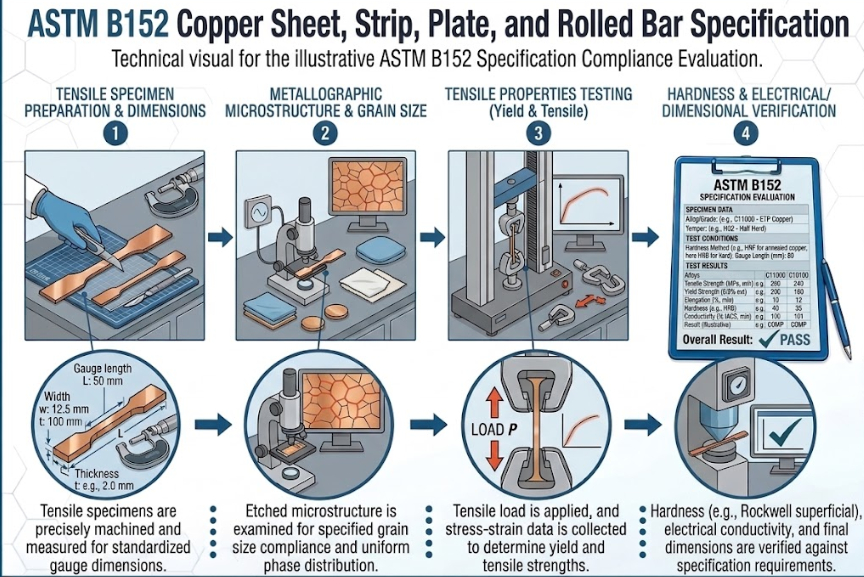
    ASTM B152 testing includes representative sampling and subsequent chemical, mechanical, electrical, dimensional, and microstructural evaluations. The measured values, applicable acceptance limits, test conditions, and copper grade and tempers are documented by the technicians for the conformity assessment.

    The image shows copper specimens and testing equipment used to evaluate ASTM B152 material requirements.
    ASTM B152 testing process for copper sheet, strip, plate, and rolled bar.

    Common Challenges and Troubleshooting

    ASTM B152 testing is subject to a number of common testing issues, such as misidentification of copper grade, preparation of non-conforming specimens, selection of an incorrect hardness scale, as well as inconsistent electrical measurements. The UNS designation, product temper, specimen condition, equipment calibration, and applicable acceptance requirements should therefore be checked by the technician prior to testing. Good sampling practices also help to assure good samples.

    ASTM B152 Analysis Results and Interpretation

    The results of ASTM B152 analysis are evaluated against the specified copper grade and temper requirements for chemical, mechanical, electrical, and applicable microstructural properties.

    Read more

    • The laboratory compares the chemical composition with the specified elemental limits for the applicable UNS copper grade to verify chemical conformity.
    • Tensile strength is reported in MPa or ksi and is compared with the requirements for the product and temper involved.
    • Rockwell hardness results are expressed on the appropriate Rockwell hardness scale and compared to the requirements.
    • When electrical property requirements are applicable, the electrical resistivity results are compared with the specified maximum.
    • The grain-size measurement is compared with the specified requirements, and applicable microscopic observations are carried out to assess the material structure and overall conformity.

    Link to ASTM B152

    FAQ

    Why is ASTM B152 important?
    The significance of ASTM B152 is to provide requirements for copper sheet, strip, plate, and rolled bar to ensure uniformity of material quality and conformance.
    ASTM B152 is applied to check the chemical composition, mechanical properties, electrical resistivity, and other requirements applicable to the specified copper products.
    ASTM B152 testing can include chemical composition, tensile strength, Rockwell hardness, electrical resistivity, grain size, and relevant microstructural properties.

    Updated on September 21, 2026

    Davis Scott
    About Author
    Davis Scott is an Electrical and Electronics Engineer specializing in multidisciplinary validation, quality assurance, and comprehensive electro-mechanical testing.
    Know More
    Testimonials
    Real results
    Engineers trust us with what matters most
    Why Choose Matestlab?
    Matestlab is a unified testing services partner based in the USA. Matestlab offers raw material and product testing services through accredited, expert laboratories primarily based in the USA. Matestlab supports physical, thermal, chemical, electrical, mechanical, environmental, and characterization testing needs through its global network of 2200+ accredited testing laboratories. Matestlab's in-house materials science experts curate and design comprehensive testing programs matched to the sample material and specific testing need, with regulatory requirements and confidentiality in mind.

    If you are looking for a managed and trusted testing partner to achieve your research goals, feel free to schedule a meeting with us or send us a request at connect@matestlabs.com to learn more about our services. For a quick quote, call us at (302)244-7710. We are happy to serve you.
    Start Your Testing
    Project Today
    Define your requirements and get access to
    specialized laboratories ready to deliver results
    Partners with us
    Clients
    Vendors
    Process for testing
    • STEP 01

      You share your testing requirements

    • STEP 02

      You share your sample(s)

    • STEP 03

      We deliver your test reports

    Get your testing done

    Let us know your testing requirements and we will be right back with a solution.

      Let us root for each other. Collaborate to grow, expand, and accelerate our businesses.

      Partner with us