ASTM A956 Standard Test Method for Leeb Hardness Testing of Steel Products

    What is ASTM A956?

    ASTM A956 is a standard test method for determining the hardness of steel products by the Leeb hardness testing principle. The method uses a portable hardness tester to measure the rebound response generated when the test impact body strikes the steel surface. Technicians prepare the test surface and position the Leeb hardness instrument correctly before taking measurements. The instrument measures impact and rebound velocities and converts them into a Leeb hardness value. The results can be used to assess and compare the hardness of steel products. ASTM A956 (Standard Test Method for Leeb Hardness Testing of Steel Products) is especially beneficial for testing large, heavy, or false steel parts for which a stationary hardness test may not be feasible.

    Read more

    Get Certified ASTM A956 Leeb Hardness Testing

    ASTM A956 testing provides a portable testing system for the hardness of steel products for the benefit of manufacturers, inspectors, engineers, and quality-control personnel. Technicians can make measurements directly on appropriate steel parts once the test surface is prepared and the instrument is set up. Analysts use the hardness readings to support material verification, quality control, production inspection, and comparison with applicable hardness requirements.

    What is the scope of ASTM A956?

    ASTM A956 is a standard that details Leeb hardness testing of steel products using portable hardness testing equipment. The method is standardized and gives a measure of the hardness of the surface according to the rebound behavior of the impact body. ASTM A956 is primarily intended to measure and report the hardness of steel products using the Leeb hardness scale and applicable converted hardness scales. The scope of ASTM A956 includes:

    Read more

    • Material Type: Steel products suitable for Leeb hardness testing.
    • Purpose: Determination and evaluation of steel hardness.
    • Property Measured: Leeb hardness and applicable converted hardness values.
    • Method: A calibrated impact device strikes the prepared steel surface and measures the relationship between impact and rebound velocities.
    • Result: Results are reported as Leeb hardness values (HL) and, where applicable, converted hardness values such as HRC, HRB, HB, HV, or HS.
    • Test Limitations: Surface condition, specimen mass and geometry, curvature, material homogeneity, impact direction, and instrument configuration can affect the measurement.
    • Environmental Conditions: Temperature, surface cleanliness, and test conditions should remain within the applicable requirements of the method and equipment.
    • Applications: Steel product inspection, quality control, production monitoring, material verification, maintenance inspection, and field hardness assessment.

    What are the uses of ASTM A956 testing?

    ASTM A956 is used to help provide some quick and minimal surface preparation determination of steel product hardness. The method is employed by engineers and inspectors for making mobility hardness tests on large components or finished steel products. Multiple readings at selected locations can be taken to determine hardness variations in the top surface. The results are also used for quality-control and material-verification activities. The test helps to:

    • Hardness Evaluation Test: A test that measures the hardness of steel products.
    • Quality Control: Test for consistency of hardness in the process of production and inspection.
    • Material Verification: Aids in the determination of the anticipated characteristics of the hardness of steel products.
    • Field Inspection: Allows hardness measurements on large or fixed components.
    • Production Monitoring: Detects variations in hardness in manufacturing.
    • Maintenance Inspection: Aids in the hardness testing of steel parts in service.
    • Material Comparison: Assesses the hardness of different steel products and/or test locations.

    Which Materials Can Be Tested According to ASTM A956?

    ASTM A956 is intended for suitable steel products that can accommodate the selected Leeb impact device and provide reliable contact with the test surface. Technicians should consider the product’s mass, geometry, surface condition, thickness, and accessibility before testing. The method is particularly useful for large or heavy steel components that are difficult to transport to conventional hardness-testing equipment. Analysts should select the appropriate impact device and hardness scale for the material and test configuration. The method applies to:

    • Material Type: Steel products suitable for Leeb hardness measurement.
    • Product Forms: Large, heavy, or fixed steel components and other suitable steel products.
    • Different Grades: Applicable steel grades with hardness characteristics suitable for the method.
    • Production Materials: Steel products evaluated during manufacturing and quality inspection.
    • Finished Components: Steel components requiring portable hardness verification.

    Why is ASTM A956 Testing Important?

    Hardness is a valuable property of steel products that gives information about the mechanical condition and consistency of the product. Changes in hardness may reflect differences in material condition, heat treatment, processing or other factors in manufacturing. ASTM A956 offers a mobile solution to assess the hardness of steel, rather than removing the large component from service or moving it to a stationary testing machine. Output can be used for quality control, inspection, material checks and engineering evaluation.

    ASTM A956 Equipment and Sample Preparation Guide

    Technicians prepare the steel surface and select the appropriate Leeb hardness tester and impact device for the product being evaluated. They verify the instrument condition, establish proper contact, and ensure that the test location provides adequate support and surface quality. The test area should meet the applicable requirements for dimensions, thickness, curvature, and surface condition.

    Read more

    Leeb Hardness Tester and Impact DeviceTechnicians measure hardness using the impact and rebound response of the steel surface.
    Steel Specimen / Product PreparationTechnicians provide a clean, stable, and suitable test surface for measurement.
    Surface Preparation and Support EquipmentThe technician removes surface irregularities and prevents movement or vibration during testing.
    Reference Test Block and Dimensional InspectionAnalysts verify instrument performance and confirm suitable specimen thickness, size, and geometry.

    ASTM A956 Testing Procedures and Requirements

    Technicians first identify the steel product and select the appropriate impact device and hardness scale. They prepare the test surface, verify the instrument, and establish stable contact with the test area. The technician positions the device in the required impact direction and performs the specified number of measurements. Analysts review the individual readings and determine the applicable hardness result while considering the test configuration and measurement consistency. The testing process includes the following steps.

    Read more

    Material IdentificationTechnicians confirm the steel product and relevant test information.
    Surface PreparationTechnicians provide a clean and suitable surface for reliable impact measurements.
    Instrument VerificationAnalysts confirm that the Leeb hardness tester operates correctly before measurement.
    Impact MeasurementThe technician applies the controlled impact and measures the rebound response.
    Repeated ReadingsTechnicians take multiple measurements to evaluate hardness consistency.
    Hardness EvaluationEngineers determine and report the applicable Leeb or converted hardness value.

    ASTM A956 Testing Process and Data Collection

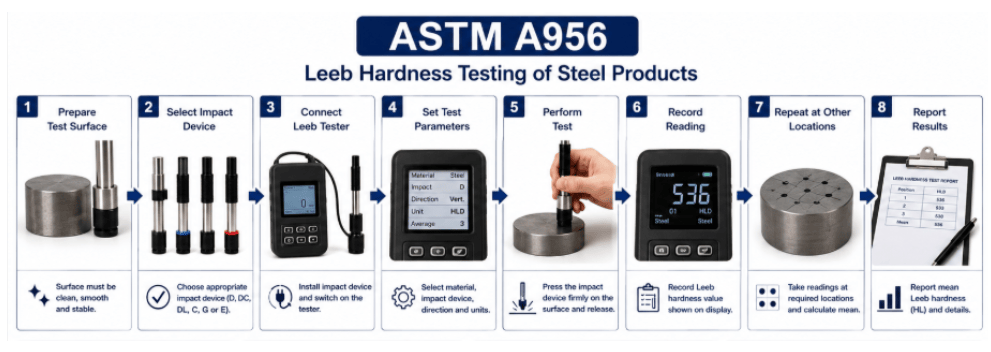
    Technicians determine the type of steel product and choose the right Leeb impact device. They perform the preparation of the test surface and verification of the instrument in accordance with the relevant verification procedure. The technician sets up the impact device properly and takes measurements. The instrument measures the impact and rebound response and gives the reading of the hardness. Analysts examine each measurement, evaluate the consistency and report the appropriate hardness values along with the test conditions and instrument information.

    The image shows the ASTM A956 testing process, including steel surface preparation, Leeb hardness tester setup, impact device contact, controlled impact, rebound measurement, hardness reading, and data evaluation.
    ASTM A956 Leeb Hardness Testing of Steel Products

    Common Challenges and Troubleshooting

    The Leeb hardness measurement can be influenced by surface roughness, coatings, scale, inadequate support, direction of impact, impact device selection, and component geometry. Technicians need to use the right instrument to impact the surface at the correct position and also need to have stable support on the surface during testing and prepare the surface correctly. When readings are significantly different, analysts should examine the surface of the specimens, the place of testing, the direction of impact, the calibration of the instrument, the specimen support, and the measurement procedure.

    Analysis Results and Interpretation

    ASTM A956 results indicate the hardness of the tested steel product based on the Leeb hardness measurement. Analysts evaluate the recorded readings and consider the selected impact device, test direction, material condition, and applicable conversion scale when interpreting the results. ASTM A956 results include:

    Read more

    • The laboratory reports the measured Leeb hardness as HL and, where applicable, converted hardness values such as HRC, HRB, HB, HV, or HS.
    • The technician records individual hardness readings at each test location and calculates the representative average hardness from the applicable measurements.
    • The analyst records the test direction and specific measurement locations because impact direction and location can influence the hardness readings.
    • The laboratory documents the steel grade or product identification when available to provide material context for the reported hardness values.
    • The analyst compares the measured hardness with applicable material specifications, drawings, heat-treatment requirements, or acceptance criteria to evaluate the material condition.

    Link to ASTM A956 

    FAQ

    What does ASTM A956 measure?
    ASTM A956 measures the hardness of suitable steel products using the Leeb hardness testing method.
    The Leeb hardness scale expresses hardness based on the relationship between the impact and rebound velocities of the test device.
    Leeb hardness is reported as HL. Applicable converted hardness values may be reported using scales such as HRC, HRB, HB, HV, or HS.
    Yes. The portable nature of Leeb hardness equipment makes the method suitable for many large, heavy, or fixed steel components when the applicable requirements are satisfied.
    Surface condition, component support, geometry, thickness, impact direction, impact-device selection, and instrument condition can affect the measured hardness.
    Rohit Dhembare
    About Author
    Rohit Dhembare is an Operations Associate at MaTestLab Inc. and holds a postgraduate degree in Organic Chemistry.
    Testimonials
    Real results
    Engineers trust us with what matters most
    Start Your Testing
    Project Today
    Define your requirements and get access to
    specialized laboratories ready to deliver results
    Partners with us
    Clients
    Vendors
    Process for testing
    • STEP 01

      You share your testing requirements

    • STEP 02

      You share your sample(s)

    • STEP 03

      We deliver your test reports

    Get your testing done

    Let us known your testing requirements and we will be right back with a solution.

      Let us root for each other. Collaborate to grow, expand, and accelerate our businesses.

      Partner with us

        Contact Us

        Discover more from Matestlab Inc

        Subscribe now to keep reading and get access to the full archive.

        Continue reading