ASTM A596 Direct-Current Magnetic Properties of Materials Using the Point-by-Point (Ballistic) Method and Ring Specimens

    What is ASTM A596?

    ASTM A596 is a standard test method that measures the direct-current magnetic performance of soft magnetic materials with ring specimens and point-by-point ballistic test equipment. ASTM A596  (Standard Test Method for Direct-Current Magnetic Properties of Materials Using the Point-by-Point (Ballistic) Method and Ring Specimens) provides detailed information on the direct-current magnetic properties of soft magnetic materials and supports the design, material selection, and quality evaluation of transformers, electric motors, generators, relays, actuators, and other electromagnetic devices.

    Read more

    Get Certified ASTM A596 Testing for Reliable Magnetic Material Performance

    Reliable magnetic property testing is crucial to the high-quality production of electrical and electromagnetic equipment and components. ASTM A596 certification ensures magnetic material profiles meet customized magnetic performance specifications before electrical device fabrication. Certified magnetic testing helps to lower product costs, reduce magnetic loss, and meet customer and industry standards.

    What is the Scope of ASTM A596 Testing?

    ASTM A596 provides standardized procedures for determining the direct-current magnetic properties of soft magnetic materials using ring specimens and the point-by-point ballistic method. The test enables manufacturers and laboratories to evaluate magnetic performance for material development, quality control, and product certification.

    Read more

    • Covers direct-current magnetic testing of soft magnetic materials. 
    • Uses ring specimens and the point-by-point ballistic method. 
    • Measures magnetic induction, permeability, coercive force, and hysteresis characteristics. 
    • Supports quality control of electrical steels and magnetic alloys. 
    • Assists in material selection for electrical and electromagnetic equipment. 
    • Provides standardized magnetic property data for research and engineering applications. 
    • Establishes procedures for obtaining complete DC magnetization curves and hysteresis loops using ring specimens and point-by-point ballistic measurements.

    What are the Applications of ASTM A596 Testing?

    ASTM A596 test results provide repeatable magnetic property data for the design, manufacture, and quality evaluation of electrical and electromagnetic components. Magnetic property measurements are used to verify the quality of magnetic core materials and electrical steel laminations during material development, production, and quality control. ASTM A596 Testing:

    • Evaluates soft magnetic materials for transformer core applications. 
    • Supports quality control during electrical steel manufacturing. 
    • Assists in developing motors, generators, inductors, and relays. 
    • Verifies magnetic properties for research and material development. 
    • Confirms compliance with customer and industry magnetic specifications. 
    • Helps optimize electromagnetic device efficiency and performance. 

    What is the Point-by-Point Ballistic Method?

    The point-by-point ballistic method is based on the measurement of the magnetic response of a material by increasing the direct-current magnetic field applied to it in small steps and recording the magnetic induction at each step. This method produces detailed magnetic property data such as the material’s magnetization curve and hysteresis properties.

    Why Are Ring Specimens Used for Magnetic Testing?

    Ring specimens create a closed magnetic circuit that reduces the magnetic leakage and demagnetizing forces. This setup provides more accurate intrinsic magnetic properties measurements than open specimen geometries.

    Which Magnetic Properties Does ASTM A596 Measure?

    ASTM A596 measures direct-current magnetic properties including magnetic induction (B), magnetic field strength (H), permeability, coercive force, residual induction, and hysteresis characteristics.

    Common Challenges and Troubleshooting

    Inconsistent coil winding, electrical noise, magnetic leakage, poor instrument calibration, inaccurate specimen machining, temperature changes, and other factors can cause inaccurate testing. If the instruments are properly calibrated, the specimens are prepared correctly, and the laboratory is kept at a controlled temperature, then accurate and repeatable results will be obtained.

    ASTM A596 Testing Process and Data Collection

    The testing procedure starts with machining a representative ring specimen and winding the magnetizing and search coils. The specimen is placed in a ballistic permeameter, and direct current is applied in a series of steps. The value of the magnetic induction is then recorded on a ballistic galvanometer or an electronic fluxmeter. Finally, technologists determine magnetic characteristics and create a detailed test report. The required magnetic field range is covered with multiple magnetization points in order to get the complete magnetization curve and hysteresis curve for analysis.

    ASTM A596 Equipment and Sample Preparation Guide

    The careful preparation of ring specimens and the calibration of magnetic testing equipment are necessary to obtain accurate measurements of magnetic properties. Repeatable and reliable magnetic property measurements require proper specimen machining, coil winding, and instrument calibration.

    Read more

    Specimen DetailsRepresentative ring specimens may be prepared from soft magnetic iron-nickel (Fe-Ni) alloys, iron-cobalt (Fe-Co) alloys, electrical steels, silicon steels, iron powder materials, and other soft magnetic materials used in electromagnetic applications.
    Specimen PreparationThe analyst machines ring specimens to specified dimensions with smooth surfaces. Magnetizing and search coils are uniformly wound around the specimen before testing. Ring specimens should be free from mechanical damage, burrs, and residual stresses that could influence magnetic measurements.
    Specimen DimensionsThe analyst prepares ring dimensions, cross-sectional area, and coil turns according to ASTM A596 requirements and the material being evaluated.
    InstrumentationBallistic permeameter, ballistic galvanometer or electronic fluxmeter, regulated DC power supply, precision ammeter, voltmeter, magnetizing coils, search coils, ring specimen fixture, current control unit, calibrated measuring instruments, and computer-based data acquisition system (when applicable).

    Testing Procedures and Requirements Guide

    ASTM A596 measures the direct current magnetic properties of soft magnetic materials by the point-by-point ballistic method in standard laboratory conditions. The preparation, instrumentation, and magnetization methods are crucial for making reproducible magnetic tests. When necessary, the magnetic specimen is demagnetized before testing to remove any residual magnetization in order to obtain accurate results for measurement of magnetic properties.

    Read more

    Other referenced standards include ASTM A34/A34M, ASTM A340, ASTM E691, and ASTM E177, where applicable.

    Ring Specimen PreparationProduces representative ring specimens with accurately machined dimensions for magnetic testing.
    Winding of Magnetizing and Search CoilsInstalls primary and secondary coils around the specimen to generate and measure magnetic flux.
    Ballistic CalibrationCalibrates the ballistic galvanometer or electronic fluxmeter before testing.
    Point-by-Point MagnetizationApplies increasing DC magnetizing current to obtain magnetic property measurements.
    Magnetic Property MeasurementDetermines magnetic induction, permeability, coercive force, and hysteresis characteristics.
    Data Analysis and ReportingCompares measured values with specification requirements and documents the results.
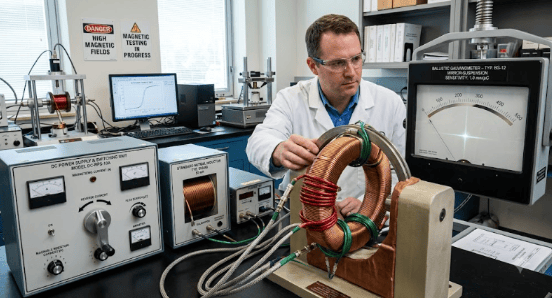
    The image shows a ballistic permeameter connected to a ring specimen measuring the direct-current magnetic properties of soft magnetic materials during ASTM A596 testing.

    Caption: ASTM A596 Ballistic Permeameter with Ring Specimen 

    Analysis Results and Interpretation

    • Magnetic induction is typically reported in tesla (T).
    • Magnetic field strength is reported in amperes per meter (A/m), permeability is reported as relative permeability (dimensionless), and coercive force is reported in amperes per meter (A/m).
    • Hysteresis characteristics from the measured magnetization curve. 
    • Overall, high permeability and low coercive force values indicate good soft magnetic characteristics for electrical equipment.
    • Results are compared with applicable material specifications or customer requirements to determine whether the magnetic material satisfies the required performance characteristics.

    Link to ASTM A596

    Read more

    Updated on July 19, 2026

    Suyog Kamble
    About Author
    Suyog Kamble is an Operations Associate at Matestlab Inc. Suyog holds a postgraduate degree in organic chemistry and is trained in material science topics.
    Know More
    Testimonials
    Real results
    Engineers trust us with what matters most
    Start Your Testing
    Project Today
    Define your requirements and get access to
    specialized laboratories ready to deliver results
    Partners with us
    Clients
    Vendors
    Process for testing
    • STEP 01

      You share your testing requirements

    • STEP 02

      You share your sample(s)

    • STEP 03

      We deliver your test reports

    Get your testing done

    Let us know your testing requirements and we will be right back with a solution.

      Let us root for each other. Collaborate to grow, expand, and accelerate our businesses.

      Partner with us

        Discover more from Matestlab

        Subscribe now to keep reading and get access to the full archive.

        Continue reading