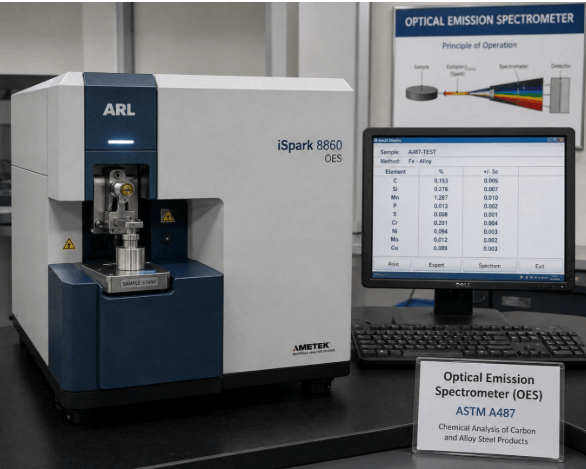
ASTM A487 establishes the manufacturing, heat treatment, testing, and inspection requirements for low-alloy steel and martensitic stainless-steel castings for pressure-containing applications. The mechanical strength, toughness, and metallurgical quality of castings are ensured by the specification. The scope of the ASTM A487 test standard
- Covers castings of low-alloy steels and martensitic stainless steels and pressure-containing parts.
- Covers normalized and tempered or quenched and tempered heat treatment.
- Sets chemical composition specifications.
- Indicates required tensile and hardness properties.
- Allows welding repair under certain conditions.
- Supports the production of pressure vessels and valves.
What is the use of ASTM A487 Testing?
ASTM A487 specifies the material and quality requirements for pressure-service steel castings, while the required inspections and tests verify that the castings meet the specified acceptance criteria before service. The testing process aims to ensure that castings have the necessary strength, toughness, and structural integrity to safely meet high-pressure and high-temperature operating conditions. Implementing ASTM A487 helps ensure product certification, improve equipment reliability, and reduce the risk of service failures in critical applications. ASTM A487 testing
- Supports the qualification and certification of pressure-service steel castings through standardized inspection and testing requirements.
- Ensures conformance to chemical composition and mechanical property requirements.
- Verifies correct heat treatment of castings.
- Supports quality control throughout casting, heat treatment, machining, and final inspection.
- Supports quality verification of steel castings used in pressure vessels, valves, pumps, and other pressure-containing equipment.
- Helps maintain safe operation in power generation, oil and gas, petrochemical, and other industrial facilities.
- Minimizes the chances of failure from pressure in critical equipment.
What materials can be tested under ASTM A487?
ASTM A487 is applicable to pressure-containing low alloy steel and martensitic stainless-steel castings. The specification applies to castings supplied in the normalized and tempered or quenched and tempered condition, as per the specified grade. These castings are typically employed in valves, pumps, pressure vessels, steam systems, piping, turbine casings, and other industrial equipment that demands high strength, toughness, and performance in pressure and high-temperature applications.
Why is ASTM A487 Important for Pressure-Service Steel Castings?
Pressure-service steel castings are typically used in harsh operating conditions such as high internal pressure, high temperatures, cyclic loading, and corrosive service. ASTM A487 sets specifications for manufacturing, heat treatment, testing, and inspection so that these castings deliver a uniform mechanical performance and structural integrity. Adhering to the specification ensures product reliability, meets regulatory and customer demands, prolongs equipment service life, and minimizes expensive equipment failure in critical industrial systems.
Common challenges and troubleshooting
The following are important factors to consider for accurate ASTM A487 testing: representative sampling, proper heat treatment, specimen preparation, and calibrated test equipment. Typical issues include inadequate treatment cycles, variations in chemistry, flaws in test specimen preparation, variability in the measured hardness, and dimensional inconsistencies. Accurate, repeatable, and standards-compliant results can be achieved by controlling manufacturing processes, referring to ASTM Mechanical Testing methods, and routine calibration of laboratory equipment.
ASTM A487 Testing Process and Data Collection Guide
The first step in the testing process is to select a representative sample of steel castings from the production lot after the required heat treating. Test specimens are prepared in accordance with ASTM mechanical testing requirements and tested for chemical composition, tensile strength, hardness, and product inspection. Laboratory testing records chemical composition, yield strength, tensile strength, elongation, reduction of area, hardness, heat treatment condition, dimensional measurements, and inspection results. These results are compared with the acceptance criteria as specified in ASTM A487 for material certification. Traceability and heat identification of materials are ensured during manufacturing and inspection.