
ASTM A342 Standard Test Methods for Permeability of Weakly Magnetic Materials

    What is ASTM A342?

    ASTM A342 defines a group of standard test methods used to determine the permeability, or relative permeability, of weakly magnetic materials. ASTM A342 standard (Standard Test Methods for Permeability of Weakly Magnetic Materials) covers materials having a relative permeability not exceeding 6.0 and provides several procedures for measuring or comparing their magnetic response. Technicians prepare representative specimens and select the applicable permeability procedure based on the material and required measurement range. Analysts measure the magnetic response using the specified test equipment and report the resulting relative permeability or comparative permeability indication.

    Read more

    Get Certified ASTM A342 Weakly Magnetic Material Permeability Testing

    ASTM A342 testing provides magnetic permeability information for materials where low magnetic response is important. The standard is suitable for specification acceptance, design purposes, service evaluation, regulatory requirements, manufacturing control, and research and development. Because specimen shape and size are restricted, ASTM notes that the method is most often used to evaluate semifinished products before fabrication into parts. Technicians prepare the specimen according to the selected method and establish the required magnetic measurement conditions. Engineers and analysts use the resulting permeability data to evaluate material suitability and compare weakly magnetic materials.

    What is the scope of ASTM A342?

    ASTM A342 covers four applicable procedures for determining the permeability of materials having relative permeability not exceeding 6.0. The standard includes methods with different measurement principles and applicable permeability ranges. The scope of ASTM A342 covers:

    Read more

    • Material Type: Weakly magnetic materials, including materials such as austenitic stainless steels that may exhibit weak ferromagnetic behavior.
    • Purpose: Determination or comparison of relative magnetic permeability.
    • Property Measured: Relative permeability or comparative permeability.
    • Method: Fluxmetric measurement, low-mu permeability indicator, flux-distortion measurement, or vibrating sample magnetometry, depending on the selected procedure.
    • Result: Relative permeability or a comparative indication against calibrated standards, depending on the test method.
    • Test Limitations: Method applicability depends on permeability range, specimen shape and size, magnetic field conditions, and selected measurement procedure.
    • Environmental Conditions: Specimen and magnetic measurement conditions are controlled according to the applicable procedure.
    • Applications: Specification acceptance, design, service evaluation, regulatory requirements, manufacturing control, research, and development.

    What are the uses of ASTM A342 testing?

    ASTM A342 testing helps determine whether a material exhibits the low magnetic permeability required for a particular application. This information is especially important when magnetic response must remain limited or controlled. Manufacturers can use permeability measurements for material qualification and manufacturing control. Engineers can use the results during design and material selection, while analysts can compare the magnetic response of different materials or product conditions. The test helps to:

    • Permeability Evaluation: Determines or compares the relative permeability of weakly magnetic materials.
    • Material Selection: Helps engineers select materials with suitable magnetic response.
    • Specification Acceptance: Provides permeability data for applicable material requirements.
    • Design Evaluation: Supports applications where magnetic permeability is an important design consideration.
    • Service Evaluation: Provides information for evaluating material performance in service.
    • Manufacturing Control: Helps monitor magnetic properties during material production.
    • Research and Development: Supports development and evaluation of weakly magnetic materials.

    Which Materials Can Be Tested According to ASTM A342?

    ASTM A342 applies to weakly magnetic materials having relative permeability within the range covered by the selected procedure. Austenitic stainless steels are among the materials typically evaluated because they can exhibit weak ferromagnetic behavior and their permeability can depend on magnetic field strength. Technicians select specimens appropriate to the applicable measurement method and verify that their shape and size satisfy the test requirements. The method applies to:

    • Austenitic Stainless Steels: Materials that may exhibit weak magnetic response.
    • Weakly Magnetic Alloys: Materials requiring low-permeability evaluation.
    • Semifinished Products: Materials evaluated before fabrication into finished components.
    • Low-Permeability Materials: Materials requiring relative permeability measurements or comparative evaluation.
    • Magnetically Sensitive Materials: Materials for applications where magnetic response must be controlled.

    Why is ASTM A342 testing important?

    Magnetic permeability can influence the suitability of a material for applications requiring limited magnetic response. ASTM A342 provides standardized methods for evaluating this property and establishes different procedures for different permeability ranges and measurement requirements. The results can support material qualification, design, manufacturing control, service evaluation, and research. ASTM also notes that materials such as austenitic stainless steels may be weakly ferromagnetic, meaning their permeability can depend on magnetic field strength; therefore, results from different methods may not closely agree. When using the fluxmetric or vibrating sample magnetometry methods, the magnetic field strength or range should be specified.

    ASTM A342 Equipment and Sample Preparation Guide

    Technicians prepare specimens that meet the shape and size requirements of the selected ASTM A342 procedure. They select the appropriate magnetic measurement system, calibrate or verify the applicable instrumentation, and record the specimen condition before testing.

    Read more

    Test Specimen and Dimensional Measuring EquipmentTechnicians provide a representative weakly magnetic specimen and verify the required specimen geometry and dimensions.
    Magnetic Measurement SystemTechnicians apply or measure the magnetic field required by the selected permeability procedure.
    Calibration Standards or Reference InsertsTechnicians provides calibrated reference values for comparative or instrument verification measurements where applicable.
    Data Acquisition and Magnetic Measurement EquipmentTechnicians records magnetic response, field conditions, permeability measurements, and other required test data.
    Specimen DimensionsASTM A342 restricts specimen shape and size, and the applicable geometry depends on the selected test method and material. 

    ASTM A342 Testing Procedures and Requirements

    Technicians first identify the material and select the appropriate permeability procedure based on the expected magnetic response and required measurement range. They prepare and dimension the specimen, verify the test equipment, and establish the required magnetic measurement conditions. The testing process includes the following steps.

    Read more

    Specimen Preparation and Dimensional VerificationTechnicians prepare the weakly magnetic specimen and verify its geometry and dimensions for the selected procedure.
    Magnetic Equipment Setup and CalibrationTechnicians establish the magnetic measurement system and verify applicable calibration or reference standards.
    Permeability MeasurementTechnicians measure or compare the specimen’s magnetic response using the selected ASTM A342 procedure.
    Permeability Evaluation and ReportingTechnicians determine the relative permeability or comparative result and document the applicable magnetic field and test conditions.

    ASTM A342 Testing Process and Data Collection

    Technicians identify the weakly magnetic material and prepare a representative specimen appropriate for the selected test method. They verify specimen geometry and establish the magnetic measurement system before beginning the permeability determination. Analysts record the magnetic response and applicable field conditions throughout the test. For methods in which the magnetic field varies locally, technicians document the applicable test configuration because a single fixed magnetic field strength cannot necessarily be assigned to the measurement. Engineers evaluate the resulting permeability data according to the selected procedure and compare the material response with applicable requirements, reference materials, or design criteria.

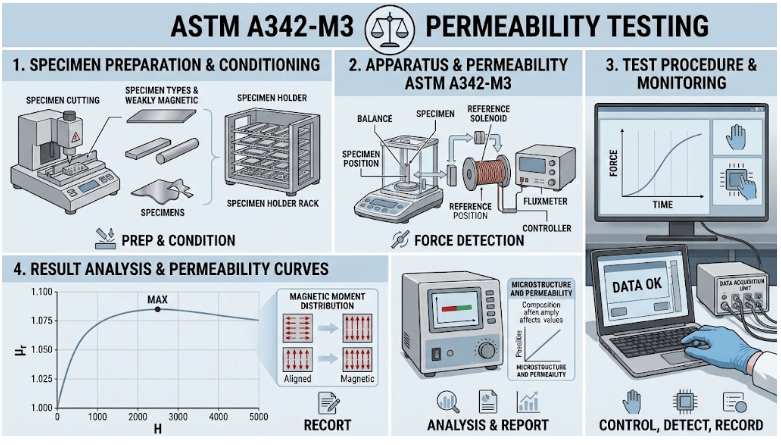
    The image shows an ASTM A342 testing process, preparation of a weakly magnetic material specimen, magnetic measurement equipment, calibration reference, controlled magnetic-field measurement, permeability evaluation, and data recording.
    ASTM A342 Permeability Testing of Weakly Magnetic Materials

    Common Challenges and Troubleshooting

    ASTM A342 results may vary because of differences in specimen geometry, magnetic field strength, specimen condition, equipment calibration, and measurement method. The test procedure should be chosen according to the expected range of permeability, and the specimen configuration should be kept. Other weakly ferromagnetic materials, such as austenitic stainless steels, can have permeability that varies in a non-linear fashion as a function of the magnetic field. Record the field strength (or range, if required), and when comparing results from different procedures, do not compare them without considering the measurement conditions. The technicians need to check the specimen, the measurement system, the reference standards, and the test conditions before the measurement is repeated.

    Analysis Results and Interpretation

    The report summarizes the relative permeability or comparative magnetic response of the tested weakly magnetic material. It presents the measured or evaluated permeability result together with relevant sample identification, specimen information, magnetic field conditions, test method, specimen dimensions, and other required test information.

    Read more

    • The laboratory reports the relative permeability as a dimensionless value and records the applicable magnetic field strength or comparative permeability result according to the selected ASTM A342 procedure.
    • The technician records specimen dimensions in mm, material identification, specimen condition, selected test method, magnetic field strength or range where applicable, and other relevant measurement conditions.
    • The analyst documents the measured relative permeability or comparative result and records the applicable reference-standard response, flux distortion, magnetic response, or other observations associated with the selected test method.
    • Analysts record specimen identification, preparation details, equipment configuration, calibration or reference information, magnetic field conditions, measurement results, and other required test information.
    • Engineers compare the observed or measured permeability results among weakly magnetic materials to support specification acceptance, material selection, design, service evaluation, manufacturing control, and research and development.

    Link to ASTM A342

    FAQ

    What is the permeability range covered by ASTM A342?
    The overall scope covers materials with relative permeability not exceeding 6.0, although each test method has its own applicable range.
    Yes. Relative permeability is a dimensionless quantity because it represents permeability relative to the permeability of free space.
    Some weakly magnetic materials can have permeability that depends on magnetic field strength. ASTM specifically requires the field strength or range to be specified when using the fluxmetric and vibrating sample magnetometry methods.
    No. Specimen shape and size depend on the applicable test method. The restrictions on specimen shape and size are also why the method is often used to evaluate semifinished products before fabrication.

    Updated on September 11, 2026

    Malhar Khole
    About Author
    Malhar Khole is a Material Testing Associate at MaTestLab Inc. and holds a postgraduate degree in Material Science and Technology from IIT (BHU), Varanasi.
    Know More
    Testimonials
    Real results
    Engineers trust us with what matters most
    Start Your Testing
    Project Today
    Define your requirements and get access to
    specialized laboratories ready to deliver results
    Partners with us
    Clients
    Vendors
    Process for testing
    • STEP 01

      You share your testing requirements

    • STEP 02

      You share your sample(s)

    • STEP 03

      We deliver your test reports

    Get your testing done

    Let us know your testing requirements and we will be right back with a solution.

      Let us root for each other. Collaborate to grow, expand, and accelerate our businesses.

      Partner with us

        Discover more from Matestlab

        Subscribe now to keep reading and get access to the full archive.

        Continue reading