ASTM A341 Direct Current Magnetic Properties of Soft Magnetic Materials Using D-C Permeameters and the Point-by-Point (Ballistic) Test Methods

    What is ASTM A341?

    ASTM A341 is a standard test method to evaluate the DC magnetic performance of soft magnetic materials. Soft magnetic materials are designed to be magnetized and demagnetized with relatively low energy loss. ASTM A341 is a test for the relationship between magnetic field strength and magnetic induction that is used to assess the permeability, coercivity, magnetic hysteresis, and magnetic characteristics of a material. The results are critical for choosing materials for electrical power equipment, industrial machines, automotive parts, and electronics.

    Read more

    Get Certified ASTM A341 Testing for Reliable Magnetic Material Performance

    This testing verifies the magnetic properties of soft magnetic materials in accordance with ASTM A341 for evaluation against applicable requirements. ASTM A341 testing measures permeability, magnetic induction, coercive force, retentivity, and hysteresis characteristics for evaluation against applicable requirements. Manufacturers use ASTM A341 test results to evaluate magnetic properties, support quality control, and demonstrate compliance with applicable requirements.

    What is the Scope of ASTM A341 Testing?

    ASTM A341 establishes standard test methods for measuring the direct-current magnetic properties of soft magnetic materials. The standard provides procedures for evaluating direct-current magnetic properties to support material development, quality control, and material evaluation for electrical and magnetic applications. The scope includes:

    Read more

    • Measures the DC magnetic properties of soft magnetic materials. 
    • Uses DC permeameters and point-by-point ballistic testing methods. 
    • Evaluates magnetic induction, permeability, coercivity, and hysteresis behavior. 
    • Supports material qualification, product development, and quality control. 
    • Applicable to electrical steels and soft magnetic alloys. 
    • Provides standardized procedures for comparing magnetic performance. 

    What is the Use of ASTM A341 Testing?

    ASTM A341 testing helps manufacturers and laboratories evaluate the DC magnetic performance of soft magnetic materials used in electrical and electromagnetic equipment. The test results support quality control, material selection, research, and product certification by providing accurate magnetic property data. Common applications include: 

    • Evaluate the DC magnetic performance of soft magnetic materials that are used for electrical equipment. 
    • Manufacturers use this test to ensure the quality and uniformity of the electrical steels and magnetic alloys. 
    • Engineers use it to choose appropriate magnetic materials for transformers, motors, generators, relays, inductors, and electromagnetic devices. 
    • ASTM A341 testing is conducted to measure the direct current magnetic properties of soft magnetic materials for evaluation against customer or industry requirements.
    • Research organizations use this standard to compare new magnetic alloys, heat treatments, and manufacturing processes.
    • The test also helps in optimizing the magnetic efficiency and minimizing losses in electrical components for product development. 

    What Materials Can Be Tested Using ASTM A341?

    Standard ASTM A341 is for the magnetic properties of the following soft magnetic materials: electrical steel, grain-oriented electrical steel, non-grain-oriented electrical steel, silicon steel, low-carbon magnetic steel, iron-nickel alloys, iron-cobalt alloys, soft ferritic alloys, transformer core laminations, motor laminations, generator cores, relay components, solenoid cores, magnetic strips, magnetic sheets, and other magnetic materials for use in DC magnetic applications.

    Why are DC Magnetic Properties Important?

    The magnetic properties of soft magnetic materials affect the efficiency of electrical equipment. Higher permeability means lower energy loss due to easy magnetization, and a lower coercive force and a narrower hysteresis loop mean that less energy is lost. ASTM A341 provides magnetic property data that assists manufacturers in selecting suitable materials for transformers, motors, generators, and other electromagnetic devices.

    Common Challenges and Troubleshooting

    Residual magnetism, improper specimen preparation, instrument calibration issues, temperature variations, and electrical noise can affect the accuracy of the test results. Suitable demagnetization, well-designed permeameters, controlled test environments, and good handling of the specimens are important in ensuring reproducibility.

    ASTM A341 Testing Process and Data Collection

    The first step in testing is the preparation and demagnetization of the soft magnetic specimen. The specimen is inserted into a DC permeameter, and a magnetic field is applied through it gradually by the point-by-point ballistic method. The magnetic induction is measured at different magnetic field strengths to get the magnetization curve. The measured data are used to calculate permeability, coercive force, remanence, and hysteresis characteristics, which are reported in the final test report.

    ASTM A341 Equipment and Sample Preparation Guide

    Specimen DetailsRepresentative specimens include electrical steels, silicon steels, low-carbon magnetic steels, iron-cobalt alloys, iron-nickel alloys, soft ferritic alloys, magnetic strips, magnetic sheets, and other soft magnetic materials prepared in accordance with the applicable test configuration.
    Specimen PreparationFerromagnetic specimens are prepared to define dimensions and smooth edges to ensure a clean reading. Specimens are cleaned and demagnetized before testing to remove any magnetism that may affect the results. 
    Specimen DimensionsSpecimen dimensions depend on the permeameter and test configuration. Ring specimens, strip specimens, bar specimens, or laminated core specimens are prepared according to ASTM A341 requirements and compatible testing equipment.
    InstrumentationDC permeameter, ballistic galvanometer or ballistic fluxmeter, magnetizing coils, search coils, regulated DC power supply, precision ammeter, voltmeter, and a computerized data acquisition system to measure magnetic field strength, magnetic induction, permeability, and coercive force. 

    Testing Procedures and Requirements

    Read more

    ASTM A341 testing determines the direct current magnetic properties of soft magnetic materials by either a DC permeameter or a point-by-point ballistic test method (also known as numerical integration in exterior ballistics). The procedure measures magnetic properties such as permeability, coercivity, and magnetic induction under controlled DC magnetization and standard laboratory conditions. The following steps are involved in the testing process:

    Specimen PreparationThe analyst prepares representative soft magnetic specimens with the required dimensions and surface finish.
    DemagnetizationRemoval of residual magnetism is performed before testing to ensure accurate measurements.
    DC Permeameter SetupThe specimen is mounted in a calibrated DC permeameter, and the magnetizing coil is configured for field application.
    Magnetic Field ApplicationThe analyst applies controlled direct current to generate the required magnetic field strength.
    Ballistic Flux MeasurementDC magnetic flux density is measured using a ballistic galvanometer or fluxmeter at defined field strengths.
    Hysteresis EvaluationThe analyst records magnetization and demagnetization characteristics.
    Data AnalysisThe analyst calculates permeability, coercive force, retentivity, magnetic induction, and hysteresis properties.
    Test ReportingThe testing report includes B-H curves, permeability values, coercivity, remanence, test compliance results, magnetic properties, and, where required, compares the results with the applicable acceptance criteria or product specification.
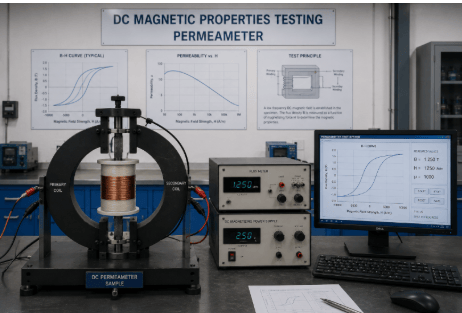
    The image shows a laboratory permeameter measuring the direct-current magnetic properties of a soft magnetic steel specimen during ASTM A341 testing.
    DC Magnetic Properties Testing Permeameter

    Analysis Results and Interpretation

    • Test results consist of magnetic induction (T), magnetic field strength (A/m or Oersted), relative permeability, coercive force (A/m), remanence or retentivity (Tesla), and characteristics of the hysteresis loop. 
    • Data on the B-H relationship and DC magnetization curves for every ferromagnetic specimen tested
    • Values for maximum, initial, and progressive permeability
    • Remanence and coercive force measurements in accordance with ASTM A 341 ballistic test protocols
    • Test compliance results are evaluated against specified DC magnetic property requirements.

    What Are the Factors to Consider for ASTM A341 Testing?

    The following can be considered while choosing a lab for this testing.

    Read more

    • Speed: Rapid specimen preparation and automated data acquisition increase laboratory productivity.
    • Expertise: It is important to have an expert technician to prepare specimens, to calibrate the instruments, and to interpret magnetic measurements correctly.
    • Cost: Early verification of magnetic properties avoids manufacturing defects, improves product performance, and reduces costly redesigns.

    Link to ASTM A341

    Updated on July 16, 2026

    Rohit Dhembare
    About Author
    Rohit Dhembare is an Operations Associate at Matestlab Inc., holds a postgraduate degree in Organic Chemistry and is trained in Materials Science testing techniques.
    Know More
    Testimonials
    Real results
    Engineers trust us with what matters most
    Start Your Testing
    Project Today
    Define your requirements and get access to
    specialized laboratories ready to deliver results
    Partners with us
    Clients
    Vendors
    Process for testing
    • STEP 01

      You share your testing requirements

    • STEP 02

      You share your sample(s)

    • STEP 03

      We deliver your test reports

    Get your testing done

    Let us know your testing requirements and we will be right back with a solution.

      Let us root for each other. Collaborate to grow, expand, and accelerate our businesses.

      Partner with us

        Discover more from Matestlab

        Subscribe now to keep reading and get access to the full archive.

        Continue reading