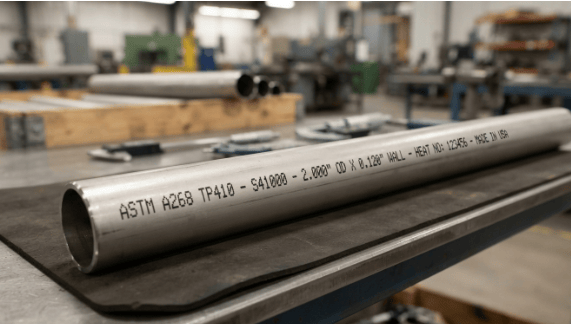
ASTM A268 covers seamless and welded ferritic and martensitic stainless steel tubing intended for general service and elevated temperature applications. The specification establishes uniform requirements for manufacturing, material properties, dimensions, heat treatment, and inspection to verify compliance with ASTM A268.
- Applies to seamless and welded ferritic and martensitic general service stainless steel tubing.
- Defines specifications for the chemical composition of specific grades of stainless steel.
- Sets mechanical property specifications, such as tensile strength and elongation.
- Specifies manufacturing processes, heat treatment, dimensional tolerances, and workmanship.
- Establishes manufacturing testing, inspection, and acceptance requirements for ferritic and martensitic stainless steel tubing.
What are the Uses of ASTM A268?
ASTM A268 tubing is widely used in industries requiring corrosion-resistant stainless steel tubing with reliable mechanical performance. The specification covers multiple ferritic and martensitic stainless steel grades with properties that vary depending on the specific grade and intended service conditions.
- Produce stainless steel tubes that are resistant to corrosion for industrial use.
- Manufacture tubing for heat exchangers, condensers, and boiler systems.
- Provide stainless steel tubes to chemical processing plants.
- Install piping systems in power generation plants.
- Produce tubes for food and beverage processing machines.
- Support oil and gas processing applications.
- Conduct quality control in the process of stainless-steel tube production.
- Check compliance prior to installation in industrial piping systems.
Which materials are used for the ASTM A268 test?
ASTM A268 specifies seamless and welded ferritic and martensitic stainless steel tubing for general corrosion-resistant and high-temperature applications. The standard covers several grades of ferritic and martensitic stainless steel tubing used in heat exchangers, boilers, condensers, power generation equipment, petrochemical plants, and industrial process systems.
Why is ASTM A268 Important for High-Temperature Service?
ASTM A268 is significant because it provides specification requirements for the manufacturing, mechanical properties, corrosion resistance, and inspection of ferritic and martensitic stainless steel tubing. ASTM A268 specifies manufacturing material testing and inspection requirements that help verify compliance with the specification for ferritic and martensitic stainless steel tubing.
Common Challenges and Troubleshooting
Some common challenges include maintaining a consistent chemical composition, achieving proper heat treatment, controlling dimensional tolerances, preventing weld imperfections, and ensuring compliance with mechanical property requirements. Technicians should regularly calibrate testing equipment, properly prepare representative specimens, complete all required dimensional inspections, and perform all evaluations in accordance with the referenced ASTM test methods.
ASTM A268 Testing Process and Data Collection
Representative tubing samples are selected from the production lot for inspection and testing. Dimensional measurements are typically performed before tensile hardness, flaring flange reverse flattening, hydrostatic or nondestructive electrical testing, and visual examination as applicable. Heat treatment records are also checked as required. Chemical composition, tensile strength, yield strength, elongation, hardness values, dimensions, hydrostatic or nondestructive examination results, visual inspection results, and final acceptance are typical data collected.