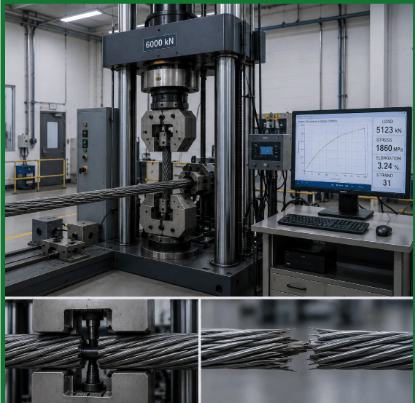
ASTM A1061 is a group of recommended test methods for the mechanical properties of multi-wire steel strands for prestressed concrete structures. The standard provides procedures for testing the strength, elongation, and dimensional properties of the product to ensure consistency and reliability in the structure of the product being manufactured. The scope of ASTM A1061 includes the following:
- Determines the mechanical properties of multi-wire steel prestressing strands.
- Measures breaking strength, yield strength, elongation, and modulus of elasticity.
- Supports manufacturing quality control and product certification.
- Applicable to prestressing strands used in prestressed concrete structures.
- Used in construction, infrastructure, transportation, and precast concrete industries.
- Provides standardized procedures for laboratory testing and acceptance.
What is the Use of ASTM A1061 Testing?
The ASTM A1061 test is usually conducted by the manufacturer, a test lab, or a construction industry to ensure that multi-wire steel prestressing strands are of good quality. The results ensure reliable structural performance, meet industry specifications, and ensure consistency in manufacturing quality. Common applications of ASTM A1061 testing include the following:
- Quality control of prestressing strand manufacturing.
- Certification of prestressing steel products.
- Bridge construction projects.
- Prestressed concrete buildings.
- Precast concrete production.
- Railway sleeper manufacturing.
- Marine and offshore concrete structures.
- Post-tensioning systems.
- Infrastructure development.
- Research and product development.
What Materials Can Be Tested Under ASTM A1061?
ASTM A1061 is intended for multi-wire high-strength steel prestressing strands used in prestressed concrete applications. Typical materials include seven-wire low-relaxation prestressing strands, stress-relieved prestressing strands, galvanized prestressing strands (where applicable), bridge tendons, post-tensioning tendons, precast concrete reinforcement strands, concrete pole reinforcement, marine structural reinforcement, and industrial prestressing systems manufactured from high-strength carbon steel.
Why is ASTM A1061 Testing Important?
The prestressing strands are subjected to high tensile stresses during their service life. ASTM A1061 ensures they are strong, stiff, and flexible prior to installation. Effective testing can help eliminate catastrophic failures on-site, enhance construction practices, and adhere to engineering design and safety standards.
Common Challenges and Troubleshooting
Test accuracy can be compromised by improper gripping, unintended specimen movement, conducting strand ribbon, damaged strand ends, incorrect positioning of the extensometer, and inaccuracy of the test machine and equipment. Properly maintained test equipment, calibrated measuring devices, specialized strand grips, and experienced laboratory workers will ensure more repeatable results.
ASTM A1061 Testing Process and Data Collection
Prestressing strand samples are first collected from the production lot to be tested to represent the lot. The specimen is subjected to visual inspection and measurement, and rigidly fixed into special tensile grips. A universal testing machine is used to apply tensile force to a body such that the load applied to the body and its corresponding extension are measured electronically. Engineers determine the breaking strength, yield strength, elongation, and modulus of elasticity following fracture and then compare the data against the ASTM A1061 acceptance requirements.