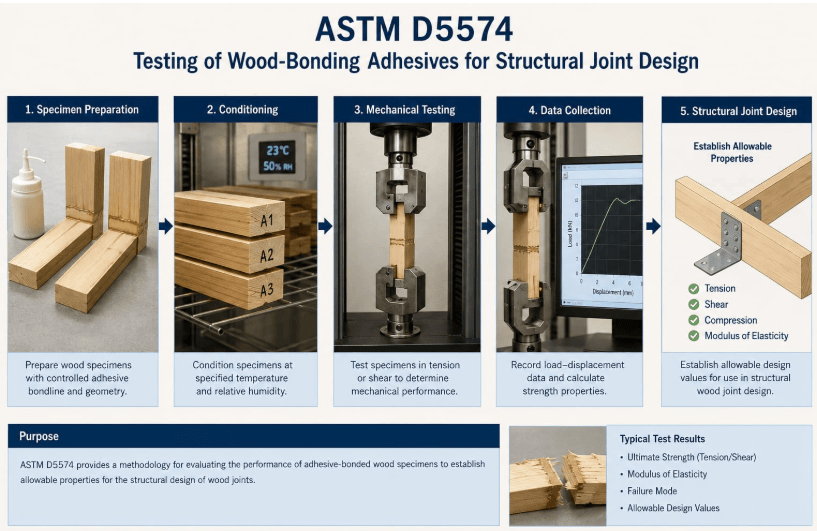
ASTM D5574 Standard Test Methods for Establishing Allowable Mechanical Properties of Wood-Bonding Adhesives for Design of Structural Joints
What is ASTM D5574?
ASTM D5574 describes a standard test method to define acceptable mechanical properties of adhesives used to create adhesive-bonded joints between wood and wood, or wood and other materials, for structural components and assemblies. The methods are adapted from Practice D245. ASTM D5574 (Standard Test Methods for Establishing Allowable Mechanical Properties of Wood-Bonding Adhesives for Design of Structural Joints) specifies three principal properties: allowable shear stress, allowable tensile stress, and allowable shear modulus. The methods also address adhesion degradation due to creep, durability (bond strength after prolonged exposure to heat and moisture), temperature, and moisture.
Get Certified ASTM D5574 Testing for Reliable Structural Adhesive Performance
Structural adhesive joints should maintain good mechanical properties during service. Variations in adhesive properties and environmental conditions affect the allowable design stress for a bonded joint. ASTM D5574 gives engineers guidance on the acceptable mechanical properties they can use when designing structural adhesive joints. The standard accounts for variability and environmental effects when engineers establish allowable design values. Engineers can apply the properties only to the specific adhesive formulation they tested and analyzed. They also use these properties only for adhesive bondline thicknesses supported by the test data.
What is the Scope of the ASTM D5574 Test Standard?
ASTM D5574 provides methods for determining allowable mechanical properties of structural wood-to-wood and wood-to-combination adhesive joints. The standard addresses the mechanical performance and durability of adhesive joints under conditions relevant to structural design. The standard methods cover-
Allowable shear stress of adhesive joints.
Allowable tensile stress of adhesive joints.
Allowable shear modulus of adhesive joints.
Creep-rupture behavior of adhesive bonds.
Effects of elevated temperature and humidity on adhesive-joint performance.
Retention of adhesive-bond properties under environmental exposure.
Bonding performance of chemically treated wood using adhesives.
Durability, permanence, and creep requirements for adhesive properties.
Application of allowable properties only to the adhesive formulation tested and to the range of bondline thicknesses supported by the available test data.
What are the Uses of ASTM D5574 Testing?
ASTM D5574 testing helps engineers and adhesive manufacturers obtain mechanical property data to design and evaluate structural wood adhesive joints. Engineers use the results to assess whether an adhesive can perform effectively under expected service conditions. These standard methods-
Obtain mechanical property data for structural joint design.
Select appropriate wood-bonding adhesives.
Determine allowable design values for an adhesive formulation.
Evaluate the effects of temperature and moisture on adhesive performance.
Assess long-term behavior through creep-rupture testing.
Study the stability of adhesive bonds under environmental conditions.
Assess adhesives for use with chemically treated wood.
Compare adhesive performance under specific conditions.
Support evaluation of adhesives used with treated wood.
Which Adhesives Can Be Tested Under ASTM D5574?
ASTM D5574 applies to adhesives intended for bonding wood to wood and wood to other materials in structural components and assemblies. The test methods allow engineers to specify permissible mechanical properties for the particular adhesive formulation they test and analyze. The standard also applies to adhesives that bond wood treated with preservatives, fire retardants, and other chemicals that alter the wood. In such cases, the standard requires engineers to conduct permanence testing on wood adherends that receive the same chemical treatment.
Why is ASTM D5574 Important?
Good mechanical properties ensure the desired structural performance of adhesive bonds. Adhesive properties naturally vary and may change under environmental conditions. ASTM D5574 considers these factors when establishing allowable design properties. The standard uses mechanical test data to determine acceptable shear stress, tensile stress, and shear modulus. It also evaluates creep rupture and permanent property loss after exposure to high temperatures and moisture. Engineers can use these test results to estimate the durability of adhesive performance in structural applications.
ASTM D5574 Equipment and Sample Preparation Guide
ASTM D5574 uses standard ASTM mechanical test methods to determine the strength properties required to establish allowable values. Laboratory technicians prepare the wood adherends (specimen joints) with an adhesive and test their mechanical behavior under specified conditions.
Laboratory technicians prepare the wood adherends (specimen joints) with an adhesive, and test their mechanical behavior under specified conditions.
Specimen Preparation
Representative adhesive-bonded specimens are prepared using wood and wood combined with other materials to evaluate allowable mechanical properties.
Specimen Dimensions
Technicians use specimen dimensions specified by the applicable ASTM mechanical test method used to establish the required property.
Instrumentation
The laboratory uses appropriate mechanical testing equipment, environmental conditioning equipment, load-measurement systems, and deformation or strain-measurement equipment.
Testing Procedures and Requirements for ASTM D5574
ASTM D5574 establishes allowable adhesive properties through mechanical testing. Technicians prepare bonded specimens and conduct the required mechanical property tests under specified conditions. The ASTM D5574 test methods comprise the following test procedure-
Technicians prepare wood adherends and form adhesive-bonded specimens for the applicable mechanical evaluation.
Mechanical Testing
Analysts determine the strength and deformation response using the applicable ASTM test method.
Creep-Rupture Evaluation
Technicians collect time-to-failure data at selected temperature and moisture conditions to evaluate long-term adhesive strength.
Aging Evaluation
Analysts expose specimens to elevated temperature and moisture, and then evaluate strength to assess permanence.
Allowable Property Determination
Analysts use the test data and applicable analysis procedures to establish allowable shear stress, tensile stress, and shear modulus.
According to ASTM D5574, creep-rupture time to failure measures ultimate adhesive-bond strength as a function of time under various temperature and moisture conditions. Laboratories use relatively short loading periods to obtain useful information about service life at a given shear stress level, provided they interpret the results with appropriate caution.
ASTM D5574 Testing Process and Data Collection
For the evaluation, engineers first select the adhesive formulation and the appropriate wood adherends. Analysts then prepare the bonded specimens according to the applicable ASTM mechanical test procedure. Next, technicians conduct the necessary strength tests and document the mechanical response. They obtain creep-rupture data at various temperatures and humidity levels. Technicians also use two different aging tests to evaluate the adhesive’s resistance to permanent property loss after exposure to high temperature and humidity. Analysts then use the resulting data to determine allowable shear stress, allowable tensile stress, and allowable shear modulus. The allowable values apply specifically to the tested adhesive formulation and the range of bondline thicknesses supported by available data.
ASTM D5574 Testing of Wood-Bonding Adhesives for Structural Joint Design
Common Challenges and Troubleshooting
Consistent adhesive formulation, wood preparation, bonding conditions, and mechanical testing are essential for accurate evaluation per ASTM D5574. The properties of wood themselves can restrict the measured allowable adhesive strength, and the laboratories should take into account the different species of wood in interpreting the results. Care must also be taken in environmental exposure, as temperature and moisture could impact the adhesive performance. If treated wood is intended for use, the laboratory should use the same treated wood to evaluate the permanence. The lab ensures the bondline thickness applied during application falls within the range of test results.
ASTM D5574 Analysis Results and Interpretation
Laboratories use mechanical test results to determine the properties of wood-bonding adhesives for designing structural joints. ASTM D5574 determines allowable shear stress, allowable tensile stress, and allowable shear modulus.
The laboratory reports allowable shear stress and allowable tensile stress in MPa (N/mm²) or psi, as applicable; higher values generally indicate greater resistance to the corresponding loading.
The laboratory reports allowable shear modulus in MPa (N/mm²) or psi; higher values indicate greater resistance to shear deformation.
The analyst records the location and type of failure, such as adhesive, cohesive, or wood failure, and uses these observations to evaluate the bonded joint’s structural performance.
The laboratory evaluates creep, durability, permanence, and environmental effects by considering creep-rupture behavior and strength changes after exposure to elevated temperature and moisture.
Engineers compare strength and deformation results under the specified environmental and loading conditions to assess the adhesive’s suitability for the intended application.
ASTM D5574 determines allowable shear stress, allowable tensile stress, and allowable shear modulus for wood-bonding adhesives used in structural joint design.
What type of wood does ASTM D5574 use for determining allowable strength?
The standard uses hard maple (Acer saccharum, Marsh.) as the wood adherend when determining allowable strength. The allowable shear and tensile stress values depend on the strength limits of the wood adherend. Other wood species require evaluation when their properties limit the allowable strengths.
Does ASTM D5574 evaluate adhesive durability and creep?
Yes. ASTM D5574 includes creep-rupture testing and strength testing after elevated temperature and moisture aging. These tests evaluate adhesive creep behavior and permanence.
Rohit Dhembare is an Operations Associate at Matestlab Inc., holds a postgraduate degree in Organic Chemistry and is trained in Materials Science testing techniques. Know More
Testimonials
Real results
Engineers trust us with what matters most
“We had a great experience working with this company for our ASTM E84 testing. They were the first company to respond to our inquiry within just a few minutes of submitting it. From start to finish, the communication was excellent, and the entire process was swift, straightforward, and hassle-free.”
Ivars FancyWalls
United States
“Very good communication, testing associates were very patient with delays on our end. Reasonable turnaround time for results and nicely detailed report. Analysts were also quick to answer any follow-up questions. Happy with results.”
Skye Henderson
United States
“Matestlab connected us with an accredited lab within days, cutting weeks off our product validation timeline.”
Rebecca Kozodoy-Pins
United States
Why Choose Matestlab?
Matestlab is a unified testing services partner based in the USA. Matestlab offers raw material and product testing services through accredited, expert laboratories primarily based in the USA. Matestlab supports physical, thermal, chemical, electrical, mechanical, environmental, and characterization testing needs through its global network of 2200+ accredited testing laboratories. Matestlab's in-house materials science experts curate and design comprehensive testing programs matched to the sample material and specific testing need, with regulatory requirements and confidentiality in mind.
If you are looking for a managed and trusted testing partner to achieve your research goals, feel free to schedule a meeting with us or send us a request at connect@matestlabs.com to learn more about our services. For a quick quote, call us at (302)244-7710. We are happy to serve you.
Start Your Testing Project Today
Define your requirements and get access to specialized laboratories ready to deliver results