ASTM G8 Standard Test Methods for Cathodic Disbonding of Pipeline Coatings

    What is ASTM G8?

    ASTM G8 measures the extent of cathodic disbondment of nonmetallic coatings on steel as the coated steel is exposed to an electrolyte and subjected to an applied cathodic potential. The method involves producing an artificial holiday by coating the steel substrate and placing the specimen under electrical stress in a conductive electrolyte. ASTM G8 (Standard Test Methods for Cathodic Disbonding of Coated Steel covers both immersion and attached-cell (sacrificial anode or impressed-current) configurations. Analysts inspect the coating for loosened or disbonded areas around the holiday. Ambient-temperature test for coated steel pipe, flat plate, and curved plate.

    Read more

    Get Certified ASTM G8 Testing for Reliable Coating Disbondment Evaluation

    ASTM G8 testing is used to determine the amount of cathodic disbondment of non-metallic coatings over steel substrates in the presence of an electrolyte and an applied cathodic potential. ASTM G8 testing helps to evaluate coating resistance to disbondment and to qualify, compare performance, and evaluate corrosion protection. Testing can evaluate coated steel pipe, flat plate, or curved plate specimens under ambient-temperature conditions specified by the standard.

    What is the Scope of the ASTM G8 Test Standard?

    ASTM G8 outlines methods to measure the extent of disbondment from the steel surface of nonmetallic coatings when the coated material is in contact with an electrolyte and an electrical potential is applied. The standard is valid for coated steel pipe and coated flat or curved steel plate at ambient room temperature. Polarization with sacrificial anodes or impressed current is included in ASTM G8. The standard calls for a test ambient temperature range of 21 °C to 25 °C (70 °F to 77 °F). The scope of ASTM G8 includes:

    Read more

    • Coating Type: Covers nonmetallic coatings that do not exhibit flow characteristics at the test temperature.
    • Substrate: Applies to coated steel pipe, flat steel plate, and curved steel plate.
    • Temperature: Applies to electrolyte immersion or attached-cell testing at 21 °C to 25 °C.
    • Method A: Uses an electrolyte immersion bath and a specified sacrificial metallic anode without electrical monitoring.
    • Method B: Uses electrolyte immersion with impressed-current polarization and electrical monitoring.
    • Method C: Uses an electrolyte cell attached to the specimen with impressed-current polarization and electrical monitoring.
    • Polarization: Applies cathodic potential using sacrificial anodes or impressed current.
    • Evaluation: Determines coating disbondment by physical examination and, where applicable, electrical monitoring.

    What are the Uses of ASTM G8 Testing?

    The cathodic disbondment resistance of non-metallic coatings applied to steel can be evaluated using the controlled procedure outlined in ASTM G8. Consequently, engineers can use the results to assess coating performance under cathodic protection conditions and support coating qualification, development, and comparative evaluation.  The ASTM G8 standard-

    • Determines the degree of coating disbondment around artificial holidays.
    • Determines resistance of coatings to cathodic protection effects.
    • Compares adhesion of various coating systems.
    • Evaluates coating characteristics on steel pipe and plate samples.
    • Measures electrical response when current testing is required.
    • Determines loosening of coating due to electrochemical conditions.
    • Aids in coating qualification and comparative performance evaluations.
    • Provides data for the evaluation of the protective behavior of coating under cathodic polarization.

    Which materials can be tested under ASTM G8?

    ASTM G8 is applicable to steel substrates having nonmetallic, electrically insulating coatings. Examples of test specimens are coated steel pipes, flat steel panels/coupons, and curved steel plates. The minimum dimensions for the standard specimen configurations are 150 × 300 mm with a minimum thickness of 3.2 mm for coated flat panels or coupons, and 50.8 mm outside diameter, 6.4 mm wall thickness, and minimum length of 300 mm for pipe specimens (Methods A and B).

    Why is ASTM G8 Important?

    ASTM G8 is important because cathodic protection can cause alkaline conditions at coating holidays, which can reduce adhesion of the coating to steel. This cathodic disbondment behavior is tested under controlled conditions as specified in the standard. The disbondment can be affected by factors including electrolyte composition, temperature, coating thickness, size of holiday, polarization method, current density, oxygen concentration, specimen configuration, and coating adhesion.

    ASTM G8 Equipment and Sample Preparation Guide

    ASTM G8 specifies the need for a controlled electrochemical test system, prepared coated-steel specimens, an electrolyte, electrodes, electrical measurement equipment, and disbondment evaluation equipment. Continuity of the coating, artificial holidays, coating thickness, and sealing of exposed edges must be verified by technicians prior to exposure.

    Read more

    Sample and Specimen DetailsTechnicians employ coated steel panels, coupons, pipes, or curved plates coated with a nonmetallic coating with artificial holidays that extend to the steel substrate.
    Specimen PreparationTechnicians check for continuity of the coating, measure the dry-film thickness, produce the required holiday (without perforating the steel), and cover the edges of the specimen or the ends of the pipe with insulating material.
    Specimen DimensionsFlat panels or coupons require minimum dimensions of 150 × 300 mm with a minimum thickness of 3.2 mm. Pipe specimens for Methods A and B use a 50.8 mm outside diameter, 6.4 mm wall thickness, and minimum length of 300 mm. Method C uses coated pipe or curved plate that accommodates the attached cell, with a recommended wall thickness of at least 6.4 mm.
    Specimen DimensionsFlat panels or coupons require minimum dimensions of 150 × 300 mm with a minimum thickness of 3.2 mm. Pipe specimens for Methods A and B use a 50.8 mm outside diameter, 6.4 mm wall thickness, and a minimum 300 mm length. Method C uses coated pipe or curved plate that accommodates the attached cell, with a recommended wall thickness of at least 6.4 mm.

    Testing Procedures and Requirements for ASTM G8

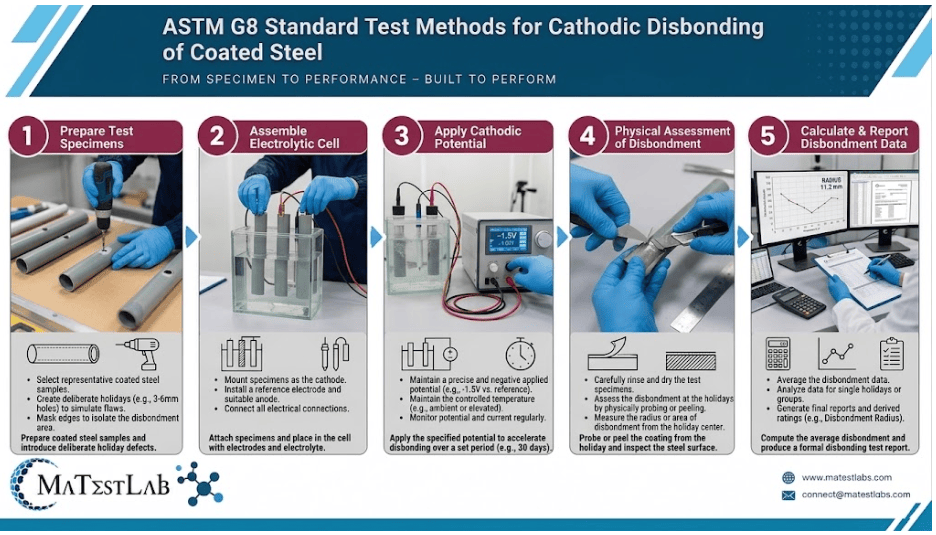
    ASTM G8 cathodically polarizes a purposely damaged coated-steel test specimen in a specified electrolyte and assesses the disbondment of the coating around the artificial holiday. The cathodic condition is generated and monitored in three different ways: Methods A, B, and C. The procedure outlined in ASTM G8 is as follows-

    Read more

    Specimen VerificationTechnicians check for continuity of coating, look for defects in the specimen, measure the dry-film thickness, and then create the artificial holiday.
    Holiday PreparationTechnicians produce the desired holiday in the coating without piercing the steel with the appropriate holiday diameter for the specimen and method.
    Electrolyte PreparationTechnicians set up a new electrolyte from any of the allowed electrolytes: 1% sodium chloride solution, 3% sodium chloride solution, synthetic seawater, or a user-specified electrolyte.
    Cathodic PolarizationThe specimen is exposed to the electrolyte and polarized using the applicable sacrificial-anode or impressed-current configuration for Methods A, B, or C.
    Electrical MonitoringTechnicians control electrochemical test conditions, and for applicable configurations, specimen potential and current are monitored during exposure.
    Result Reporting After exposure, operators physically examine the coating, create a reference holiday where required, lift the loosened coating, and measure the extent of cathodic disbondment.

    ASTM G8 Testing Process and Data Collection

    In ASTM G8 tests, the coated-steel test pieces with artificial holidays are subjected to an electrolyte and cathodic polarization. The method chosen is either sacrificial anode or impressed current, with electrical response recorded during exposure. Once tested, technicians examine the coating around the holiday and measure the area of disbonded or loosened coating.

    Coated steel specimen undergoing cathodic polarization in an electrolyte bath for ASTM G8 disbondment testing.
    ASTM G8 cathodic disbonding evaluation of a coated steel specimen.

    Common Challenges and Troubleshooting

    Common ASTM G8 challenges include defective coating continuity, incorrect holiday dimensions, steel perforation during holiday preparation, unstable electrical connections, inaccurate reference-electrode readings, improper electrolyte preparation, and inconsistent coating-disbondment measurements. Coating thickness, specimen sealing, holiday geometry, electrolyte condition, polarization, temperature, and electrical instrumentation shall be checked before and during testing by the technicians.

    ASTM G8 Analysis Results and Interpretation

    ASTM G8 results indicate the degree of disbondment caused by cathodic polarization of the coating. The physical and electrical observations are interpreted by engineers as a function of the coating system, the specimen configuration, the electrolyte, the method of polarization, and the conditions of exposure.

    Read more

    • The laboratory documents the coating thickness, specimen configuration, artificial holiday dimensions, electrolyte, and test conditions.
    • The analyst determines the area or extent of the loosened coating around the immersed artificial holiday.
    • The electrical measurements, as per the applicable methods, provide information on current and potential during the cathodic exposure.
    • Engineers compare the disbonded region with the coating condition at a reference holiday when required by the procedure.
    • The measurements obtained are used to evaluate the resistance to cathodic disbondment of the coating under controlled conditions.

    Link to ASTM G8

    FAQ

    Why is ASTM G8 important?
    ASTM G8 is significant because it offers standardized test methods to assess the ability of coated steel to withstand cathodic disbondment.
    ASTM G8 is used for the evaluation and comparison of the cathodic disbondment resistance of nonmetallic coatings on steel under controlled electrochemical conditions.
    ASTM G8 quantifies the degree of coating disbondment around artificial holidays and the electrical current and potential during exposure (where applicable).

    Updated on September 24, 2026

    Gokula Srinivasan Selvam
    About Author
    Gokula Srinivasan Selvam is a Material Testing Associate at Matestlab Inc. and holds a postgraduate degree in Ceramic Engineering from IIT (BHU), Varanasi. His academic background and professional experience are centered on advanced ceramic materials, their processing, characterization, and performance evaluation.
    Know More
    Testimonials
    Real results
    Engineers trust us with what matters most
    Why Choose Matestlab?
    Matestlab is a unified testing services partner based in the USA. Matestlab offers raw material and product testing services through accredited, expert laboratories primarily based in the USA. Matestlab supports physical, thermal, chemical, electrical, mechanical, environmental, and characterization testing needs through its global network of 2200+ accredited testing laboratories. Matestlab's in-house materials science experts curate and design comprehensive testing programs matched to the sample material and specific testing need, with regulatory requirements and confidentiality in mind.

    If you are looking for a managed and trusted testing partner to achieve your research goals, feel free to schedule a meeting with us or send us a request at connect@matestlabs.com to learn more about our services. For a quick quote, call us at (302)244-7710. We are happy to serve you.
    Start Your Testing
    Project Today
    Define your requirements and get access to
    specialized laboratories ready to deliver results
    Partners with us
    Clients
    Vendors
    Process for testing
    • STEP 01

      You share your testing requirements

    • STEP 02

      You share your sample(s)

    • STEP 03

      We deliver your test reports

    Get your testing done

    Let us know your testing requirements and we will be right back with a solution.

      Let us root for each other. Collaborate to grow, expand, and accelerate our businesses.

      Partner with us