ASTM G48 Standard Test Methods for Pitting and Crevice Corrosion Resistance of Stainless Steels

    What is ASTM G48?

    ASTM G48 outlines standard test methods for determining the resistance of stainless steels and related alloys to pitting and crevice corrosion. These techniques include exposing test specimens to corrosive environments with high chloride concentrations and measuring the resulting corrosion. Technicians prepare stainless steel specimens, set up the required test solution and exposure parameters, and examine specimens following the test. Under these conditions, technicians observe corrosion features such as pitting or crevice attack to assess the material’s corrosion resistance. ASTM G48 (Standard Test Methods for Pitting and Crevice Corrosion Resistance of Stainless Steels) serves as a reference for comparing stainless steel grades and determining whether they are suitable for use in chloride environments.

    Read more

    Get Certified ASTM G48 Pitting and Crevice Corrosion Testing

    ASTM G48 is a testing method that evaluates stainless steels under controlled laboratory conditions for localized corrosion resistance. Technicians prepare representative specimens, apply the specified exposure conditions, and use the applicable test method for pitting or crevice corrosion evaluation. Analysts examine the specimens for localized attack and determine the applicable corrosion resistance result. Results can help with material selection, quality control, product development, and corrosion performance evaluation.

    What is the scope of ASTM G48?

    ASTM G48 includes several test methods to evaluate stainless steels and related alloys for resistance to pitting and crevice corrosion. Methods involve the purposeful acceleration of localized corrosion by ferric chloride exposure and the comparison of the various materials. ASTM G48 covers:

    Read more

    • Material Type: Stainless steels and related corrosion-resistant alloys.
    • Purpose: Evaluation of resistance to pitting and crevice corrosion.
    • Property Measured: Resistance to localized corrosion under specified ferric chloride exposure conditions.
    • Method: Controlled exposure of prepared specimens to ferric chloride solution using the applicable ASTM G48 method.
    • Result: Corrosion behavior, including mass loss and/or evidence of pitting or crevice attack, as applicable to the selected method.
    • Test Limitations: Results depend on alloy composition, specimen surface condition, exposure temperature, exposure time, solution condition, and test configuration.
    • Environmental Conditions: Controlled ferric chloride solution, temperature, and exposure conditions.
    • Applications: Stainless steel comparison, corrosion-resistant alloy evaluation, material selection, quality control, and research.

    What are the uses of ASTM G48 Testing?

    ASTM G48 testing assesses the localized corrosion resistance of stainless steels in aggressive chloride environments. The methods offer a controlled environment to compare the pitting and crevice corrosion responses of various materials. Engineers and corrosion specialists use the results to support material selection and assess performance for applications where localized corrosion is a concern. The test helps to:

    • Pitting Corrosion Evaluation: Determines the tendency of stainless steel to develop localized pits.
    • Crevice Corrosion Evaluation: Assesses susceptibility to corrosion in crevice conditions.
    • Material Comparison: Compares localized corrosion resistance among stainless steel grades.
    • Material Selection: Supports material selection for chloride-containing environments.
    • Quality Control: Provides corrosion-performance information for specified materials.
    • Product Development: Supports development and evaluation of corrosion-resistant alloys.
    • Research: Provides data for corrosion studies and material-performance investigations.

    Which Materials Can Be Tested According to ASTM G48?

    Technicians prepare sample pieces with the required surfaces and sizes, then place them in the ferric chloride solution ASTM G48 specifies. The choice of test method and how the sample is set up depends on whether the test’s looking at pitting corrosion, crevice corrosion, or some other type of local corrosion that ASTM G48 covers. The method applies to:

    • Evaluation of susceptibility to pitting corrosion: Identifies the potential susceptibility of stainless steel to pitting corrosion. 
    • Crevice Corrosion Detection: Tests for crevice corrosion. 
    • Material Comparison: Compares the localized corrosion resistance of stainless steel grades. 
    • Material Selection: Can select materials used in chloride environments. Quality Control: Gives corrosion performance data for a specified material. 
    • Product Development: Assists with product development and evaluation of corrosion-resistant alloys. 
    • Field observations and samples: Collects field samples for study, testing, and evaluation.

    Why is ASTM G48 Testing Important?

    Localized corrosion can cause damage even when the metal surface is relatively clean. ASTM G48 offers controlled accelerated exposure conditions to test the susceptibility of S/S to pitting and crevice corrosion. The results provide information for engineers that helps them understand the differences in localized corrosion resistance between materials. The test can also support material selection for applications involving chloride exposure. By using controlled specimen preparation, exposure conditions, and evaluation procedures, technicians can generate comparable corrosion-performance information.

    ASTM G48 Equipment and Sample Preparation Guide

    Technicians prepare representative stainless steel specimens, ferric chloride test solution, exposure equipment, and inspection instruments before testing. They prepare the specimen surfaces according to the selected test method and establish the required test temperature and exposure conditions. Specimen dimensions and configuration should follow the applicable ASTM G48 method and product requirements.

    Read more

    Test Specimen and Surface Preparation EquipmentTechnician provides representative stainless steel specimens with suitable surfaces for localized corrosion evaluation.
    Ferric Chloride Solution and Test ContainerTechnician provides the controlled aggressive environment required for pitting or crevice corrosion testing.
    Temperature-Controlled Exposure EquipmentTechnician maintains the specified exposure temperature and test conditions.
    Balance, Inspection and Measurement EquipmentTechnician supports specimen mass measurements and evaluation of pitting, crevice attack, and other corrosion effects.
    Specimen DimensionsSpecimen dimensions and configuration depend on the applicable ASTM G48 test method and test arrangement. Technicians should prepare specimens according to the specified dimensions, surface condition, and exposure configuration rather than applying one universal specimen size.

    ASTM G48 Testing Procedures and Requirements

    Technicians first prepare and clean the stainless steel specimens and establish the specified ferric chloride exposure environment. They place the specimens under the required test conditions for the selected ASTM G48 method and monitor the exposure temperature and duration. After exposure, technicians clean and inspect the specimens, while analysts evaluate mass changes and localized corrosion according to the applicable procedure. The testing process includes the following steps.

    Read more

    Specimen Preparation and Initial MeasurementTechnicians prepare representative specimens and establish the required initial condition and measurements.
    Ferric Chloride ExposureTechnicians expose specimens to controlled, aggressive conditions to evaluate localized corrosion.
    Post-Exposure Cleaning and InspectionThe technician removes corrosion products and examines specimens for pitting or crevice attack.
    Corrosion Evaluation and ReportingThe technician determines applicable corrosion measurements and evaluates the material’s localized corrosion resistance.

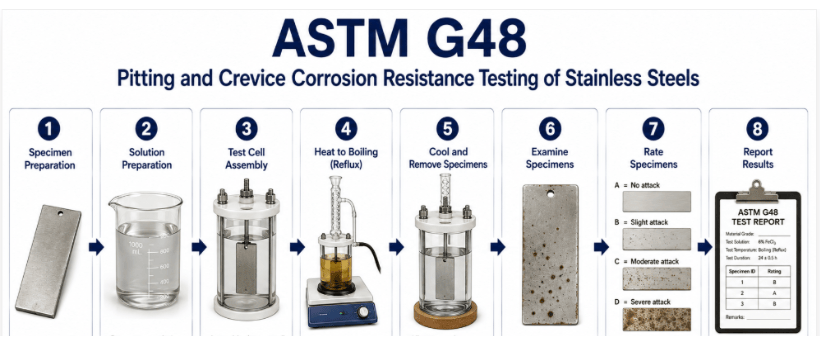
    ASTM G48 Testing Process and Data Collection

    The technicians prepare the stainless steel samples and set up the required ferric chloride test. They expose the specimens under controlled temperature and time as per the ASTM G48 method. Techniques are used to clean and inspect the specimens after exposure and to take the necessary measurements. The observed corrosion is assessed, appropriate results are calculated, and the material’s resistance to localized attack is recorded. The corrosion data obtained suggests the susceptibility of the stainless steel to pit or crevice corrosion under the given test conditions.

     The image shows an ASTM G48 process showing stainless steel specimen preparation, ferric chloride solution exposure, controlled temperature testing, specimen cleaning, corrosion inspection, measurement, and result evaluation.
    ASTM G48 Pitting and Crevice Corrosion Resistance Testing of Stainless Steels

    Common Challenges and Troubleshooting

    External factors such as differences in the level of the surface condition of the specimen, strength and concentration of ferric chloride solution, temperature, exposure duration, sample preparation, and cleaning procedures before and after the test may affect the results of ASTM G48. Technical personnel should be consistent with the time, temperature, and file condition of the specimen and solution throughout the experiment. 

    Analysis Results and Interpretation

    The report summarizes the pitting or crevice corrosion resistance of the tested stainless steel material. It presents the calculated or observed corrosion result together with relevant sample identification, specimen information, initial and final mass measurements, exposure conditions, test duration, and other required test information.

    Read more

    • The laboratory reports the initial and final specimen mass in g and records the calculated or evaluated corrosion results according to the applicable procedure.
    • The technician records specimen dimensions in mm, surface condition, ferric chloride exposure conditions, test temperature in °C, and exposure time in h.
    • The analyst documents observed pitting or crevice corrosion and records the location and characteristics of relevant corrosion damage.
    • Analysts record specimen identification, preparation details, solution conditions, post-exposure cleaning, inspection, and other required test information.
    • Engineers compare the observed or calculated corrosion results among stainless steel materials to support material selection for applications involving chloride exposure.

    Link to ASTM G48

    FAQ

    How does ASTM G48 test corrosion resistance?
    The method involves the preparation of specimens and exposing them to a controlled environment of ferric chloride solution and then measuring the localized corrosion that occurs under these conditions.
    The primary result is dependent on the specific test method and may consist of mass loss and observations or measurements of pitting or crevice corrosion.
    This method is mostly employed to assess stainless steels and related corrosion-resistant alloys.
    Ferric chloride offers an aggressive chloride environment that can induce local corrosion and serve as a contrast to the differences in material corrosion resistance.

    Updated on September 6, 2026

    Suyog Kamble
    About Author
    Suyog Kamble is an Operations Associate at MaTestLab Inc. and holds a postgraduate degree in Organic Chemistry.
    Testimonials
    Real results
    Engineers trust us with what matters most
    Start Your Testing
    Project Today
    Define your requirements and get access to
    specialized laboratories ready to deliver results
    Partners with us
    Clients
    Vendors
    Process for testing
    • STEP 01

      You share your testing requirements

    • STEP 02

      You share your sample(s)

    • STEP 03

      We deliver your test reports

    Get your testing done

    Let us known your testing requirements and we will be right back with a solution.

      Let us root for each other. Collaborate to grow, expand, and accelerate our businesses.

      Partner with us

        Contact Us

        Discover more from Matestlab Inc

        Subscribe now to keep reading and get access to the full archive.

        Continue reading