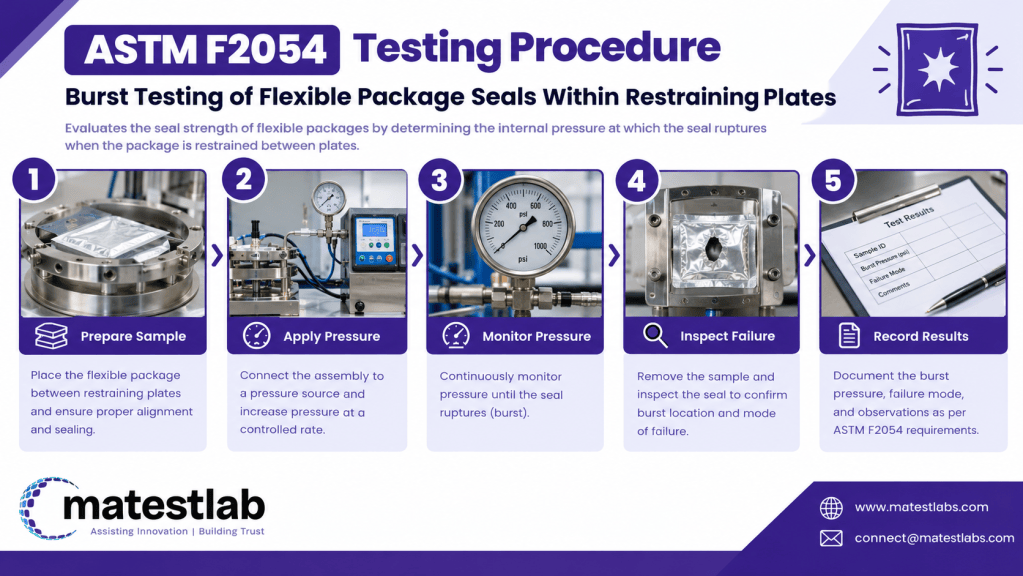
ASTM F2054/F2054M is a standard test method for burst testing of flexible package seals using internal air pressurization within restraining plates. It applies only to flexible packages with seals around the perimeter, often called pouches, and it suits peelable seals especially well. The test pressurizes the package until a seal around the perimeter bursts open, and the plates keep the package dimensionally stable so stress spreads evenly along the seal. ASTM F1140 covers a related method for packages without restraining plates. Users combine the method with other methods to evaluate overall package integrity, seal uniformity, or opening functionality. Values in SI units and inch-pound units are each regarded separately as the standard.
The scope of ASTM F2054 includes:
- Material type: Flexible packages with seals around the perimeter (pouches), including peelable seals.
- Purpose: To provide an indicator of the burst strength of a package seal.
- Properties evaluated: Burst strength of the perimeter seal under internal air pressure.
- Testing method: Technicians pressurize the package with air between rigid restraining plates until a seal bursts.
- Results: The pressure at failure and the location and type of failure, in kPa (SI) or psi (inch-pound).
- Test limitations: The method cannot measure seal uniformity, overall package integrity, or the burst strength of areas that contact the plates. Results may not correlate with seal strength measured by ASTM F1140 or by peel methods. Porous barrier materials may fail to reach burst pressure when airflow is insufficient.
- Use conditions: Technicians keep the package size, material, seal type, airflow rate, pressure sensing sensitivity, plate rigidity, and plate distance equivalent when they compare results between equipment. SI and inch-pound values are each regarded separately as the standard.
- Applications: Seal quality checks, seal comparison, and production monitoring.
What are the Uses of ASTM F2054 Testing?
ASTM F2054 testing provides burst strength data for flexible package seals. Packaging engineers use the results to compare seal designs and sealing conditions across materials. Quality teams use the data to check seal quality during manufacturing and at stages of the package life cycle. This testing:
- Provides an indicator of the burst strength of flexible package seals.
- Uses internal air pressurization within restraining plates.
- Evaluates how a seal tends to fail under a pressure differential, such as during sterilization and transportation.
- Allows comparison of seals made with different materials or sealing conditions.
- Works with other methods of evaluating the package, since it cannot judge seal uniformity or overall integrity.
Which Materials Can Be Tested Under ASTM F2054?
ASTM F2054 applies only to flexible packages with seals around the perimeter, often called pouches. It suits packages with peelable seals that the end user peels open to remove the contents. Porous barrier materials may fail to reach the burst pressure when the air supply cannot provide enough volume flow.
Why is ASTM F2054 Important?
Seal burst strength describes how much internal pressure a package seal can hold before it opens. Pressure differentials during sterilization and transportation can open a weak seal. ASTM F2054 gives packaging teams a rapid, repeatable way to evaluate that tendency, and the restraining plates spread stress evenly along the seal so the test can find its weakest area. Engineers use the result as an indicator of minimum burst strength, not as a full package evaluation.