ASTM F1685 Standard Specification for Pressure-Reducing Manifolds for Air or Nitrogen Systems
What Is ASTM F1685?
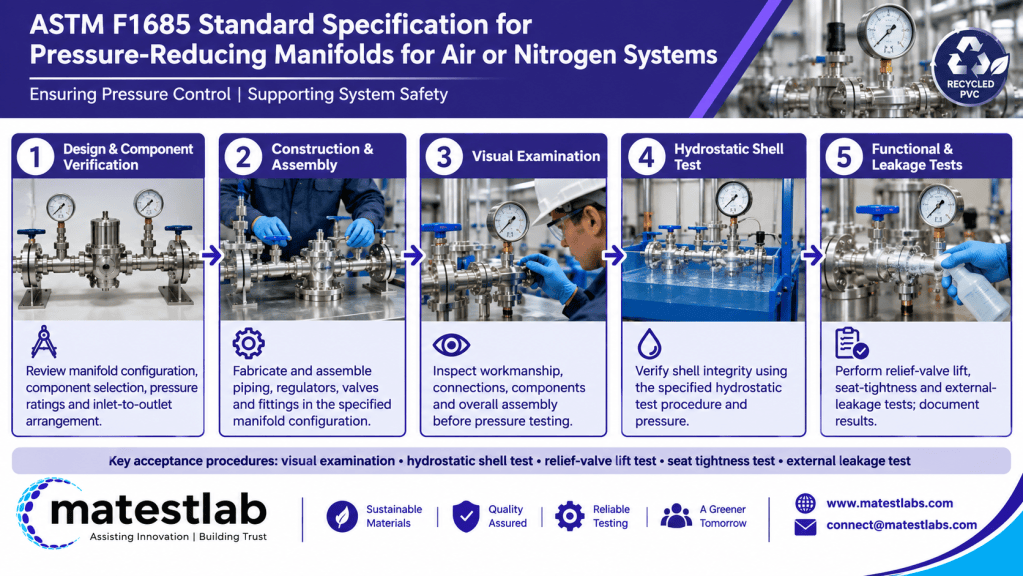
ASTM F1685 is a standard specification for the design, construction, testing, and operating conditions of pressure-reducing manifolds for use with air or nitrogen systems. A manifold includes all components and piping between, and including, its inlet and outlet ports. The specification covers manifold configurations, pressure ratings, connections, construction materials, and functional components. ASTM F1685 (Standard Specification for Pressure-Reducing Manifolds for Air or Nitrogen Systems) also specifies five basic testing and examination procedures: visual examination, hydrostatic shell testing, relief-valve lift testing, seat tightness testing, and external leakage testing. These requirements are used to evaluate manifold assemblies for their specific operating conditions.
Get Certified ASTM F1685 Testing for Reliable Pressure-Reducing Manifold Evaluation
ASTM F1685 is a standard specification that sets requirements for evaluating pressure-reducing manifolds for use in air or nitrogen systems. Technicians visually inspect the entire assembly and perform the tests, and analysts note pressure readings, valve operation, and leakage. The results aid the manufacturer or quality-control team to evaluate the quality of construction and ensure that the manifold conforms to relevant specification requirements.
What Is the Scope of ASTM F1685?
ASTM F1685 is the standard for design, construction, testing, and operating characteristics of pressure-reducing manifolds for air or nitrogen systems. It evaluates the complete assembly, including its components and piping between the inlet and outlet ports.
Manifold Configuration: Evaluation of assemblies designed with one pressure reducer and one relief valve or two pressure reducers and one relief valve, as applicable.
Pressure Ratings: Testing of specified inlet and outlet pressure ratings as per applicable manifold specifications.
End Connections: Evaluation of inlet, outlet, pressure-reducing valve, and pressure-relief valve connections as per the given configuration.
Construction Materials: Review of materials used for manifold blocks, piping, fittings, valves, and other components for applicable construction and service requirements.
Functional Components: Inspection of inlet and outlet stop valves, bleed valves, pressure reducing valves, pressure relief valves, gauge isolation valves, and bypass throttle valves.
Pressure and Leakage Performance: Hydrostatic shell testing, relief-valve lift testing, seat tightness testing, and external leakage testing.
Operating Requirements: Check the manifold to the specified inlet pressure range, outlet set pressure, flow demand, and applicable operating conditions.
What Are the Uses of ASTM F1685 Testing?
ASTM F1685 testing is used to assess pressure-reducing manifold assemblies used for air or nitrogen service for manufacturers, suppliers, and quality control teams. The specification:
Evaluation of the design and construction of pressure-reducing manifold assemblies.
Manifold inlet and outlet pressure verification and specified connection configurations.
Hydrostatic shell testing of pressure-containing sections.
Testing for lifting performance of pressure-relief valve(s) under the required test conditions.
Inspection of valve seat tightness and leakage around the valve.
Inspection of product to check for quality before acceptance or installation.
Documentation of test results for product verification, procurement, and compliance assessment.
Which Materials Can Be Tested Under ASTM F1685?
ASTM F1685 is an equipment specification rather than a test method for determining the properties of individual material specimens. It applies to full pressure drop manifolds in air or nitrogen systems. The construction requirements specify corrosion-resistant 300 series stainless steels such as SS304, 304L, 316, 316L, or other appropriate materials based on their weldability and corrosion resistance.
Why Is ASTM F1685 Important?
Pressure-reducing manifolds control downstream pressure, and they relieve excessive pressure on systems connected to them due to their pressure-reducing and pressure-relieving functions. Manifold block, connection defects, valve seat defects, and pressure containment defects can impact system operation and reliability.
ASTM F1685 Equipment and Sample Preparation Guide
ASTM F1685 specifies a full-length pressure reducing manifold assembly and appropriate testing tools for visual inspection, pressure testing, valve testing, and leakage detection. Before testing, technicians should review the manifold configuration, pressure rating, connection information, and order documentation.
Analysts identify the complete manifold assembly, manufacturer, model or product number, configuration, inlet and outlet pressure ratings, connection types, pressure-reducing and relief-valve details, and applicable product documentation.
Sample preparation
Skilled personnel verify the assembly configuration, inspect the components and connections, review the specified operating conditions, and prepare the manifold for the required examinations.
Specimen dimensions
ASTM F1685 does not prescribe one universal specimen size. Technicians document the actual manifold configuration, inlet and outlet connection sizes, component arrangement, and relevant dimensions according to the product drawings and ordering requirements.
Instrumentation
The test setup may include suitable hydrostatic pressure-testing equipment, pressure gauges or measurement devices, relief-valve test equipment, leakage-detection materials such as bubble fluid or water-submersion arrangements, and tools for visual examination.
Testing Procedures and Requirements for ASTM F1685
ASTM F1685 tests pressure-reducing manifolds using four specified tests and visual examination. Technicians should prepare the complete assembly and verify the test equipment before carrying out the required procedures. Other reference ASTM documents include F992, F1508, and F1795. The complete procedure for ASTM F1685 is given as:
Technicians inspect the complete manifold for visible defects, damage, construction irregularities, and improper component or connection arrangements.
Hydrostatic shell test
The inlet and outlet pressure-containing sections are subjected to the specified hydrostatic shell test pressures. The specification establishes these pressures at 1.5 times the manifold’s rated inlet and outlet pressures.
Relief-valve lift test
Technicians evaluate the pressure-relief valve’s lifting operation under the applicable test requirements. Skilled personnel record the relevant pressure measurements and valve response for review against the specification.
Seat tightness test
The relevant valve seats are evaluated for tightness under the specified test conditions. Technicians record leakage observations or measurements, and analysts assess the findings against the applicable requirements.
External leakage test
The complete manifold is examined for leakage escaping to the atmosphere through its external pressure-containing boundaries and connections. Technicians document the test conditions and observe leakage, while experts review the results against the specification.
ASTM F1685 Testing Process and Data Collection
ASTM F1685 testing starts with identifying the full pressure-reducing manifold and reviewing its configuration, pressure ratings, connection information, and ordering details. Technicians visually examine the assembly before preparing it for the specified tests. Skilled personnel arrange the hydrostatic shell, relief-valve lift, seat tightness, and external leakage evaluations using suitable equipment. Technicians document applied pressure, valve response, leaks, and any obvious defects during testing. The measurements are organized and compared by analysts to the relevant requirements. Data collected include product identification, test conditions, pressure readings, valve performance, leakage observations, and deviations from the specified procedures.
ASTM F1685 Testing Procedure
Common Challenges and Troubleshooting
Manifold configuration, pressure ratings, connection arrangements, conditions of the manifold components, and appropriateness of the testing equipment can all impact ASTM F1685 results. To avoid using the wrong pressure or connection requirements, technicians must confirm product identification and order details before testing. Prior to the procedures, skilled personnel need to check pressure gauges, test connections, and the leakage-detection equipment. Any pressure fluctuations, responses to valves, or leakage noticed should be noted and investigated. The hydrostatic shell test, relief valve performance, seat leakage, and external leakage are all different aspects of the assembly and need to be distinguished by the analyst. Any variation from the test conditions should be noted for review by the expert.
ASTM F1685 Analysis Results and Interpretation
ASTM F1685 analysis focuses on the construction, pressure integrity, and functional performance of pressure-reducing manifolds for air or nitrogen systems. The laboratory report should state the manifold identification, applicable pressure ratings, test conditions, and observations from examination and testing procedures specified.
Laboratory reports provide information on the manifold manufacturer, model or product identification, configuration, inlet and outlet pressure ratings, connection details, and applicable ASTM specification.
Technicians obtain visual examination data, record the hydrostatic test pressures, and observe the condition of the pressure-containing segments.
Analysts evaluate the hydrostatic shell test results and document whether the manifold shows evidence of damage or leakage under the specified test conditions.
Skilled personnel document relief-valve lift behavior, valve seat tightness, external leakage observations, and other relevant test measurements.
Analysts compare the results with the applicable manifold construction, pressure-rating, and performance requirements rather than applying universal acceptance limits.
FAQs
What equipment and methods do you use for ASTM F1685?
Visual examination, hydrostatic shell testing, relief-valve lift testing, seat tightness testing, and external leakage testing are included in ASTM F1685. Equipment may consist of hydrostatic pressure-testing systems, pressure-measuring devices, valve test arrangements, and leakage-detection materials, as appropriate.
How do I submit a sample or request an ASTM F1685 quote?
Provide the manufacturer and model of the manifold, configuration, inlet pressure, outlet pressure, connection information, and technical documentation available. Ensure the correct tests, specimen handling arrangements, and laboratory capacities are confirmed prior to assembly completion.
Do you serve clients internationally for ASTM F1685?
The service available for this product is dependent on the service area of the laboratory, the sample shipping arrangements, complete manifold acceptance, and availability of suitable testing facilities. Please check with the lab to verify services and shipping needs.
Is your company accredited to perform ASTM F1685 testing?
The accreditation status will be based on the current accredited scope of the individual laboratory. Contact the laboratory to verify whether the required ASTM F1685 examination and testing procedures are included in its accreditation.
Zunaira Tehseen is a scientific content specialist who bridges interdisciplinary research across biochemistry, molecular genetics, and materials science with technical content management. Leveraging expertise in bio-interface characterization, advanced materials evaluation, and AI-driven workflows, she curates, structures, and communicates complex technical data. At Matestlab, she leads content strategy and documentation for metallographic testing, mechanical characterization, and compliance with international standards such as ASTM and ISO, delivering precise, high-impact technical assets for industrial and scientific audiences. Know More
Testimonials
Real results
Engineers trust us with what matters most
“We had a great experience working with this company for our ASTM E84 testing. They were the first company to respond to our inquiry within just a few minutes of submitting it. From start to finish, the communication was excellent, and the entire process was swift, straightforward, and hassle-free.”
Ivars FancyWalls
United States
“Very good communication, testing associates were very patient with delays on our end. Reasonable turnaround time for results and nicely detailed report. Analysts were also quick to answer any follow-up questions. Happy with results.”
Skye Henderson
United States
“Matestlab connected us with an accredited lab within days, cutting weeks off our product validation timeline.”
Rebecca Kozodoy-Pins
United States
Why Choose Matestlab?
Matestlab is a unified testing services partner based in the USA. Matestlab offers raw material and product testing services through accredited, expert laboratories primarily based in the USA. Matestlab supports physical, thermal, chemical, electrical, mechanical, environmental, and characterization testing needs through its global network of 2200+ accredited testing laboratories. Matestlab's in-house materials science experts curate and design comprehensive testing programs matched to the sample material and specific testing need, with regulatory requirements and confidentiality in mind.
If you are looking for a managed and trusted testing partner to achieve your research goals, feel free to schedule a meeting with us or send us a request at connect@matestlabs.com to learn more about our services. For a quick quote, call us at (302)244-7710. We are happy to serve you.
Start Your Testing Project Today
Define your requirements and get access to specialized laboratories ready to deliver results